Life Raft Deployment Mistakes That Can Turn Safety Gear Deadly
A life raft can look ready and still fail to float free. Check the cradle, HRU, painter, dates, and launch path before your next passage.

The most dangerous life raft is the one that looks ready on deck and fails when the boat is on her ear. Steve D’Antonio’s warning is uncomfortable because it is simple: offshore sailors rarely use the raft, and that is exactly why bad installations survive for years without getting noticed.
The raft is not the system
A canister on deck is not a finished safety plan. The raft, the cradle, the hydrostatic release unit, the painter, the weak link, and the surrounding deck layout all have to work together, and any weak point can break the chain when the boat is sinking or getting hammered by boarding seas. That is why the right question is not “Do I carry a life raft?” but “Will this specific raft actually clear the boat and inflate?”
The seat-belt comparison makes sense for a reason. You install it once, assume it is fine, and then hope you never have to prove it under load. In a life raft system, that assumption can become the hazard.
Mounting: the cradle has to stay put
If rough water can tear the raft loose before you want it loose, the mounting is wrong. A cradle should be through-bolted, not simply screwed down, because the raft has to survive green water, wave impact, and the kind of ugly motion that can rip light hardware off a deck.
Placement matters just as much as fastening. Professional BoatBuilder warns that HRU-equipped rafts should avoid unprotected foredeck locations on sailing vessels because boarding seas can trigger an unintended release. Ocean Safety makes the same broad point in a different way: deck position can help with quick launching, but you still have to think through how the raft will behave when the boat is being worked by rough water.
That is the real trap. A raft can look perfectly sensible in calm marina conditions and still be poorly positioned for the conditions that matter most.
Hydrostatic release units are not install-and-forget parts
The HRU is the part many owners forget because it disappears into the background until the day it has to do something. Under 46 CFR 185.740, non-disposable hydrostatic release units must be serviced within 12 months of manufacture and within 12 months of each later servicing, with only a limited delay allowed until the next scheduled vessel inspection if that delay is no more than five months. Disposable HRUs must be marked with an expiration date two years after installation.
That schedule is not paperwork for the sake of paperwork. It is the law’s way of admitting that these devices age, degrade, and lose reliability. D’Antonio also notes that hydrostatic releases expire, typically on a two-year schedule, and that even the manual deployment hardware can deteriorate so badly that it disintegrates when finally pulled.
One manufacturer’s instructions, for example, call for replacement two years after installation on board or four years after manufacture, whichever comes first. Another technical data sheet lists typical hydrostatic activation depths of about 1.5 to 4.0 meters for SOLAS units, with weak-link breaking strength around 2.2 ± 0.4 kN. Those numbers are a reminder that you need the right release for the boat’s exposure, not just a release that happened to fit the cradle.
The painter and weak link are where many rigs go wrong
The painter is not just a line to “tie off somewhere.” It has to be connected exactly as intended so the raft can float free and inflate without being dragged down with the sinking vessel. That usually means the painter is secured through the HRU’s designated weak link, or to a proper hard point such as the cradle or a pad-eye if the installation calls for that arrangement.
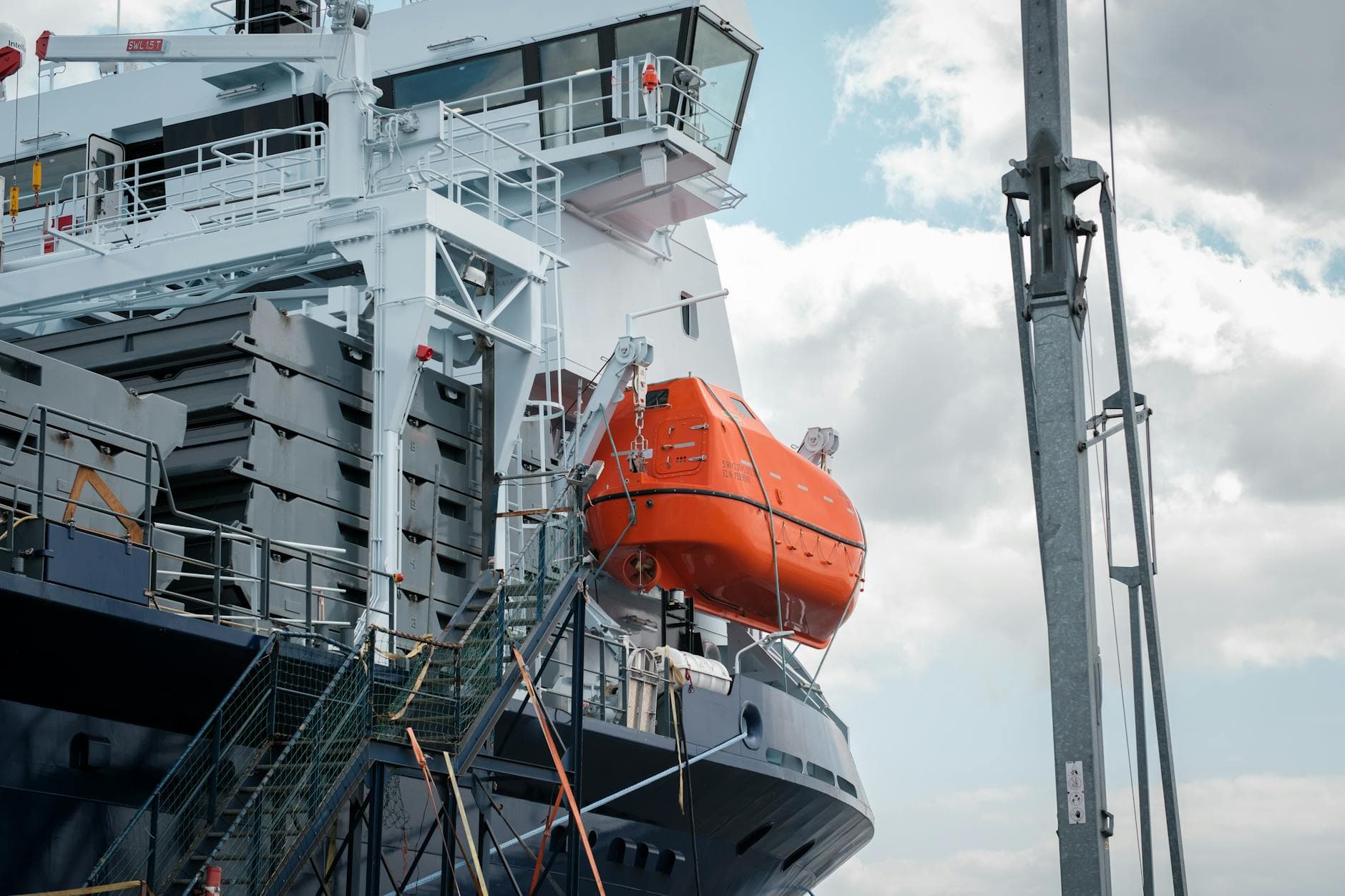
The mistake is easy to make and hard to spot. IMCA documented a life raft attached incorrectly to its cradle, with the painter rope connected to the cradle instead of to the HRU weak link. That one error is enough to turn a supposed escape route into dead weight.
This is the part of the system where “close enough” does not count. If the weak link is wrong, missing, badly routed, or attached to the wrong point, the raft may never separate the way the designer intended.
Access and launch path matter as much as the hardware
You can have a serviceable raft and still fail to deploy it if gear, lashings, lockers, or deck clutter block the launch path. D’Antonio’s point is that the installation has to be judged as a full system, because no one gets to rehearse the real emergency at leisure. If the raft cannot be reached quickly, or if you have to fight around other gear to get to it, the installation is already working against you.
That is why a pre-passage inspection should include the same ugly questions every time: Can I actually get to the raft? Can I release it without contorting around stanchions, dinghies, solar gear, cockpit clutter, or a bad stow? If the answer is no, the raft is less ready than its canister suggests.
What to inspect today
Walk the boat and check the raft as a system, not as a box.
- Confirm the cradle is through-bolted and the mounting hardware is sound.
- Check that the raft sits in a location that is protected from boarding seas, especially if it is on or near the foredeck.
- Read the HRU label and service date, then verify the unit is within the correct replacement or servicing window.
- Make sure the painter runs exactly as designed and is attached to the proper weak link or hard point.
- Trace the deployment path and clear anything that could snag, block, or trap the raft during release.
- Inspect the manual deployment gear for age, stiffness, corrosion, or deterioration that could make it fail when pulled.
- Recheck the expiration date if the HRU is disposable, because two years after installation is not a suggestion.
That is a short list, but it is the one that keeps a false sense of security from creeping in.
Why this is a human-factors problem, not just a gear problem
A recent academic paper on life raft inspection and maintenance treats bad packing and component installation as a human-factors vulnerability that can lead to catastrophic non-deployment even when regulations exist. That tracks with what inspectors keep finding in the field: the failure is rarely dramatic at first glance. It is usually a small rigging mistake, a stale service date, a bad mounting choice, or a painter led to the wrong place.
That is what makes this gear worth a hard look before every offshore passage. A life raft is not safety because it is aboard. It is safety only if it can leave the boat, inflate, and stay clear when everything else has gone wrong.
This article was produced by Prism’s automated news system from verified source data, official records, and press releases, then run through automated quality and moderation checks before publishing. The system is built and supervised by the people who set the standards it runs under. Read our full AI policy.
Did this article answer your question?