Chainplate failure on Albin Cumulus leads to stronger rig redesign
A chainplate let go on Joe and Linda Magee’s Albin Cumulus 85 under full sail, and the fix became a smarter, stronger rig redesign.

The bang you never want to hear
A chainplate failure does not start as a dramatic movie scene. It starts as a sudden bang, a slack shroud, and the ugly realization that the rig is no longer behaving like a single system. That is what Joe and Linda Magee ran into in the Firth of Clyde near Largs, where the port-side chainplate on their Albin Cumulus 85 let go while they were close-hauled on a port tack in about 12 knots of apparent wind.
That detail matters because this was not storm survival sailing or a hard knockdown at sea. It was the kind of ordinary, under-full-sail passage that most owners trust without thinking twice. When the failed fitting was carrying both cap and lower shrouds through a common chainplate, the whole mast suddenly depended on one compromised point, and the boat went from normal cruising to a structural emergency in an instant.
Why this failure matters on an older cruiser
The Albin Cumulus is not some obscure one-off oddity. Designed by Swedish naval architect Peter Norlin, it first entered production in 1978 and was built until 1985, with sources putting output at several hundred boats and one database listing 567 hulls completed. That puts it squarely in the older-production-boat category, where the hardware may have done decades of work before anyone takes a really hard look at it.
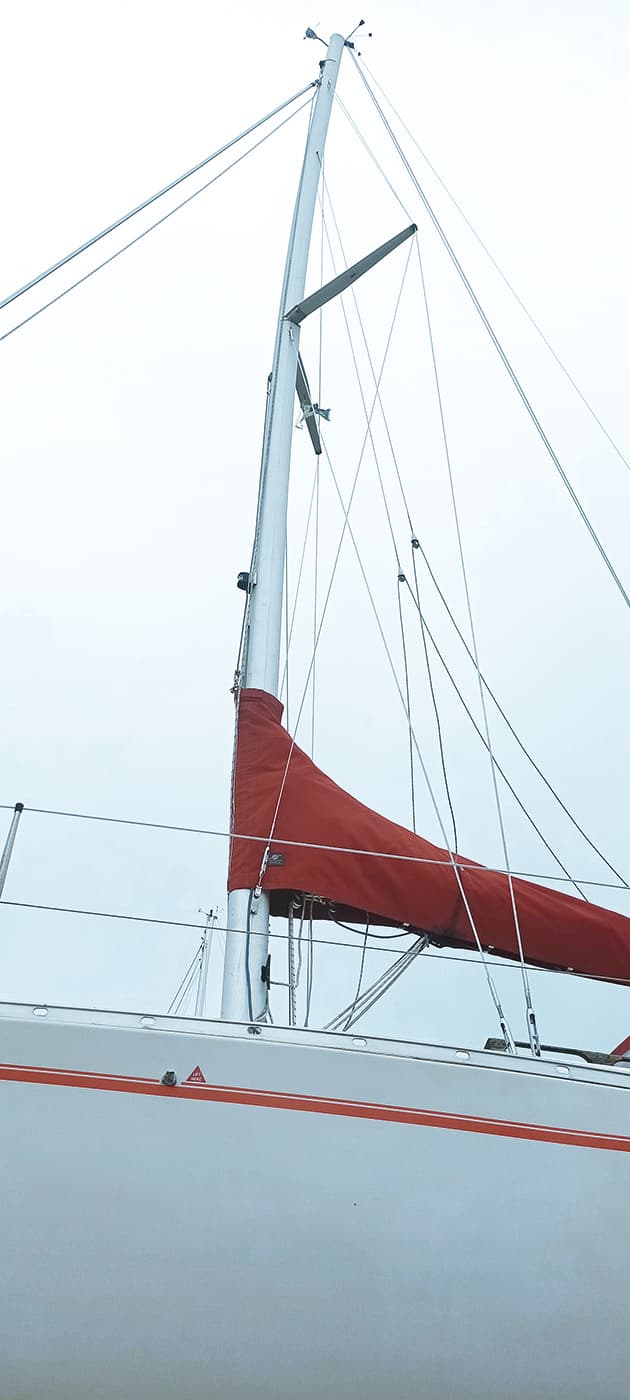
The rig itself explains the stakes. The Cumulus 85 carries a 10.5-meter mast, a fractional rig, 7mm 1x19 stainless wire for the cap and lower shrouds, 5mm wire for the backstay and furling forestay, and 5mm diamond stays for the swept-back spreaders. That is not fragile gear, but it is all only as good as the load path feeding it, and the chainplate is one of the most critical links in that path.
The ugly part is that chainplates are often hidden belowdecks or glassed into structure, which makes them easy to forget until they fail. You can glance at the visible stainless and think it looks fine, while crevice corrosion or cracking is doing real damage where you cannot see it.
What the crack was telling Joe Magee
Joe Magee reported visible fatigue-crack beach marks on the broken chainplate, and that is the clue every owner should learn to respect. Beach marks point to repeated cyclic loading, not a one-off catastrophe, which means the fitting had been working its way toward failure for a while before the day it finally gave up.
That is why chainplates are never just “hardware.” They are structural components that can carry loads of several tonnes in heavy weather, so a crack or bend is not a cosmetic defect. Once one side fails, the rest of the rig deserves a hard look immediately, because the surviving side may have been carrying more than its share for years.
The Magees’ story is useful because it shows how quickly a normal sail can turn into a rig-loss risk. It also shows the trap of a fitting that looks serviceable at the start of the season, then fails under a steady, believable load instead of some dramatic overreach.
The redesign lesson, not just the replacement lesson
The constructive part of this story is that Joe did not just bolt in a like-for-like part and call it done. He designed and fitted new chainplates with the goal of making the mast stronger and the system more trustworthy. That is the right instinct, because the moment a chainplate has failed, the old geometry has already lost the argument.
A smarter replacement starts with load-path thinking. Ask where the shroud load enters the hull, how it reaches the structure below, whether the fitting is easy to inspect, and whether the new arrangement spreads load better than the old one. If the answer is merely “same shape, same place, new metal,” you have probably repaired the symptom but not the weakness.
There is also a broader lesson here for older cruisers. A similar hidden-chainplate failure on the 1979 Cheoy Lee Avocet ended with rusted-through chainplates being replaced by stronger fabricated parts, which is exactly the sort of outcome that should make you think beyond simple substitution. When hidden parts have lived a long time in a damp, loaded corner of the boat, better fabrication and better access can be worth more than matching the original design.
How to inspect before the rig tells you for you
The inspection clue set is plain once you know where to look. Start with any visible rust staining, weeping at the deck line, distorted bolts, cracked bedding, or movement around the chainplate attachment. Then dig deeper belowdecks, especially where chainplates disappear into glassed structure or behind liners, because that is where corrosion can hide long after the top side still looks presentable.
For an offshore cruising boat, the guidance is simple enough to remember: a professional rig survey every three to five years, yearly DIY inspections, and extra scrutiny if you already know a boat has trouble spots like hidden chainplate corrosion. On an older production cruiser, I would treat that as the minimum, not the target. Once a chainplate has shown fatigue, the adjacent fittings, surrounding laminate, bulkhead attachment, and opposing side of the rig deserve attention too.
When a competent owner can improve a chainplate, and when to stop
A capable owner can absolutely improve a chainplate system if the problem is localized and the structure is still sound. That means clean access, visible load paths, no sign of bulkhead crush or laminate damage, and a redesign that stays within the boat’s basic structural logic rather than trying to force a clever shortcut into a weak corner.
The line gets crossed fast when the chainplate is deeply glassed in, the surrounding structure is compromised, the load direction is changing, or the new part needs to do more than the old one ever did. At that point, the job belongs with a marine engineer or a rigger who can think through the loads in the same way the mast does. A chainplate is not the place to trust guesswork, because the failure mode is not a nuisance, it is a dismasting risk.
That is what makes the Magees’ near-miss so valuable. The bang in the Firth of Clyde was the warning; the stronger redesign was the response. If your own boat still carries a chainplate that has only ever been “fine,” this is the reminder to inspect like the rig depends on it, because one day it will.
This article was produced by Prism’s automated news system from verified source data, official records, and press releases, then run through automated quality and moderation checks before publishing. The system is built and supervised by the people who set the standards it runs under. Read our full AI policy.
Did this article answer your question?