Downrigging and Transport Prep for 1971 O'Day Daysailer II CYANE
A restoration crew downrigged the 1971 O'Day Daysailer II CYANE to prepare her for transport and a homeport change, documenting safety steps and homemade fixes useful to small-boat owners.
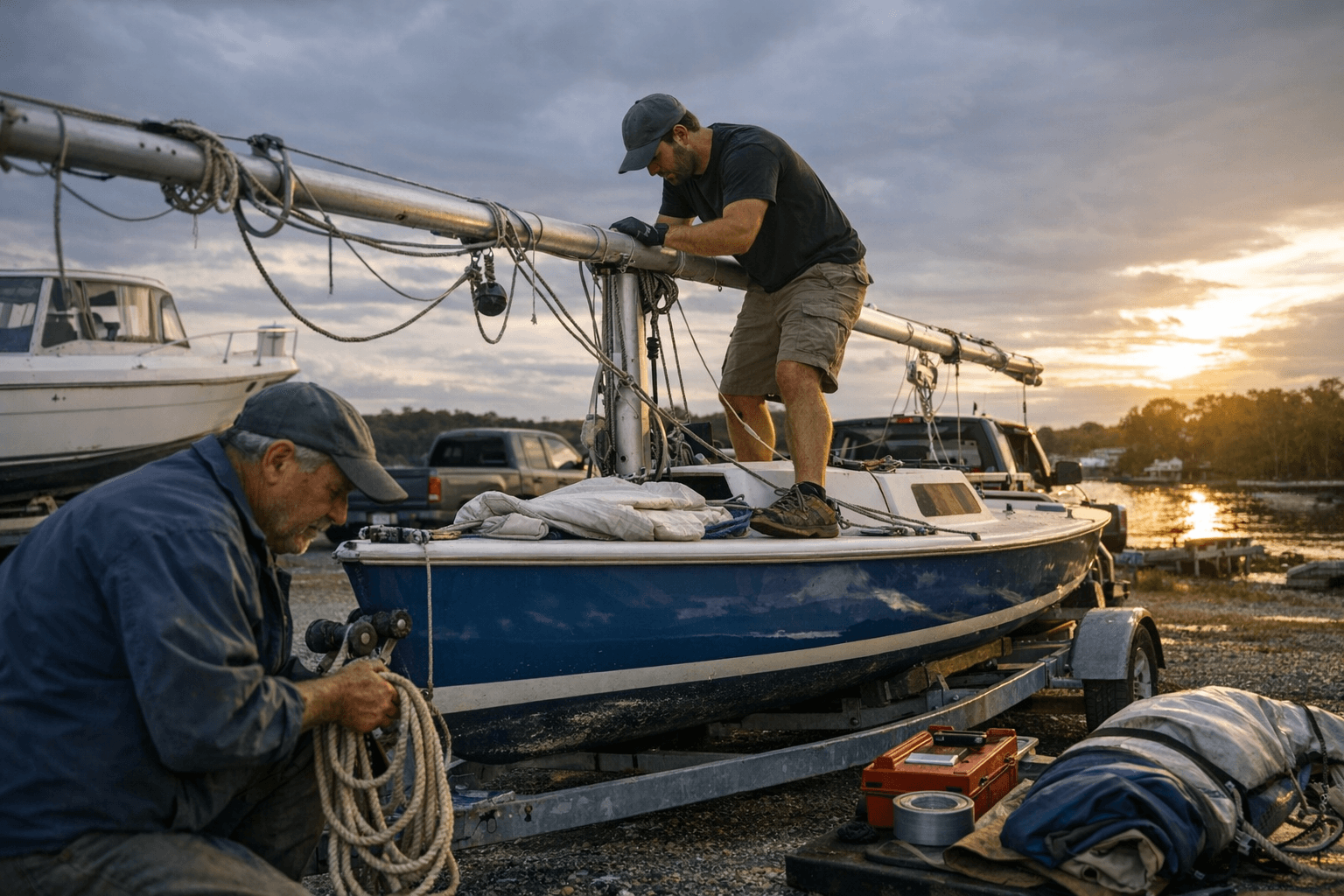
A compact downrig and transport prep for the 1971 O'Day Daysailer II named CYANE focused on two practical problems: protecting the gelcoat around the outboard and keeping the trailer balanced while working at the stern. The work was documented in a short photo diary during the week of Jan. 23–28, 2026, with the primary entry dated Friday, January 23, 2026; the record also contains unexplained date tokens labeled "23 Jan 21" and "23 Jan 26:".
The crew described the operation in straightforward terms: “We downrigged CYANE in prep for her homeport change, here's a few photos of what had to happen along the way, mostly for us to reference when we put her back together.” Photographs accompany the notes to serve as reassembly references, although captions and detailed measurements were not included in the captured material.
Safety and preservation drove the sequence. The team highlighted a simple but easy-to-miss precaution: “The first thing to do is hook up a tow vehicle, so the trailer will not tip the boat on her stern when working near the transom. Ask me how we learned about this :)” That instruction calls out trailer balance as a primary hazard during downrigging and outboard removal.
To protect the transom and the outboard clamp area, the crew built small outboard support pads. “But first, a look at the little pads we made to support an outboard motor, they prevent gouges in the gelcoat and spread the outboard clamp pressure out over a larger area.” The construction is explicit: “The pads are 1/4 inch marine grade plywood, attached with double sided tape.” Those dimensions and attachment method are the only technical specifics provided, but they give a ready DIY option that readers can adapt to different clamp sizes and engine weights.
The entry alternates spellings of the boat model, “Daysailer” and “Day Sailer”, but consistently identifies the hull as CYANE. The homeport change is mentioned but not named, and no geographic work location, tow vehicle specifications, trailer class, or outboard weight figures are supplied.
Verify your tow vehicle hookup and trailer balance before working near the stern, protect gelcoat where clamps will press, and photograph each step so reassembly is straightforward. For owners moving classic small craft like the O'Day Daysailer II, the CYANE notes offer a compact, photo-backed example of balancing safety and simple DIY protection during downrigging and transport prep.
This article was produced by Prism’s automated news system from verified source data, official records, and press releases, then run through automated quality and moderation checks before publishing. The system is built and supervised by the people who set the standards it runs under. Read our full AI policy.
Did this article answer your question?