Emergency Sail Repairs, Proactive Care Keep Sails Strong Longer
A flogging headsail can wreck a passage fast. Know which repairs buy time underway, and which ones only last after you get the sail down.
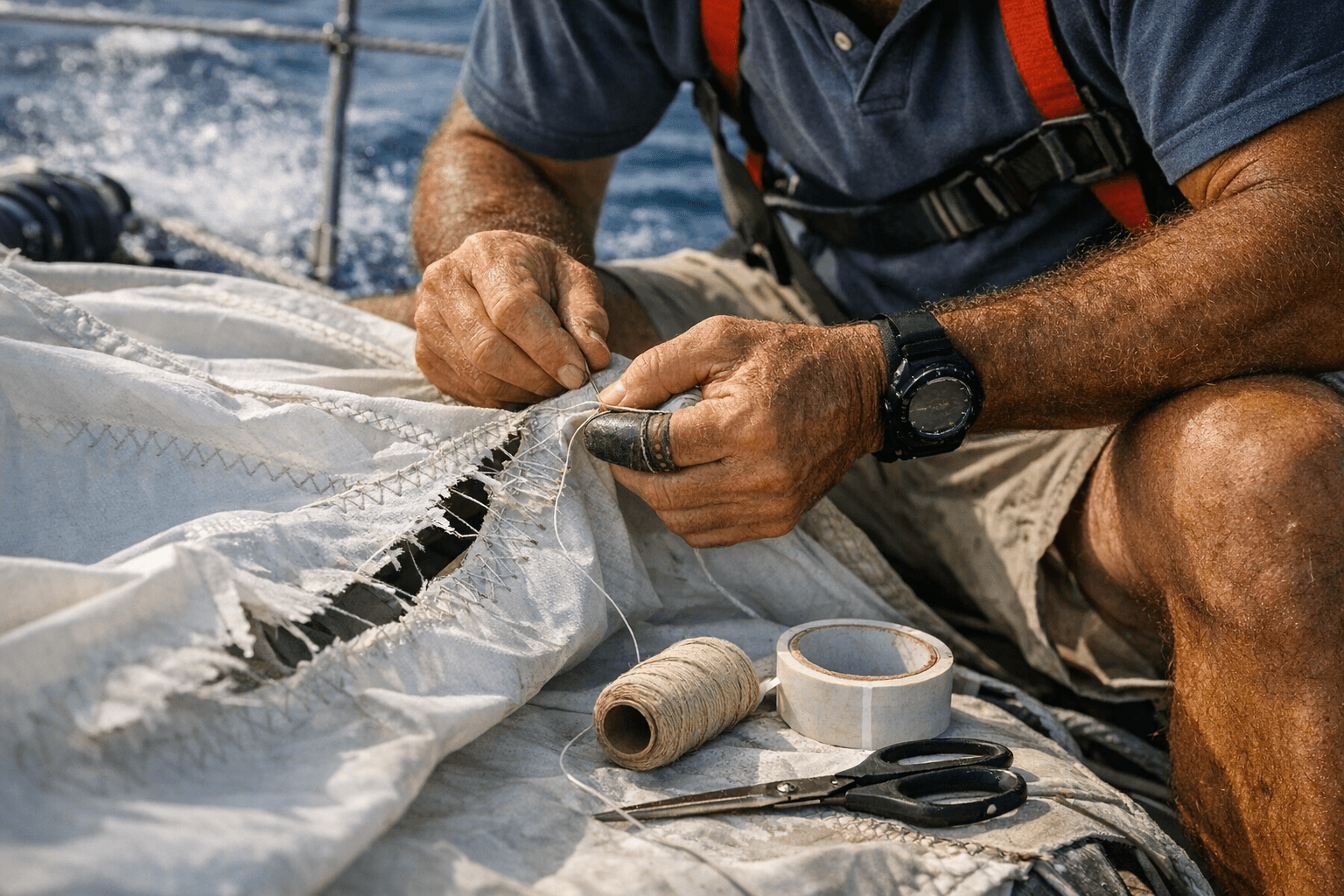
When the breeze turns the wrong way
A headsail that starts flogging in a sloppy sea can go from annoyance to real damage in seconds, and Adam Cove’s emergency-repair advice is built around that exact kind of moment. Cove, SAIL’s technical editor, makes the case that the smartest sail repair is the one that keeps a torn edge, failed panel, or blown seam from ending the trip before you do.
That matters more when the sail is yours, not just rented trouble. Cove notes that his main was built by him and his genoa was a major investment, which is exactly why prevention and fast triage both matter. One bad afternoon can turn expensive cloth into a bigger bill if you do not know the difference between a quick underway fix and a repair that needs proper shop conditions.
What beats up sails first
Cove’s list of wear factors reads like the daily reality of cruising: sun, salt, use, and bad handling. UV exposure is relentless because it degrades threads, fabrics, adhesives, and fibers. Salt adds abrasion, especially on sails and canvas that live folded, rolled, or rubbing against hardware and lifelines.
Chafe is the damage most sailors see late, after it has already done its work. Cove points out that good trim and properly placed chafe patches reduce that wear, but fatigue is also always in the background any time a sail is moving. Flogging is one of the worst offenders, because every uncontrolled snap works the cloth over and over, and every tack takes a little more life out of the sail.
Then there are the habits that seem harmless until they are not. Tight folding, careless reefing, and point loading all create stress where the cloth is least ready for it. Cove specifically flags spinnaker handling as a danger zone, because a sail without a clean launching or retrieval path can be damaged suddenly by concentrated load rather than slow wear.
The difference between emergency and lasting repair
The temptation underway is to do the fastest thing possible, and sometimes that is the right move. Cove says minor repairs can sometimes be handled while sails are flying or while a dodger is installed, especially when the goal is to stop a tear from growing and get through the day. Repair tape has its place there, along with other quick containment fixes.
But a durable repair usually asks for more patience than a boat under way wants to give. Cove’s point is simple: for the strongest, longest-lasting result, you usually need to take the sail or canvas down, unload the fabric, and work dry and ergonomically. That is the cleanest way to restore strength instead of just hiding damage until the next hard puff opens it again.
This is the divide that matters on board. Emergency fixes are about buying time. Proper repairs are about preserving the cloth for the next season, not just the next hour.
What to keep on board before trouble starts
A good repair kit is less about convenience store optimism and more about being ready for the failures you actually see underway. You want materials that can stop a rip, protect a seam, or stabilize a panel long enough to reach a better repair environment. That means having the right tape, hand tools, and reinforcement materials close at hand instead of buried somewhere below the quarter berth.
The bigger lesson from Cove’s guidance is that repair materials should match the kind of damage you are trying to control. Tape can hold a failing edge in place for a short passage, but it is not a substitute for a real stitched repair when the cloth is unloaded and dry. On the canvas side, the same logic applies: you want enough on board to control the damage, not just cosmetically cover it.
- stopping a growing tear before it reaches load-bearing stitching
- reinforcing a chafe point before it becomes a hole
- managing a panel or seam failure until you can unbend the sail
- keeping the repair area clean and dry enough to accept a durable fix
A practical kit should support these jobs:
Why some repairs only work on the hard
Sail cloth behaves better when it is not fighting wind pressure. That is why a repair done with the sail flogging, loaded on a furler, or stretched awkwardly across the deck often ends up weaker than it should be. Cove’s guidance pushes you toward a flat, unloaded workspace because the fabric, thread, and adhesive all bond and hold better when they are not under tension.
That same idea also explains why careless reefing and tight folding do so much damage in the first place. Every time you force cloth into a bad shape or let it rub under load, you set up the next repair job before the current one is finished. The most durable fix usually comes after the sail is removed, inspected, and laid out so the damage can be addressed cleanly.
UV protection and the long game
If you want sails to stay strong longer, the best repair is often the one you never need. Sailmakers and sail-supply sources recommend sacrificial UV strips or covers on furling headsails because the exposed edge is constantly taking sunlight. Those covers are typically made from UV-resistant fabric such as Sunbrella, and they need to cover the sail edge fully while allowing extra width to account for furling irregularities.
That extra width matters because real boats do not furl perfectly every time. If the cover is too narrow, the sail edge can still see sun, and the problem you thought you solved keeps eating cloth in the background. A proper sacrificial strip turns a weak spot into a controlled wear layer instead of a hidden failure point.
Inspection is the cheapest repair habit
North Sails recommends annual inspection because early catches are easier, cheaper, and less disruptive than full-blown failures underway. That advice fits the rest of Cove’s piece perfectly: the boat that gets checked before the season is the boat that is less likely to need an improvised fix in a rough seaway.
North Sails also says it offers one year of free sail care and repair with the purchase of a new sail, which is a reminder that even new cloth benefits from ongoing attention. The goal is not to wait for a tear big enough to get your attention. It is to spot the chafe, stitching wear, UV breakdown, or handling damage while the repair still counts as maintenance instead of rescue.
The habit that keeps trips going
SAIL Magazine calls itself the magazine of record on the sailing way of life, and Cove’s piece lands exactly where cruising sailors live: between seam failure and seamanship. The strongest takeaway is not just how to patch a torn panel, but how to make the next problem smaller, slower, and more manageable.
If you know when tape is enough, when the sail has to come down, and how UV covers, chafe patches, and annual inspection extend cloth life, you buy yourself more sailing time. That is the real prize: not a perfect sail forever, but fewer emergencies, cleaner repairs, and gear that keeps working when the wind is already asking a lot.
This article was produced by Prism’s automated news system from verified source data, official records, and press releases, then run through automated quality and moderation checks before publishing. The system is built and supervised by the people who set the standards it runs under. Read our full AI policy.
Did this article answer your question?