Omega 42 Hull and Deck Bonding Showcases Precision, Teamwork
A hull-deck joint is where a boat becomes a yacht, and the Omega 42 build shows why symmetry, glue timing, and 120 bolts matter before the deck ever drops.
The joint that decides whether the boat stays dry
A sloppy hull-deck bond is how a sailboat turns into a leak hunt. Get the alignment wrong, skimp on the bedding, or treat the joint like a cosmetic seam, and you buy yourself flex, water ingress, and years of rework that are far more expensive than doing it right the first time.
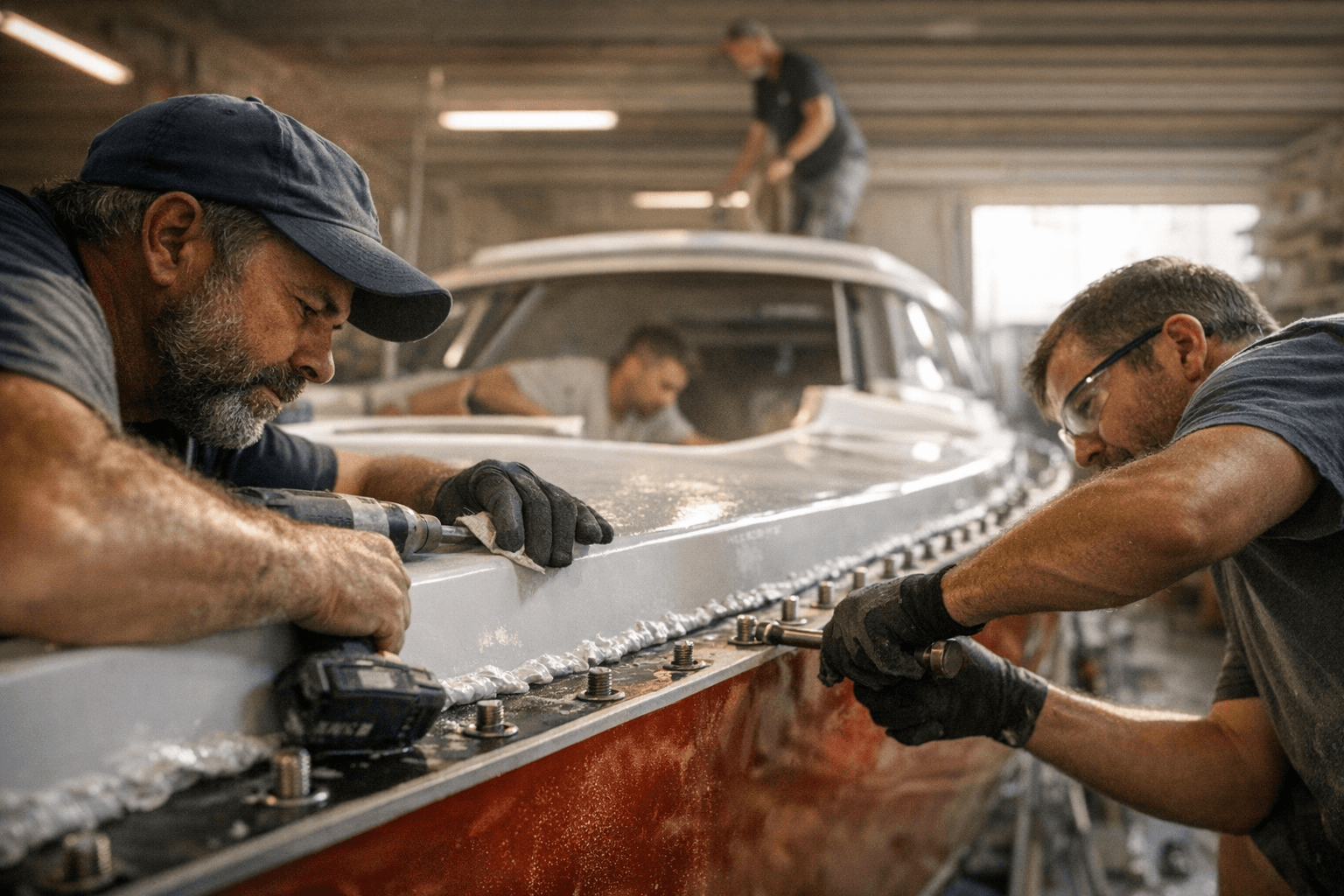
That is exactly why the Omega 42 mating mattered. The shipyard let NO FRILLS SAILING witness the deck and hull coming together in mid-April 2026, and the follow-up on April 21 showed the joint already glued and bolted with a special chemical bonding agent, about 120 stainless steel bolts, and the same number of washers and nuts. This was not a casual assembly step. It was the moment the build stopped being a collection of parts and started becoming a structural system.
Why this stage carries so much weight
Hull-to-deck bonding sits near the top of the list of critical boatbuilding decisions because it has to do three jobs at once: keep water out, keep the structure stiff, and survive the pounding that comes with real sailing. Sika calls deck-to-hull bonding arguably the most crucial joint on a vessel, and that tracks with what most DIY builders learn the hard way. If the joint moves, works loose, or lets water into the flange area, you are into recurring repairs instead of a finished boat.
The historical shift matters too. Good Old Boat explains that wooden boats once relied on sheer clamps, beam shelves, and knees to marry hull and deck. Fiberglass changed the game by reducing the boat to two major pieces, hull and deck, that still had to be joined in a way that behaves like one structure. That is where modern joint designs come in: outward flange, inward flange, and shoebox or overlap.
What the Omega 42 build got right
The most useful part of the Omega 42 sequence is how much attention went into preparation before the deck went down. Hulls and decks are never perfectly symmetrical, even in a careful build, so the team corrected small inconsistencies down to fractions of a centimeter before joining the parts. That sounds fussy until you remember what happens when a long flange is forced together under stress: the load gets stored in the joint, not removed from it.
The shipyard also used steel shaping formers inside the boat to bring the hull into near-perfect symmetry. That is the kind of step that separates a clean bond from a joint you will be chasing forever. If the geometry is off, the best adhesive in the world cannot fully rescue the fit. A strong bond starts with surfaces that actually want to meet.
The team itself says a lot about how serious this stage was. Five boatbuilders handled the work, including three master craftsmen, and the shipyard boss, Heiner, stayed behind the operation and let the writer remain all day. That kind of access is unusual, especially because the writer notes that other shipyards, including Beneteau, had refused publication of similar deck-mating footage as a production secret.
Glue, bolts, and the no-lunch window
Once the bonding phase begins, there is no drifting off to answer emails or break for a long lunch. The writer says the glue application could not be interrupted, and only brief pit stops were allowed after the process started. That tells you everything about hull-deck bonding: once the chemistry is live, the clock is no longer your friend.
The follow-up on April 21 makes the sequence even clearer. The deck had already been glued and bolted, and the team was fitting the last, most complicated bolts, cleaning the joint, inspecting it, and getting ready for the next stage. For a DIY builder, that is the practical lesson right there: dry-fit, align, and stage every part before the adhesive goes on. If you are still searching for hardware while the bond is curing, you are already in trouble.
A solid hull-deck joint usually depends on some mix of these moves:
- A strong bedding adhesive or bonding agent that fills small gaps and spreads load.
- Through-bolting or other mechanical fastening that keeps the joint clamped while the adhesive cures.
- Glassing over the seam in some builds so the hull and deck behave more like one piece.
Sika’s guidance points out that modern polyurethane adhesives can reduce alignment tolerances, absorb stress, and even eliminate the need for mechanical fixings in some designs. That is a big deal, but it does not mean the joint can be sloppy. It means the adhesive can help the structure work, not forgive bad geometry.
Why leaks show up later, not in the shop
The ugly truth is that hull-deck joints often fail where the boat is actually sailed hard. Wave Train notes that this is often the first place leaks appear when a boat is underway, especially closehauled in a breeze. That fits the real-world pattern: the boat flexes, the load cycles, and water finds any weak seam that was just barely acceptable in the yard.
That is why getting the bond right during construction matters so much more than trying to fix it later. Repairing a hull-deck joint after years of service is brutal because the joint is hard to open, harder to clean, and harder still to re-bond without creating another ugly patch. Restoration guides make the same point in different ways: this is one of the least forgiving repairs on a fiberglass boat.
What the Omega 42 reveals about the design itself
There is also a visual payoff when the deck finally lands. On the Omega 42, the attachment exposes the yacht’s final lines, including the sharp bow and long overhangs that define Peter Norlin’s design. Once that edge is set, the project stops looking like a shell and starts reading like a finished sailboat with a real profile.
That is not just aesthetic. In a semi-custom build, the deck-to-hull stage is where the boat’s shape becomes legible and its stiffness is locked in. Hanse Yachts points out that the era of making sailboats and yachts accessible to ordinary buyers began in the late 1960s, helped by fiberglass-reinforced hulls and series production. The Omega 42 sits in that broader history, but it still shows how much craftsmanship a serious hull-deck joint can demand when a yard refuses to treat it like assembly-line work.
The take-away for anyone building or rebonding a hull-deck joint
The Omega 42 job is a good reminder that the strongest joint is rarely the fastest one. Precision in symmetry, disciplined timing on the adhesive, clean hardware staging, and enough hands on deck to keep the process moving all matter more than any single product on the shelf.
If you want a joint that stays dry and serviceable, the formula is plain: fit it accurately, bond it deliberately, clamp or bolt it correctly, and respect the fact that this seam will be asked to carry the boat’s future. Get that stage wrong and you inherit leaks, flex, and rework. Get it right and the hull and deck stop behaving like separate parts, which is exactly what a proper sailboat needs.
This article was produced by Prism’s automated news system from verified source data, official records, and press releases, then run through automated quality and moderation checks before publishing. The system is built and supervised by the people who set the standards it runs under. Read our full AI policy.
Did this article answer your question?