Ha’Penny 20 shows why a tiny junk-rigged cruiser can cross oceans
Ha’Penny 20 proves offshore cruising can get simpler, not bigger, when the rig, hull, and systems are built for one job: getting there and back safely.
Ha’Penny 20 as a design brief
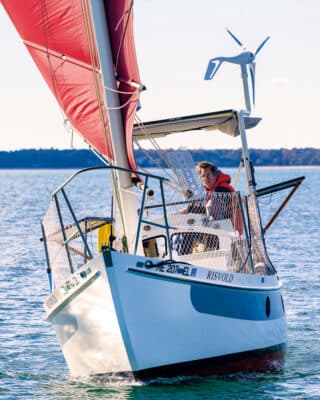
Ha’Penny 20 is a sharp reminder that offshore sailing does not have to be a contest in size, horsepower, or gadget count. RW Henson built this tiny junk-rigged cruiser for a grand adventure, and the whole boat reads like a deliberate refusal to overcomplicate the business of going to sea. Instead of chasing speed or luxury, the project puts reliability, manageability, and self-sufficiency at the center.
That matters because the boat is not being sold as a novelty. It is being presented as a serious micro-voyager, the kind of small craft that asks a very direct question: what if the smartest way to cross oceans is to remove the stuff that usually makes cruising harder?
What the numbers tell you
The dimensions tell the story before the interior does. Artisan Boatworks described Ha’Penny 20 as a 20-foot mini offshore cruiser by Tom MacNaughton of Eastport, Maine, with an overall length of about 20 feet 5/16 inch, a waterline just over 14 feet, a beam of 7 feet 2 inches, a draft a bit over 3 feet 7 inches, and a displacement of 5,403 pounds. That is not a floating condo, and it is not pretending to be one.
Cruising World’s preview sharpened the picture: trailerable, built for passagemaking, with a rugged full-keel hull, a simple junk rig on a carbon mast, and a compact pilothouse with 6-foot-6-inch headroom. The point is not that this is a small boat that feels like a big one. The point is that it is small enough to keep the systems honest, while still carrying the basic structure needed for real offshore use.
Inside, the layout stays equally focused. The boat has two long berths, a charcoal-burning stove, ample stowage, no through-hulls, no cockpit to flood, a servo-style windvane, and an oversized rudder. That combination tells you exactly where the designer’s priorities landed: keep water out, keep control simple, keep the crew comfortable enough to stay effective, and reduce the number of things that can fail at the worst time.
Why the junk rig belongs on a boat like this
The junk rig is not a fashion statement here. It is the logic of the boat. A single junk rig fits a small offshore cruiser because it keeps sail handling controlled and predictable, which is exactly what you want when the crew is short-handed and the weather is changing faster than your patience. Reefing becomes less of a wrestling match, and sail management stops depending on a pile of winches and gymnastics.
That is why Ha’Penny 20 is interesting to DIY sailors even if they never build one themselves. It shows how the rig can be chosen to support the mission instead of being treated as a separate preference to bolt on later. If your goal is long-distance cruising with fewer moving parts, a junk rig is not a compromise to apologize for. It is a system that puts easy handling and survivability ahead of outright performance.

This is also where the boat’s scale helps. On a 20-footer, every extra complication gets magnified. Fewer sail-handling steps, fewer deck loads, and fewer opportunities for error matter more on a small platform than on a larger cruiser with more hands, more power, and more margin.
The reliability-first systems philosophy
Ha’Penny 20 is also valuable because it shows how far you can go by cutting the right corners, not the dangerous ones. No through-hulls means one of the classic leak paths is removed. No cockpit to flood means another major failure mode is addressed in the basic shape of the boat. A charcoal-burning stove keeps the liveaboard side of the boat simple and old-school, and the ample stowage suggests the interior was built for use, not display.
Artisan Boatworks said the brief was for a voyaging yacht sized to be a minimum long-term liveaboard on which one person can live a simple life. That is the most useful idea in the whole project for mainstream owners. You do not need to copy the boat exactly to borrow the philosophy. The real lesson is to stop adding systems that do not earn their keep and start building around what you actually need when the boat is offshore and the nearest chandlery is a distant memory.
For a lot of home builders and refit sailors, that translates into a practical checklist:
- Reduce leak points before chasing comfort upgrades.
- Choose a sail plan that makes reefing easy under pressure.
- Favor self-steering and rudder control that can live with long passages.
- Design the interior for a small crew living aboard, not for occasional showroom use.
- Put stowage and access ahead of decorative complexity.
That is not austerity for its own sake. It is the difference between a boat that asks for maintenance every weekend and a boat that can keep going when conditions are not polite.
The junk-rig lineage behind the boat
Ha’Penny 20 also sits inside a real cruising tradition, not a one-off experiment. The Junk Rig Association, formed in 1980, exists to further the development of the rig and build an international community around it. That matters because junk-rig cruising has always relied on shared experience, not just individual enthusiasm.
The modern case for the rig is often traced back to Blondie Hasler’s junk-rigged Jester, which helped establish the rig for solo and long-distance sailing after the 1960 Single-handed Transatlantic Race. That lineage gives Ha’Penny 20 a useful context: this is not a weird departure from offshore sailing practice, it is a continuation of a long argument that simplicity can be seaworthy. For DIY sailors, that history is the proof of concept. The rig has been tested by the kind of people who care less about trend and more about getting across water with their nerve and their gear intact.
What mainstream owners can borrow from it
You do not need a 20-foot junk-rigged cruiser to apply the lesson. The smarter takeaway is how Ha’Penny 20 trims the boat to the mission. If your own boat feels overbuilt in the wrong places, the fix is often not a bigger budget. It is a clearer brief.
A mainstream production cruiser can still learn from this approach by simplifying the deck layout, reducing failure-prone plumbing, choosing easier reefing, and making self-steering or windvane gear part of the plan instead of an afterthought. The more your setup assumes a tired crew on a rough day, the more useful it becomes offshore. That is the real appeal of Ha’Penny 20: it makes low-complexity cruising look less like a niche and more like common sense.
Ha’Penny 20 shows why a tiny junk-rigged cruiser can cross oceans because it never pretends tiny means timid. It proves the opposite, that a small boat built around simple systems, honest handling, and a ruthless focus on reliability can carry the same offshore ambition as something much larger, and do it with fewer moving parts to betray you when the sea gets serious.
This article was produced by Prism’s automated news system from verified source data, official records, and press releases, then run through automated quality and moderation checks before publishing. The system is built and supervised by the people who set the standards it runs under. Read our full AI policy.
Did this article answer your question?