Hidden Diesel Tank Leak Forces Major Replacement on Fantasia 35
A rivulet of diesel exposed a 120-gallon iron tank failure on Cetus, and the fix meant cutting the cabin sole on a 31-year-old Fantasia 35.
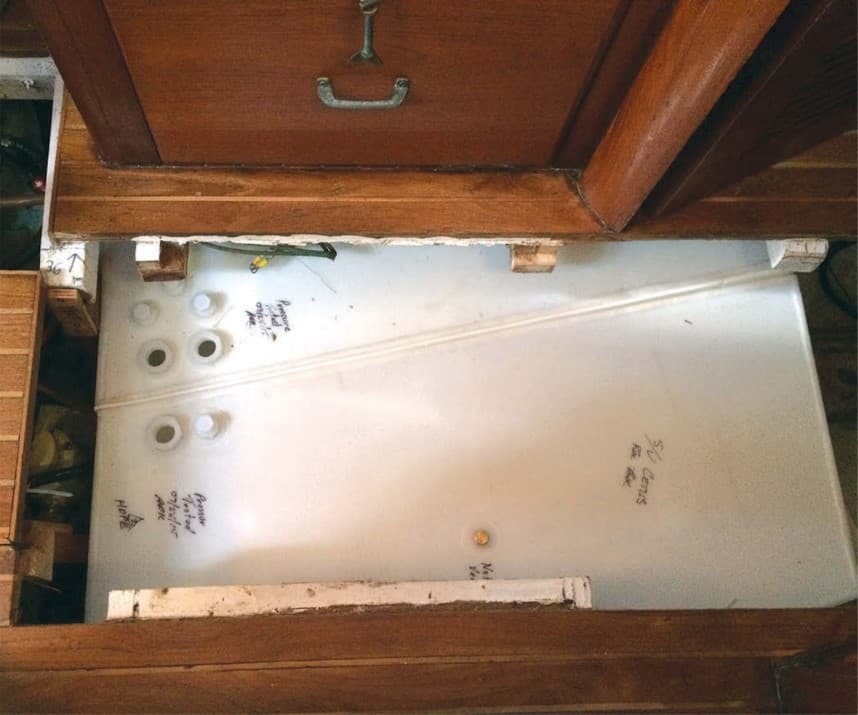
The first warning was a rivulet of diesel near the tank, and on Cetus that small leak quickly pointed toward a much bigger job. Terry Kotas was dealing with a 120-gallon iron tank on a Fantasia 35 that had been their cruising home for 21 years, a boat that was 31 years old and had already crossed the South Pacific four times.
The failure surfaced while Cetus was in La Paz, Mexico, in the Sea of Cortez. Kotas and Heidi headed back to their marina slip and offloaded diesel to fellow cruisers so they would not be managing a larger spill if the leak worsened. That kind of improvisation is familiar on older cruising boats, where the owner is also the repair yard and every delay carries a cost in time, fuel, and risk.
What made the tank so hard to save was not just age, but placement. On Fantasias and many 1970s- and 1980s-era boats, fuel tanks were installed with little regard for eventual maintenance or replacement. Cetus’ tank was nearly as wide as the boat’s beam and about 4 feet long, with only one inspection plate reachable through a small hatch in the cabin sole. The settees, chart table, and bulkheads above it made patching unrealistic, so replacement became the only sensible path.
That decision turned into real labor. Because Kotas and Heidi planned to keep living aboard during the project, they cut a rectangular opening in the cabin sole, 4 feet by 18 inches, just to get the tank out. Three 2 x 2-inch support beams crossing over the tank had to come out as well. The repair was no longer about chasing a drip. It had become a structural access problem.

Practical Sailor has long noted that boats often outlast their diesel fuel tanks, and diesel is still a combustible fire and environmental hazard. ABYC’s H-33 standard covers the design, materials, construction, installation, repair, and maintenance of permanently installed diesel fuel systems from the fuel fill opening to the engine connection. Practical Sailor also cites ABYC guidance that tanks should not move more than one quarter inch at the mounting surface, a reminder that support, restraint, and access all matter as much as the tank wall itself.
The real-world price of ignoring those details can climb fast. In one 2018 case study, The Ensign reported professional estimates of about $18,000 to $20,000 for a leaking diesel tank on a 1983 Atlantic 30. The culprit there turned out to be a hidden stainless-steel washer beneath the tank. Once diesel is escaping, the problem can become a spill issue as well as a refit issue. The Environmental Protection Agency says a visible sheen can trigger reporting under the federal sheen rule, and BoatUS advises boaters to stop the leak, notify the marina, and call the National Response Center.
Cetus is a reminder that a leaking tank is rarely just a tank problem. On an older cruising boat, it can become a test of access, planning, and how much of the interior has to come apart before the leak can finally be put to bed.
This article was produced by Prism’s automated news system from verified source data, official records, and press releases, then run through automated quality and moderation checks before publishing. The system is built and supervised by the people who set the standards it runs under. Read our full AI policy.
Did this article answer your question?