Long prop shaft vibration traced to missing support bearing
A 15-year driveline mystery on a 34-foot Creekmore ended with one overlooked detail: a 56-inch unsupported shaft span.
The real lesson in Eurisko’s vibration
A long-running driveline vibration on the 34-foot Creekmore Eurisko turned out not to be a bad bearing, a bad shaft, or a sloppy alignment. The real culprit was simpler and harder to spot: the prop shaft had too much unsupported span, and it was bowing under its own length.
That is the kind of problem that can burn through years of labor and parts. In Eurisko’s case, the owners spent about 15 years chasing symptoms, replacing cutless bearings, buying a new shaft, and aligning the engine carefully, only to see the vibration and stuffing-box leakage return.
Why the usual fixes kept failing
Eurisko is a semi-custom boat, which made the diagnosis harder from the start. There was no manufacturer to call and no large owners’ forum filled with identical boats to compare notes with, so the crew had to work from scattered clues instead of a ready-made fix.
That matters because driveline vibration often looks like a component problem when the real issue is geometry. If the shaft is flexing between supports, a new cutless bearing or a more careful alignment may temporarily mask the symptoms, but it cannot stop the shaft from moving in an eccentric path. In other words, the system was being repaired as if it were a worn-out part, when the layout itself was the problem.
What the shaft was actually doing
The breakthrough came when the pattern finally made sense: the shaft was bowing under its own length, so instead of spinning concentrically it was making circles. That eccentric rotation stressed the transmission seal, accelerated wear at the cutless bearing, and compacted the stuffing-box packing until it leaked more and more.
The stuffing box was an important clue, but it was not a support point. Good Old Boat notes that it was not counted as a bearing because it is a flexible hose, which means it cannot do the job of controlling shaft geometry. If you are troubleshooting a similar setup, that distinction matters: a component that seals water out is not automatically a structural support for the shaft itself.
The vibration could be seen at the stuffing box because that is where the shaft’s motion and the resulting wear were easiest to observe. But the problem began farther forward, in the span between the cutless bearing and the transmission coupling. That is where the unsupported run was long enough for the shaft to flex instead of stay centered.
The measurements that changed the diagnosis
The numbers on Eurisko are what make this case so useful. The prop shaft was 1 inch in diameter, and the unsupported section measured 56 inches between the cutless bearing and the transmission coupling. Once that span was measured correctly, the diagnosis stopped being a mystery and started looking like a straightforward support problem.
The article ties that measurement to a practical rule of thumb for shaft supports, often called the 20-40 rule. Shaft supports should be no closer than 20 times the shaft diameter and no farther apart than 40 times it. On a 1-inch shaft, that puts the preferred spacing roughly between 20 and 40 inches. Eurisko’s 56-inch unsupported span was clearly beyond the long end of that range, which made the need for another support much more obvious.
That is the key troubleshooting move for DIY owners: stop asking only whether the shaft is worn and start asking whether the shaft is properly supported. A shaft that is too long between supports can create the same kind of headache as a damaged component, but the cure is completely different.

Why alignment alone could never solve it
Engine alignment still matters, but it is not a cure for a shaft that is physically flexing between supports. If the shaft is bowed, aligned machinery can still be forced to follow a path that is not truly straight. The result is more vibration, more seal wear, and more frustration, not less.
This is why Eurisko’s repeated alignment work did not end the problem. The transmission coupling could be adjusted, and the engine could be lined up as carefully as possible, but the unsupported span was still letting the shaft deflect. Once the shaft begins to orbit instead of spin true, every nearby wear point gets punished. The cutless bearing sees extra load, the stuffing box gets compacted, and the transmission seal gets hammered by movement it was never meant to absorb.
The fix: add support where the shaft needs it
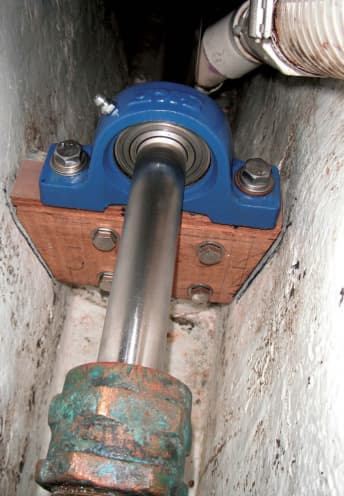
The solution described for Eurisko was the installation of a pillow block bearing. That extra support gives a long prop shaft a place to stay centered when the run is too long for a single stern bearing alone.
This is exactly the kind of repair that saves time and money once the layout problem is identified. Instead of swapping parts at random, you add support where the shaft needs it and stop the deflection that was causing the chain reaction of wear. For older or semi-custom sailboats, where original installations were not always optimized for vibration control or serviceability, that can be the difference between endless trial and error and a permanent fix.
How ABYC P-6 frames the issue
ABYC’s P-6 Propeller Shafting Systems standard gives the bigger design context. It applies to boats driven by propeller shafting systems that penetrate the hull, and ABYC recommends compliance for boats, associated equipment, and systems manufactured after July 31, 2003. The standard also defines shaft-bearing spacing as the center-to-center distance between the bearings supporting the propeller shaft.
That definition reinforces the lesson from Eurisko: shaft support is a layout issue, not just a maintenance issue. If the spacing is wrong, the system can create vibration even when the parts are new. ABYC guidance does not replace hands-on diagnosis, but it does point directly to the geometry that has to be right before the drivetrain can run smoothly.
The troubleshooting roadmap to keep in mind
If a prop shaft keeps vibrating after the usual fixes, follow the pattern Eurisko exposed:
- Measure the unsupported span between supports, not just the condition of the parts.
- Do not count a stuffing box with a flexible hose as a true support.
- Compare the shaft diameter to the support spacing.
- Look for signs of deflection, including stuffing-box leakage, seal strain, and repeated cutless-bearing wear.
- Consider an intermediate support, such as a pillow block bearing, when the shaft run is too long.
The larger takeaway is practical and expensive to ignore: many driveline “mysteries” are really layout problems. Once you understand how the shaft is being supported, you can stop buying false fixes and solve the vibration at its source.
This article was produced by Prism’s automated news system from verified source data, official records, and press releases, then run through automated quality and moderation checks before publishing. The system is built and supervised by the people who set the standards it runs under. Read our full AI policy.
Did this article answer your question?