How Mooring Line Physics Can Keep Your Boat Safer at the Dock
The physics of your dock lines can mean the difference between a secure berth and a snapped line turning lethal — here's what every DIY boater needs to understand.
There's a moment every boater knows: you've tied off, killed the engine, and stepped away from the helm feeling like the job is done. But the lines you've just cleated are doing complicated, invisible work — stretching, loading, and storing energy in ways that can turn dangerous in seconds if the wrong things go wrong. Understanding the physics behind mooring lines isn't an academic exercise; it's the foundation of genuinely safe docking practice.
Why lines are more than just rope
A mooring line under load isn't static. Every shift in wind, every wake from a passing vessel, every tidal change puts dynamic force through the line. The critical concept here is elasticity: a line's ability to stretch and absorb those loads matters enormously. Nylon, the workhorse of mooring lines, can stretch 20 to 40 percent before failure, which means it acts like a shock absorber between your boat's cleat and the dock fitting. Polyester lines stretch far less, making them better suited for control but worse at absorbing sudden surges. Choosing the wrong material for the job isn't just a performance issue; it's a safety calculation.
The diameter and length of a line also directly affect how much load it can handle and how it behaves under stress. A longer line of the same material will absorb more total energy than a short one, because the stretch is distributed across a greater length. This is why experienced sailors will often run longer spring lines rather than keep everything tight and short: the geometry buys forgiveness when conditions change.
The snap-back zone: what it is and why it kills
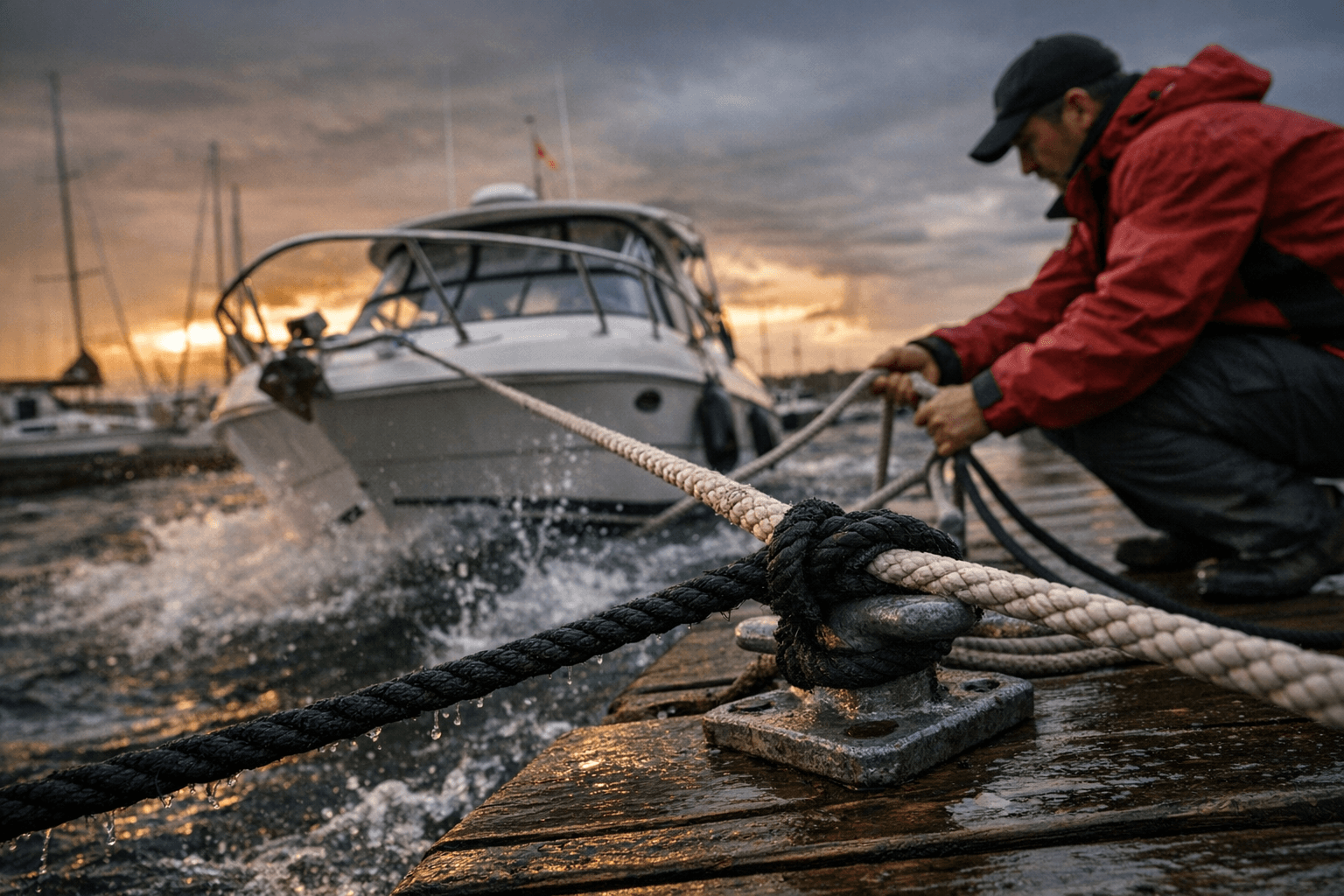
Snap-back is the most acutely dangerous phenomenon in mooring line physics, and it's one that doesn't get nearly enough attention in casual dock talk. When a line under high tension suddenly fails, either by parting or jumping off a cleat, it doesn't just fall slack. It recoils violently, releasing all of its stored elastic energy in a fraction of a second. The speed and force of that recoil can be devastating. Commercial shipping and offshore industries treat snap-back as a primary cause of serious injury and death among deck crews, and the same physics apply at a marina or alongside any dock.
The danger zone for snap-back is the arc the line would sweep through if it let go. Anyone standing in that arc is at risk. The instinct to lean over a tight line to inspect a cleat, or to stand directly in line with a loaded spring line while a crewmate takes in slack, puts you exactly where you don't want to be. The rule professionals use is simple: never position your body in the potential recoil path of a loaded line, and make sure anyone else on deck understands the same principle before you start handling lines under load.
Chafe: the slow failure mode
While snap-back is sudden and spectacular, chafe is the threat that builds quietly over days and weeks until a line fails at the worst possible moment. Anywhere a line passes over or through a hard edge — a chock, a fairlead, a dock cleat with a rough casting — friction is working to degrade the fibers. A line that looks perfectly healthy on the working section can be worn dangerously thin at the contact point, and you won't see it unless you actively run the line through your hands and inspect it.
Good chafe management means a few consistent habits:
- Use chafe guards at every point where a line contacts hardware, whether that's commercial chafe protectors, split hose secured with sail ties, or leather wrapping on traditional rigs.
- Vary the position of your lines periodically so the same section of fiber isn't always bearing the load at the friction point.
- After any period of heavy weather or strong tidal movement, inspect all mooring lines at their contact points before trusting them for another cycle.
A line that has visible flattening, discoloration, or fuzzing at a chafe point has already lost significant strength. Replace it before it decides for you.
Line geometry and load multiplication
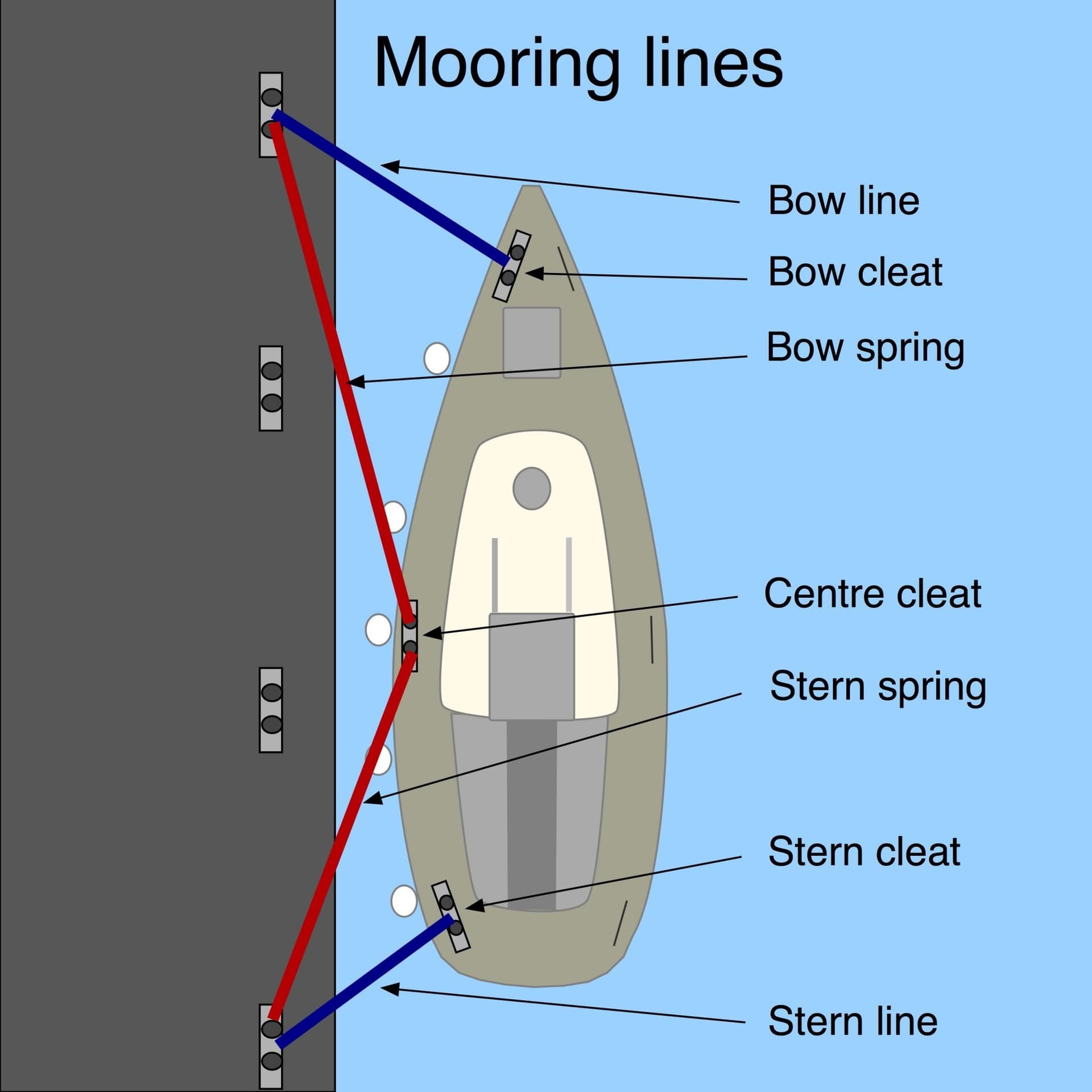
The angle at which a line runs between your boat and its dock attachment point isn't just a matter of convenience; it's a direct factor in how much load each line carries. When spring lines run nearly parallel to the dock, they're efficient at controlling surge and preventing the boat from moving forward or aft. When they run at sharp angles, the geometry multiplies the load each line must carry to achieve the same holding effect.
This matters most when you're setting up a boat to be unattended for any length of time, or when weather is building. Taking a moment to think about load distribution across your complete set of lines, bow lines, stern lines, and both forward and aft springs, means no single line is doing disproportionate work. A common mistake is setting springs that run at a steep angle to the dock, effectively asking those lines to do twice the work a better-positioned line would carry.
Working with dock fittings and cleats
Even a correctly sized, properly positioned line can fail if it's attached to hardware that isn't up to the job. Dock cleats vary enormously in quality and in how they're fastened to the dock structure. A cleat bolted through a solid timber with backing plate and nut is a very different proposition from one lag-screwed into the edge of aging decking. When you're in an unfamiliar marina, it's worth a quick look at the dock hardware before you put your trust in it.
On your own vessel, keep cleat bases inspected and fasteners torqued. A cleat that spins or flexes under hand pressure has compromised fastening and needs attention before it's loaded. The cleat-to-deck connection is the final link in the chain; all the physics of the line itself means nothing if that anchor point gives way.
Building better habits at the dock
The underlying message in mooring line physics is that safety comes from treating lines as dynamic, load-bearing systems rather than passive accessories. A few habits that translate this physics into daily practice:
- Brief your crew on snap-back zones before any docking maneuver involving loaded lines.
- Always tail a line from the side, never from directly behind it, when taking in or letting out under load.
- Carry dedicated chafe protection aboard rather than improvising; the weight and cost is trivial against what it protects.
- Size your lines appropriately for your boat's displacement, not just for convenience of handling.
- Inspect lines at the start of every season and after any severe weather event.
The sailors who've spent real time at sea or in commercial operations have a different relationship with their dock lines than most recreational boaters develop. They've been taught, or have learned the hard way, that a line is never just a line. Getting there without the hard lesson is what the physics is for.
This article was produced by Prism’s automated news system from verified source data, official records, and press releases, then run through automated quality and moderation checks before publishing. The system is built and supervised by the people who set the standards it runs under. Read our full AI policy.
Did this article answer your question?