How to Add Masthead Light Options With Too Few Wires
Too few masthead wires do not have to force a full mast teardown. A diode-and-switch retrofit can give you either an anchor light or a tricolor, without making the mast your ground path.
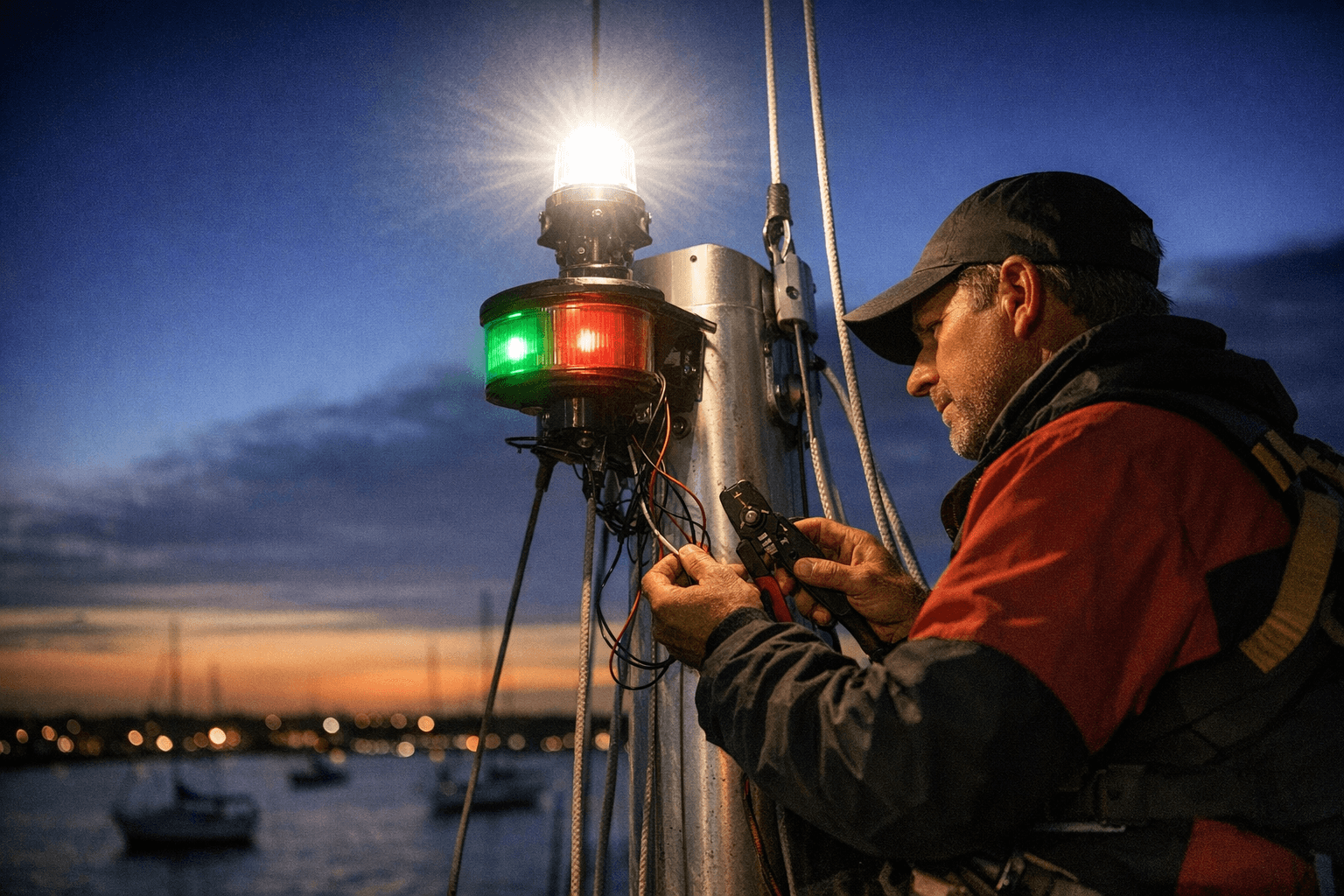
The masthead wiring trap
The expensive mistake is not the switch or the diode. It is deciding that a “simple” light upgrade is safe while the mast is still wired like a compromise from three refits ago. If you use the mast as a ground path, you invite corrosion where you least want it, and if you wire the wrong lights together underway, you can confuse every boat around you.

John Churchill’s answer to that familiar problem is blunt and funny at the same time: the number of wires led to the masthead is always one fewer than needed. That is the reality behind a lot of sailboat electrical frustration, especially when you already have an anchor light at the masthead and want to add a more visible tricolor for sailing offshore.
Why this retrofit makes sense
Churchill’s example is the kind of boat you see all the time in a refit yard, not a clean-slate build. The mast is already stepped, the owner wants better visibility at sea, and running a fresh conductor up the spar would turn one lighting upgrade into a much bigger project. In that situation, conductor-sharing can be a smart retrofit because it preserves the masthead hardware you already have, keeps current draw low, and avoids the cost and disruption of unstepping the mast just to pull another wire.
That does not mean every boat should take this path. It makes sense when you need two different masthead lighting states from a limited cable run, and when the existing system is otherwise sound. It makes less sense if the wiring is already brittle, waterlogged, or patched so often that every added component becomes one more failure point.
A good rule of thumb is simple:
- Use it when the mast is already stepped and the wire run is the real bottleneck.
- Use it when you need either an anchor light or a tricolor, not both at once.
- Skip it when the cable, fixture, or connections are already so compromised that a partial retrofit would only bury the problem deeper.
- Skip it if you are trying to mask a broader corrosion issue by treating the mast like part of the circuit.
How Churchill’s circuit works
The heart of the trick is a double-pole, double-throw, center-off switch, the kind Churchill notes in his explainer as a practical off-the-shelf solution. In his setup, the switch is mounted at the breaker panel, and a pair of diodes sits at the common fixture. The switch reverses polarity so the same two conductors can selectively power one light or the other, while the diodes keep current flowing only to the selected bulb and block it from the other.
That matters because it solves two problems at once. First, it lets you make two wires do the work of three. Second, it keeps the mast from becoming the ground path, which is the bad practice that leads to corrosion and headache later.
Churchill says the diodes can be tucked into a common AquaSignal lamp fixture, which is exactly the kind of compact, boat-specific detail that makes this approach appealing. If the housing is too small, the same idea can be built into a small external mounting board. The point is not the packaging; the point is that the isolation happens at the fixture, while the selection happens at the panel.
The lighting rules you are really satisfying
This is not just an electrical convenience. It is a navigation-light problem, and the rules matter.
The U.S. Coast Guard Navigation Rules handbook says the lights prescribed by the rules must be shown from sunset to sunrise and in restricted visibility. The Coast Guard also says sailing vessels under 20 meters may use a tricolor masthead light as an accepted alternative to separate sidelights and sternlight while under sail. That makes a tricolor a real compliance tool, not just a cosmetic upgrade.
The other rule that should shape your wiring choices is just as important: the Coast Guard warns against showing running lights and anchor light together underway. If you wire carelessly, you can create exactly the kind of mixed signal the rules are trying to prevent. Churchill’s method helps because the switch selects one light or the other, so you cannot accidentally energize both at the same time.
That simple built-in discipline is part of why this workaround is better than improvised jumper wires or “temporary” toggles that never seem to become permanent. You are not just saving conductors. You are forcing the boat to present one clear lighting mode at a time.
Why the standards backdrop matters now
There is also a bigger technical shift behind this kind of upgrade. In 2025, the Coast Guard announced acceptance of American Boat & Yacht Council C-5 for navigation-light design, construction, performance, and testing. ABYC says C-5 aligns with ISO 19009:2015 for electric navigation lights with permanently fixed LED assemblies on small craft up to 24 meters.
That matters for older sailboats because many of them were built in a different era, before LED navigation lights and modern light-circuit expectations became common. If you are retrofitting today, you are working in a world where the technical baseline has moved on. The wiring solution still has to be clean, but the lighting technology and standards language around it are more current than the boat that came from the factory.
What Churchill’s background adds to the story
Churchill is not writing from theory. Good Old Boat says he grew up boat-crazy in Indiana, built a raft at age 6, sailed Snipes as a teenager, and later worked his way toward saltwater and bigger boats. His resume includes sailing a Cape Dory 26 singlehanded to Bermuda and back, plus a Bristol Channel Cutter transatlantic with his father.
That matters because the advice feels like it came from someone who understands the cost of an elegant idea that fails offshore. A masthead wiring fix should be tidy, low-risk, and easy to understand when you are squinting up a spar at dusk, not a puzzle box that only works on paper.
The tradeoff to remember
The best use of conductor-sharing is narrow and practical: one mast, too few wires, two lighting states, and a real need to keep the system simple. The moment the retrofit starts pulling the mast into the ground path, adding hidden corrosion risk, or making it too easy to misread the boat’s light status, the convenience stops being worth it.
That is the real lesson of Churchill’s explainer. When the masthead is already crowded and the wire count is always one short, a well-designed diode-and-switch setup can be the cleanest way to get the light you need. The goal is not to squeeze in more hardware for its own sake. It is to make sure the boat shows the right signal, with the fewest possible failure points, every time you need it most.
This article was produced by Prism’s automated news system from verified source data, official records, and press releases, then run through automated quality and moderation checks before publishing. The system is built and supervised by the people who set the standards it runs under. Read our full AI policy.
Did this article answer your question?