How to Install a Holding Tank in an Older Cruising Boat
A holding tank on an older cruiser is a layout puzzle, and the right answer balances legality, hose length and future access as much as capacity.
Why the retrofit matters
A holding tank on an older cruising boat is never just a plumbing upgrade. If you cross the North Sea and want real access to Dutch or Belgian waters, the tank quickly becomes a cruising tool, not a luxury, because the rules and the realities of discharge both tighten the moment you leave your home berth.
Internationally, MARPOL Annex IV sets sewage controls for ships of 400 gross tonnage and above, or vessels carrying more than 15 passengers. That does not mean a smaller yacht can ignore the issue, because coastal states can impose stricter rules on visiting boats in their own waters. In the Netherlands, black-water discharge has been prohibited on all pleasure boats in inland waterways, lakes, the Wadden Sea and territorial waters since January 2009, and Dutch guidance says new craft fitted with a toilet must have a holding tank or wastewater treatment system. Belgium is looser on paper for private pleasure craft, but the practical rule is still clear: polluting discharges are not allowed.
The boat’s layout decides everything
The hardest part of an older retrofit is rarely the toilet itself. It is finding a home for a 100-litre-plus tank in a boat that was designed before anyone expected today’s waste-handling standards, or before the owner wanted to cruise through waters with stricter environmental rules. By the time you open up a typical 1980s or 1990s cruiser, the obvious spaces are already full of engines, lockers and long-installed gear.
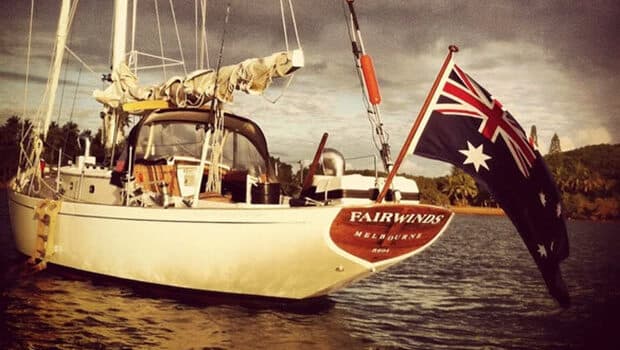
That is why the example of an Oyster 406 lands so well. The boat, built from 1986 to 1990, was developed from the HP46 and the 435, and Oyster called it the smallest deck saloon design the company ever produced. In other words, it is exactly the kind of compact, ambitious interior where every cubic inch already has a job. In this case, the boat came in for an engine swap, a new electric toilet and a waste tank, which turned one maintenance job into a full layout rethink.
Fit the tank to the boat, not the other way round
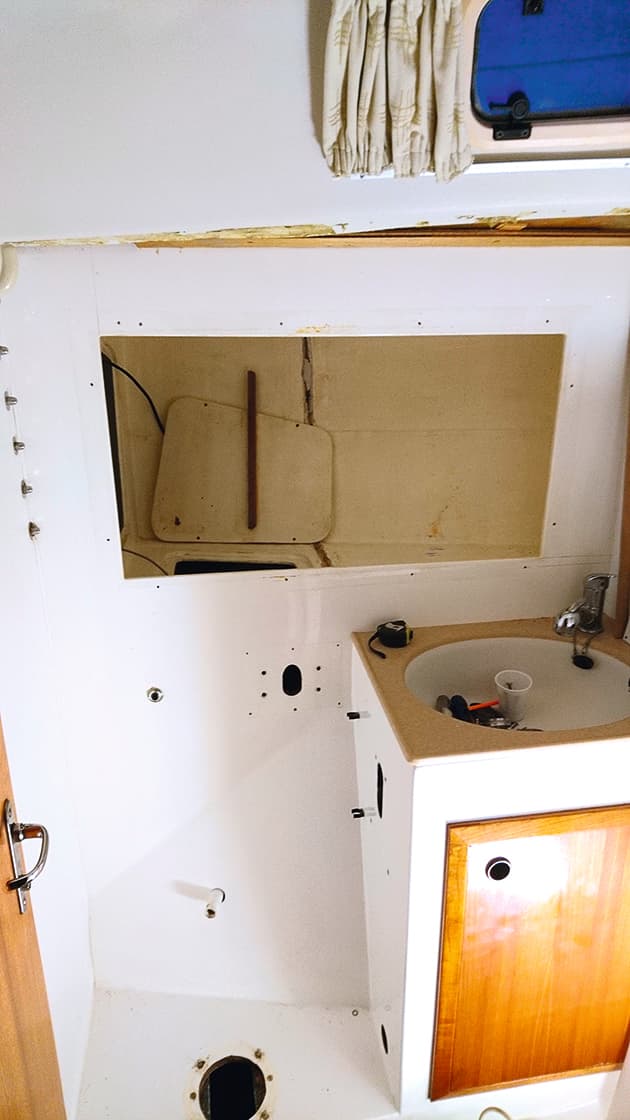
The breakthrough came from measuring the cupboard area above and behind the forward heads, then treating the tank as a custom shape instead of a standard box. Tek-Tanks, a bespoke plastic tank manufacturer for marine and other applications, is built for this kind of awkward geometry, and the available space was not a neat rectangle at all. It was the sort of strange profile that can look absurd on paper and still be perfectly logical once the boat itself sets the boundaries.
That matters because a custom tank is not just about squeezing in more litres. It is about using dead space without sacrificing the rest of the installation. A standard tank might leave wasted volume, force ugly hose runs, or make the system impossible to service once the cabinetry goes back in. A bespoke tank can reclaim the odd corner that a builder never intended for storage, but only if the measurements are accurate and the final shape still allows access around it.
A few practical truths follow from that approach:
- An odd-shaped tank can fit a bigger real-world space than a standard unit ever will.
- A little lost volume may be worth it if the plumbing stays sensible.
- Replacement later is easier if the tank is shaped to the boat, but not trapped inside the joinery.
Short hose runs beat heroic plumbing
Marine-plumbing wisdom is consistent on one point: keep the holding tank as close to the head as practical. Short hose runs make the system easier to route, easier to maintain and less prone to odor problems. Long runs create more places for waste to sit, more opportunities for smell to creep through the boat and more friction every time a fitting needs attention.
That is why the tank location is tied directly to cruising comfort. If the heads are forward and the tank ends up aft, you may gain a clean-looking install but pay for it later in hose length, bends and odor control headaches. If you keep the tank near the toilet, every flush has a shorter path, and every future job, from checking a hose clamp to replacing a vent line, becomes less punishing.
Access is the difference between a good install and a regret
The smartest part of the Oyster 406 installation was not how much tank volume was found. It was the decision to preserve access for the future. Mike Pickles and the team deliberately avoided the temptation to use every last millimetre, because once a boat is buttoned up, the hidden fittings are the ones that matter most.
That means planning for the parts you will actually need to touch later: fittings, pipes, level senders, breather lines and flush-out points. If any of those disappear behind permanent joinery, the system may work beautifully on day one and become miserable the first time something clogs, weeps or needs inspection. The article’s own judgment was telling: there might have been room for another 30 litres, but practicality won because future access was worth more than a slightly larger tank.
That is the real retrofit lesson for older cruising boats. Capacity matters, but serviceability wins. A tank that can be inspected, cleaned and repaired without dismantling half the heads compartment is the one that will still feel like a smart decision after a season of cruising, a wet crossing, and one too many marina pump-out queues.
Compliance is the easy part if you plan the layout correctly
Once the tank is in the right place, the legal side becomes much easier to live with. A boat that can comply in Dutch waters is already better prepared for North Sea cruising, and one that has been thought through for odor control and maintenance is easier to keep compliant in the long run. Belgium may not yet require holding tanks for private pleasure craft, to the best of the Coast Guard’s knowledge, but the discharge prohibition still pushes owners toward the same practical solution.
That is why this retrofit is bigger than a plumbing job. It is a way of making an older cruiser fit the cruising grounds modern sailors actually use. On a boat like the Oyster 406, the best answer is not the biggest tank you can force into place. It is the tank that fits the boat, keeps the system serviceable and lets you keep sailing without treating every border crossing like a waste-management problem.
This article was produced by Prism’s automated news system from verified source data, official records, and press releases, then run through automated quality and moderation checks before publishing. The system is built and supervised by the people who set the standards it runs under. Read our full AI policy.
Did this article answer your question?