How to keep a sailing yacht ready after months ashore
A seven-month lay-up in Portugal turned into a cheap lesson: keep the batteries healthy, free the shaft by hand, and use vinegar only where the fouling and materials make sense.
A boat left alone for months in a warm climate can haunt you long before you step back aboard. Stu Davies’s Beneteau 381, based in Portugal, sat unattended for seven months while he was ill, and the return visit could have been ugly: mould in the cabin, dead batteries, a barnacled prop shaft, the usual lay-up misery. Instead, the cabin was clean, the batteries were still showing 13.8 volts, and the real drama was confined to the propulsion train.
Start with the obvious wins
The first lesson is that long lay-ups are won or lost before you touch the engine key. Davies left his solar panels mounted on swivels and set them vertical while the boat was away, with a Victron controller helping keep charge in the bank. That matters because Victron’s own marine guidance says a modern sailing yacht can easily use 1.2 to 2.4 kWh a day, and 48 hours without shore power, engine, generator, or solar is a useful endurance benchmark.
In other words, the electrical system is not a side issue, it is the backbone of a boat that has to sit still for weeks or months. If the batteries are healthy when you return, everything else gets easier: bilge checks are simpler, electronics wake up properly, and you are dealing with maintenance instead of rescue work.
Check the shaft before you chase ghosts
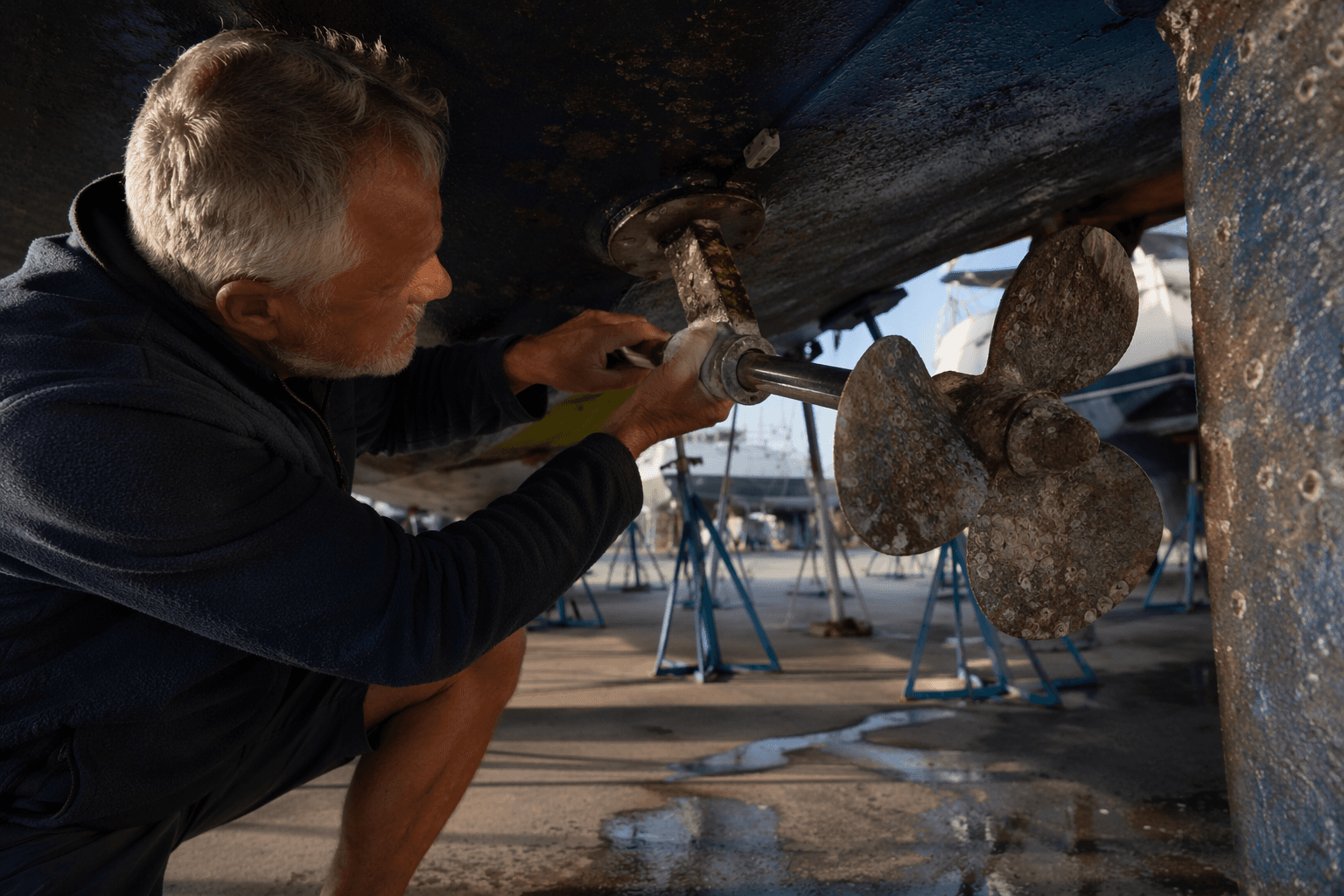
Davies’s smart move was to check whether the prop shaft would turn by hand in the engine room before assuming the worst. He had seen barnacles grow between the prop and the cutless bearing before, producing that nasty crunchy sound that makes every owner think of haul-out bills. This time the shaft would not move at all.
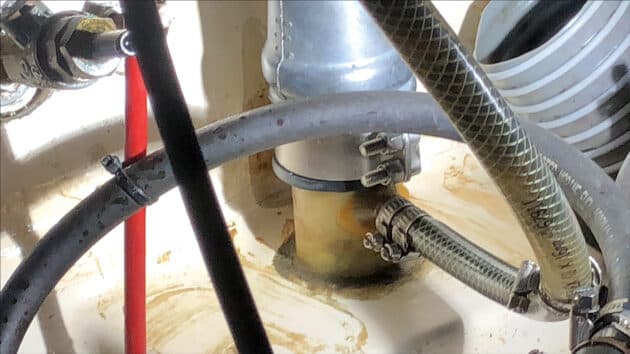
A screwdriver used carefully as a lever between two flange bolts freed it a little, then more, until it turned again. That is the kind of practical test that saves time, because a stuck shaft does not automatically mean a failed gearbox or some deep internal fault. On older Beneteau layouts like this one, the shaft passes through a Volvo shaft seal and a stern tube arrangement, and there is also a small 10 mm OD copper pipe behind the seal used for circulating water to lubricate it.
Davies rigged that pipe with flexible hose and two jubilee clips so he could flush the system. The takeaway is simple: when a boat has sat, inspect the propulsion train manually, expect growth, and do not rush straight to expensive mechanical conclusions.
Where vinegar earns its keep
This is where the vinegar story becomes more interesting than a gimmick. Davies frames vinegar as the accidental solution he reached while trying to free the prop, and that fits with what more technical sources have found: mild acids can help with certain kinds of marine growth, especially where you are dealing with awkward fouling on hardware rather than heavy structural buildup.
A 2023 study in Marine Pollution Bulletin found that apple cider vinegar significantly reduced total fouling biomass, ascidians, and mussels in field trials. That does not make vinegar a magic antifoulant, but it does support the idea that ordinary acetic acid can have a real effect on some marine growth. In the right setting, it is a low-cost experiment worth trying before you reach for harsher chemicals or book a lift-out.
- It is cheap, easy to get, and easy to apply.
- It is gentler than stronger acid cleaners.
- It can be used as a targeted flush or soak on parts that have only light to moderate fouling.
- It carries a smaller environmental sting than a lot of nastier boatyard chemicals, though it still needs sensible handling and disposal.
For DIY sailors, the appeal is obvious:
Where vinegar stops being the answer
Vinegar is not a universal cure, and treating it like one would be a mistake. Practical Sailor notes that barnacles are tenacious, that folding propeller mechanisms can stick when growth collects in the nooks and crannies, and that acids can help, but stronger acids such as muriatic acid can damage metal and strip grease. That is the line worth remembering: vinegar may help loosen fouling, but it is not a substitute for inspection, lubrication, and proper cleaning of moving parts.
It is also not the right choice for every material or every job. If you are dealing with delicate finishes, unknown alloys, seals, or grease-packed assemblies, a more aggressive cleaner can do more harm than the growth itself. The whole point of vinegar is that it is a cautious, low-cost first pass, not a shortcut that lets you ignore the rest of the system.
What this means for real lay-ups
Davies’s account is useful because it ties all the pieces together. He had a boat that sat for months in Portugal, he kept the electrical side alive with vertical panels and a Victron controller, he checked the shaft by hand, and he treated the marine growth problem as something to be solved pragmatically rather than dramatically. That is the kind of maintenance discipline that keeps a yacht ready for use after a long lay-up.
If you want the same result, think in layers. Keep charge in the bank, stop fouling from becoming a surprise, inspect the shaft before you panic, and use vinegar where a mild acid makes sense and where the materials can take it. The cheap solution is only cheap if it works without creating a new problem.
The return to a boat after months away should feel like opening a hatch to find the same clean cabin you left behind, not a summer’s worth of damage. Davies’s experience shows that with the right storage setup, a careful hand on the shaft, and a sensible respect for what vinegar can and cannot do, that return visit can still be a relief instead of a repair list.
This article was produced by Prism’s automated news system from verified source data, official records, and press releases, then run through automated quality and moderation checks before publishing. The system is built and supervised by the people who set the standards it runs under. Read our full AI policy.
Did this article answer your question?