How to raise a mast safely with minimal help
The safest mast-raising systems are the ones that control load and sideways sway, not the ones that rely on muscle. Mazza’s lesson is simple: build for repeatability, not bravado.
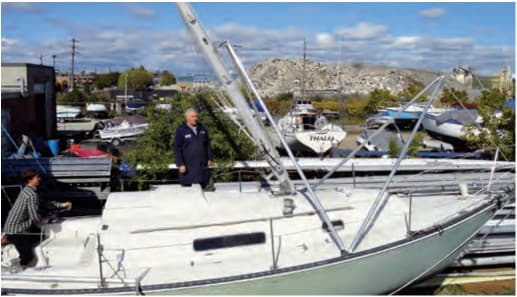
A mast that hangs halfway up with no one to catch it is where a launch day turns expensive. That is the problem Rob Mazza tackles in “Mast-raising magic,” and his answer is not brute strength but geometry, control, and a system that works with limited help. The goal is a mast-raising setup that is self-contained, safe, and repeatable, so the mast goes up and comes down without bent gear, drama, or improvisation.
Start with the real problem: keeping the mast controlled
Mazza frames mast handling as two jobs at once. One part of the system supplies leverage, usually through an A-frame or gin pole that pivots from the deck. The other part keeps the mast from swinging sideways while it rises, because a mast that is being lifted is not just heavy, it is unstable until it is fully vertical and secured.
That distinction matters because so many failed setups solve only the lifting problem. A block and tackle, or a mainsheet tackle led to the cockpit winch, can give you plenty of purchase. But if the mast step is offset from the chainplates, the load path is no longer centered, and the mast wants to wander. That is why mast raising on trailer sailers is as much about transverse support as it is about leverage.
Why gin poles and A-frames keep showing up
The two broad approaches you keep seeing on production boats are the gin pole and the A-frame. Both are trying to do the same thing: create a stable lever arm that lets a small crew move a mast in a controlled arc rather than in a free fall. The difference is usually in how much lateral stability the structure gives you during the lift.
A gin pole is simpler and compact, which is part of its appeal on small trailerable boats. An A-frame spreads that support wider and can feel more forgiving because it resists side swing better. Either way, the system only works if the pivot point, the tackle, and the masthead attachment all line up with the mast’s actual path through the air.
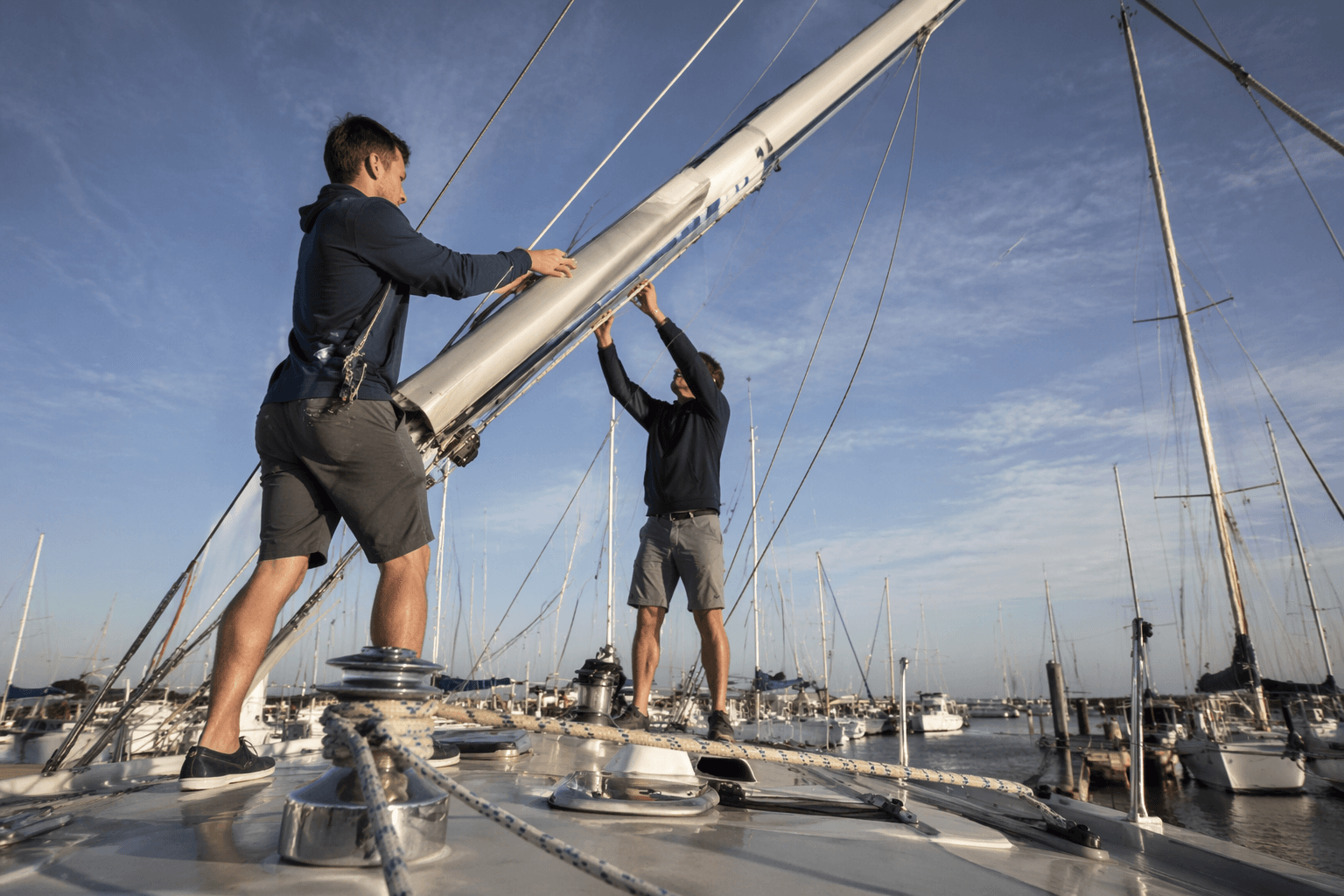
That is why the jib halyard so often becomes the connection to the masthead. It gives you a ready-made attachment point high on the spar, and it keeps the lifting load where the rig already expects to carry it. If the tackle is led to the cockpit winch, the operator gets a clear control point and can make fine adjustments instead of yanking blindly on the spar.
Get the sideways support right or the whole lift gets ugly
The mast does not just need to go up. It needs to stay centered while it is moving. Because the mast step is usually offset from the chainplates, Mazza emphasizes transverse support wires or equivalent stabilizers to keep the mast from slewing left or right during the lift.
Some owners have gone so far as to add stainless support structures to line up the geometry, but that is a fairly elaborate answer to a problem that can usually be handled more elegantly. The more common approach is raised stanchion eyes paired with removable support wires. Those wires can be disconnected once the mast is vertical, which keeps the lift manageable without leaving permanent hardware in the way.
That design detail is the difference between clever and genuinely repeatable. A mast-raising system should not depend on one person “feeling” the right moment to brace the spar. It should make the correct path obvious, keep the load in line, and leave little room for the mast to surprise you.
The production-boat lessons are the useful ones
Mazza’s examples are not abstract theory. They come out of real production-boat design, especially from his work around C&C and later the Hunter 23.5 and 26. That matters because production builders were trying to solve the same exact pain point trailer-sailors still face now: how to deliver a boat that can be rigged without a yard crane and without a small army on the ramp.
The C&C Mega 30 is a strong example of why this became a serious design issue. Introduced in 1977, it was considered radical for its lifting keel, 30-foot length, and road-legal beam. Reference sources describe the Mega 30 One Design as a C&C and North Sails joint concept brought to C&C by Peter Barrett of North Sails, with design work overseen by George Cuthbertson and the C&C Design Group headed by Rob Ball. One reference source lists 115 built, and some sources also note a fixed-keel variant.
That history helps explain why Mazza’s mast-raising advice carries weight. The Mega 30 was not a toy experiment, but part of a serious attempt to make a big, performance-minded boat trailerable and usable. When a boat is designed to move between road and water, mast handling becomes part of the boat’s identity, not an afterthought.
The Hunter 23.5 and 26 made the same promise
Hunter’s water-ballasted trailerables pushed the same idea from a different angle. Practical Sailor reported that the Hunter 23.5’s water ballast system removes 1,000 pounds from trailering weight, and that the mast is fairly easy to step and unstep. That kind of weight reduction only matters if the rig can be managed just as cleanly on the ramp.
Owner resources reflect that thinking. Hunter-supplied mast raising gear directions are part of the 23.5’s downloadable material, and there is also a mast-raising pole drawing for the Hunter 26. The factory clearly treated mast handling as part of the supported system, not something left for owners to puzzle out from scratch.
The Hunter 26 fits neatly into this story. It is listed as a Rob Mazza design first built in 1994, and Good Old Boat notes that it was added that same year as a larger version of the Hunter 23.5, then revised in 1997. That kind of product evolution tells you the market was not just asking for lighter trailering loads. It was asking for rigs that could be stepped and unstepped without turning every outing into a production.

Build the system around repeatable control points
If you are adapting or building your own mast-raising setup, the safest answer starts with a few non-negotiables.
- Make the load path obvious from the base of the mast to the tackle and winch.
- Use the jib halyard or another solid masthead connection rather than improvising at the top.
- Control sideways movement with removable support wires or a wide, stable frame.
- Keep the system self-contained so you are not hunting for extra lines or hardware at the ramp.
- Test the geometry on the hard before trusting it with the mast.
The point is not to eliminate effort. It is to make effort predictable. A good mast-raising system should let a small crew guide the spar with confidence, not wrestle it into place and hope the rigging forgives the guesswork.
That is the quiet brilliance in Mazza’s advice. The best mast-raising system is the one that keeps the mast from becoming a moving target. When the geometry is right, the leverage is clean, and the side support is built in, a difficult launch-day job turns into something you can repeat without crossing your fingers every time the spar comes off the crutch.
This article was produced by Prism’s automated news system from verified source data, official records, and press releases, then run through automated quality and moderation checks before publishing. The system is built and supervised by the people who set the standards it runs under. Read our full AI policy.
Know something we missed? Have a correction or additional information?
Submit a Tip