NextFour’s Q smart marine system simplifies helm navigation
Q turns the helm into one connected screen stack, but the buying decision hinges on whether that smartphone-like workflow is worth the four-figure refit bill.
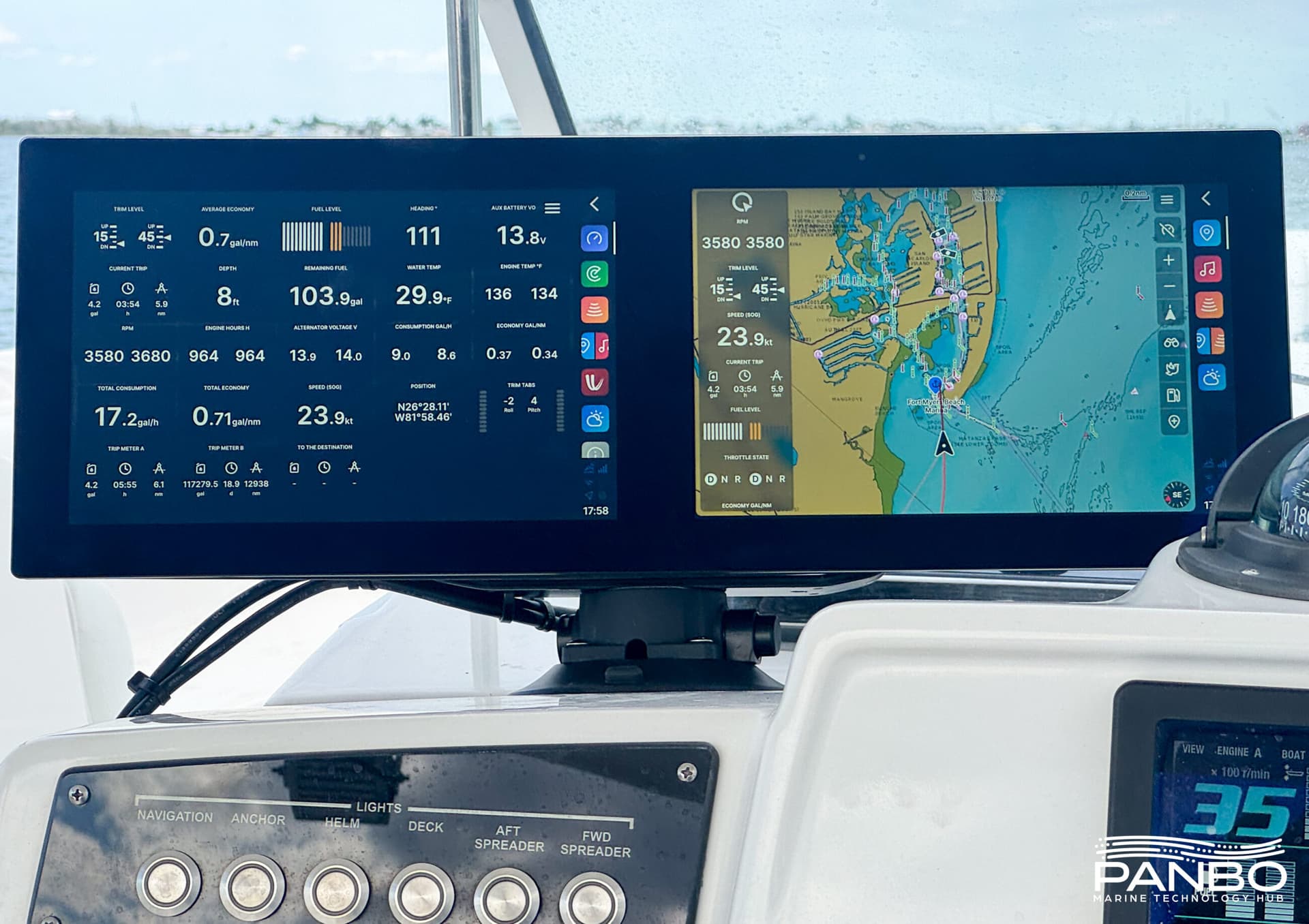
A suction-cupped dual-display unit on the helm tells you almost everything you need to know about NextFour’s Q system: this is not trying to behave like a bolt-on chart plotter. In Ben Stein’s multi-week trial, the appeal was the way Q compressed navigation, monitoring, and cockpit control into one familiar interface, with the company’s whole pitch built around a newcomer being able to learn it quickly without specialist training.
A helm interface built for quicker decisions
NextFour says the Q Experience traces back to Buster Boats asking for a helm interface that could be understood fast, and that origin still shapes the product. The company describes Q as its own smart marine technology solution with integrated connectivity for modern boaters, but the practical takeaway for a DIY sailor is simpler: the screen is meant to feel closer to a smartphone than to a traditional marine computer. That matters when you are trying to steer, zoom a chart, check a sensor, and keep the cockpit from turning into a puzzle of menus.
Stein’s trial suggested that the difference is not just visual polish. It is the way the platform is organized around a single experience, rather than a stack of disconnected functions that each demand their own learning curve. For owners refitting a boat themselves, that can mean fewer separate components to wrangle and fewer separate habits to learn at the helm.
What the hardware stack brings to a refit
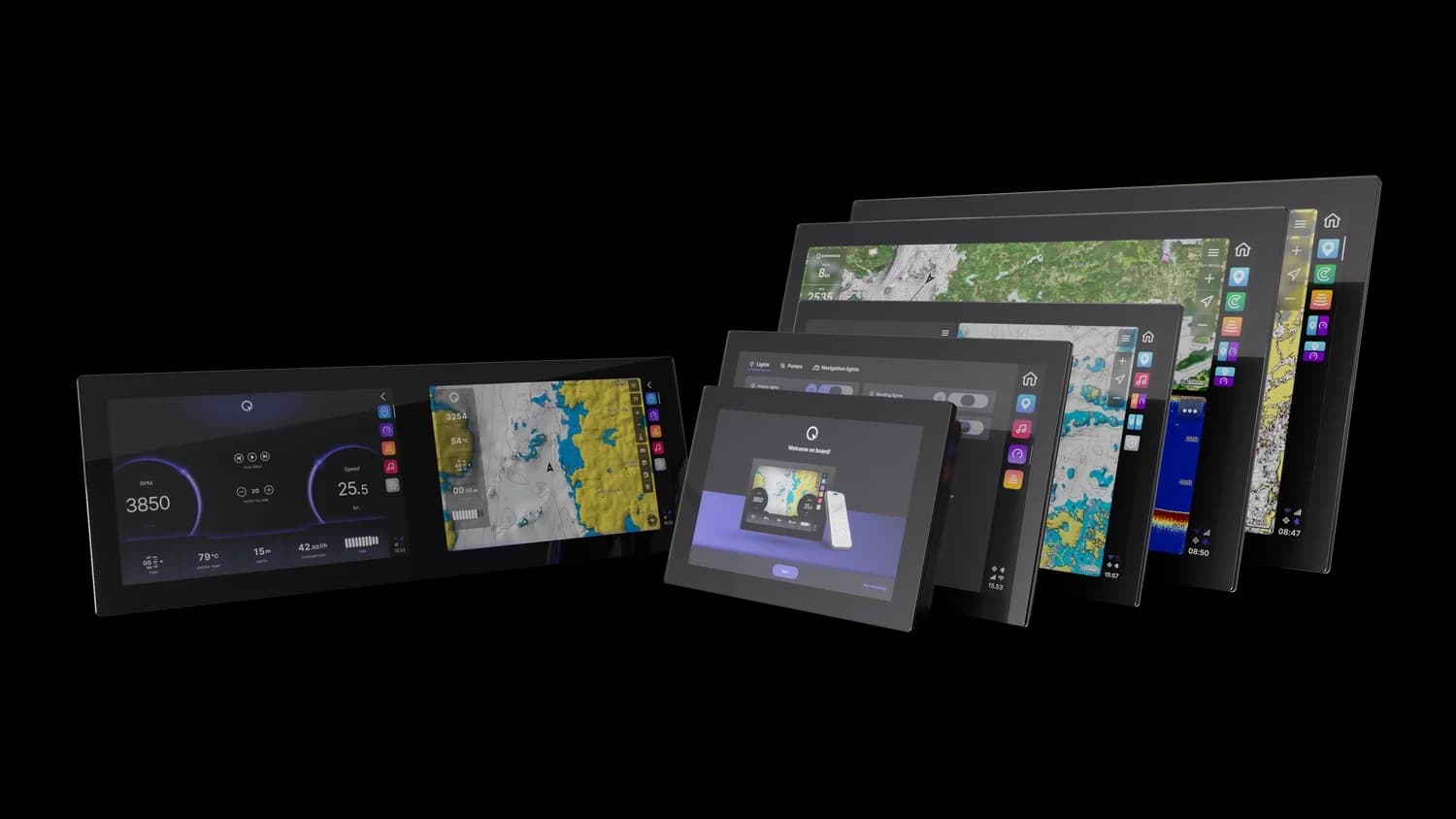
The current Q lineup is broader than a lot of sailors may expect from a system often talked about as a plotter. NextFour’s range includes single displays in 10-, 12-, 16-, 22-, and 24-inch sizes, a dual 10-inch configuration, and floating versions in 10-, 12-, and 15-inch sizes. That makes it clear the system is aimed at different helm geometries, from compact cockpit installs to larger command stations.
Under the hood, the platform is unusually complete. NextFour and Panbo’s trial notes point to hexa-core processors, front-side IP67 sealing, rear-side IP65 sealing, 4G/LTE and Wi-Fi radios, NMEA 2000, USB, Ethernet, chart plotting, entertainment, cellular connectivity, boat monitoring, and network-connected sonar and radar. The classic displays also add Q Guard boat-monitoring inputs and relay outputs, which pushes the platform toward full helm integration rather than a stand-alone screen.
For a DIY installer, that breadth cuts both ways. On one hand, it can reduce the number of separate boxes and interfaces you need to mount, wire, and troubleshoot. On the other, it asks you to commit to a more unified system architecture from the start, which is a bigger decision than dropping in a simple chart display.
The software layer is where Q tries to separate itself
The clearest proof that Q is built as a platform, not just a monitor, comes from the service layer. Buster’s subscription page says the internet-connected system enables automatic software updates, Q Guard surveillance, weather reports, WLAN hotspot, Google place search, real-time boat status, trip logbook, season summary, automatic service book, and engine alarm logs. Add-ons include Cloud AIS and Limitation Areas.
The pricing makes the structure plain. Buster Connected costs 11.90 €/month or 119 €/year. Cloud AIS is 7.99 €/month or 59 €/year. Limitation Areas is 4.99 €/month or 29 €/year. That is the kind of recurring cost many owners will weigh carefully, especially if they are comparing Q against a more traditional plotter that asks less of the wallet after purchase.
The app side also extends the experience beyond the helm. NextFour and app-store listings describe mobile access to boat location, fuel level, battery voltage, manuals, and video guides. That is useful in the real world because it links cockpit awareness to the same system you use ashore, which can help when you are checking status at the dock, planning a trip, or chasing down an issue before you leave the harbor.
What it costs, and who the system is really for
The big barrier is price. The hardware starts around $2,000 for a 10-inch single display and rises to about $9,000 for the 24-inch model. That puts Q squarely in the higher-end refit, OEM installation, and owner-priority category, not the bargain-bin upgrade aisle.
For DIY sailors, the upside is a single vendor with a unified software-and-hardware stack, which can simplify installation and support. The downside is commitment: once you buy into the ecosystem, you are buying the workflow as much as the display. If you want integrated navigation, monitoring, and connectivity in one place, Q makes a strong case. If you only want a chart plotter, the value proposition gets harder to justify.
How the company got to this point
NextFour is based in Turku, Finland, and was founded in 2007. The product line has been in development for about a decade, and the company says it holds ISO 9001:2015 certification. Its own history shows a steady shift from concept to platform: it announced the Q Experience app on August 20, 2019, launched a new Q product family on November 26, 2020, said in March 2015 that it had joined the National Marine Electronics Association, and reported that the Buster Q system won SuomiAreena’s Best Mobile Service in 2017.
The company also kept building through partnerships and distribution. It announced a partnership between Q Experience and Vita in November 2017, and said in 2023 that it had distribution agreements in markets including Poland and Germany. That business momentum helped set up the investment move with Verso Capital, which was announced on November 26, 2021 and later dated by PwC Finland as November 29, 2021. Verso said Q Experience was already pre-installed on boats from Buster, Yamarin, Cross, Askeladden, and Grand, and described the system as a forerunner because it brings an automotive-like interface to boating.
That is the real story here. Q is not just another screen for the dash, it is a bet that the helm works better when navigation, monitoring, and app-based ownership all live in the same place. For a sailor staring at a blank helm and a fresh wiring job, that is either the cleanest possible path or the most expensive one, and NextFour has built the system to make that choice feel very deliberate.
This article was produced by Prism’s automated news system from verified source data, official records, and press releases, then run through automated quality and moderation checks before publishing. The system is built and supervised by the people who set the standards it runs under. Read our full AI policy.
Know something we missed? Have a correction or additional information?
Submit a Tip