How to Repair Fiberglass and Gelcoat Correctly for Lasting Results
Fiberglass forgives most mistakes, but misreading structural damage as surface cosmetics can quietly compromise your boat. Here's the decision tree that routes every repair correctly.
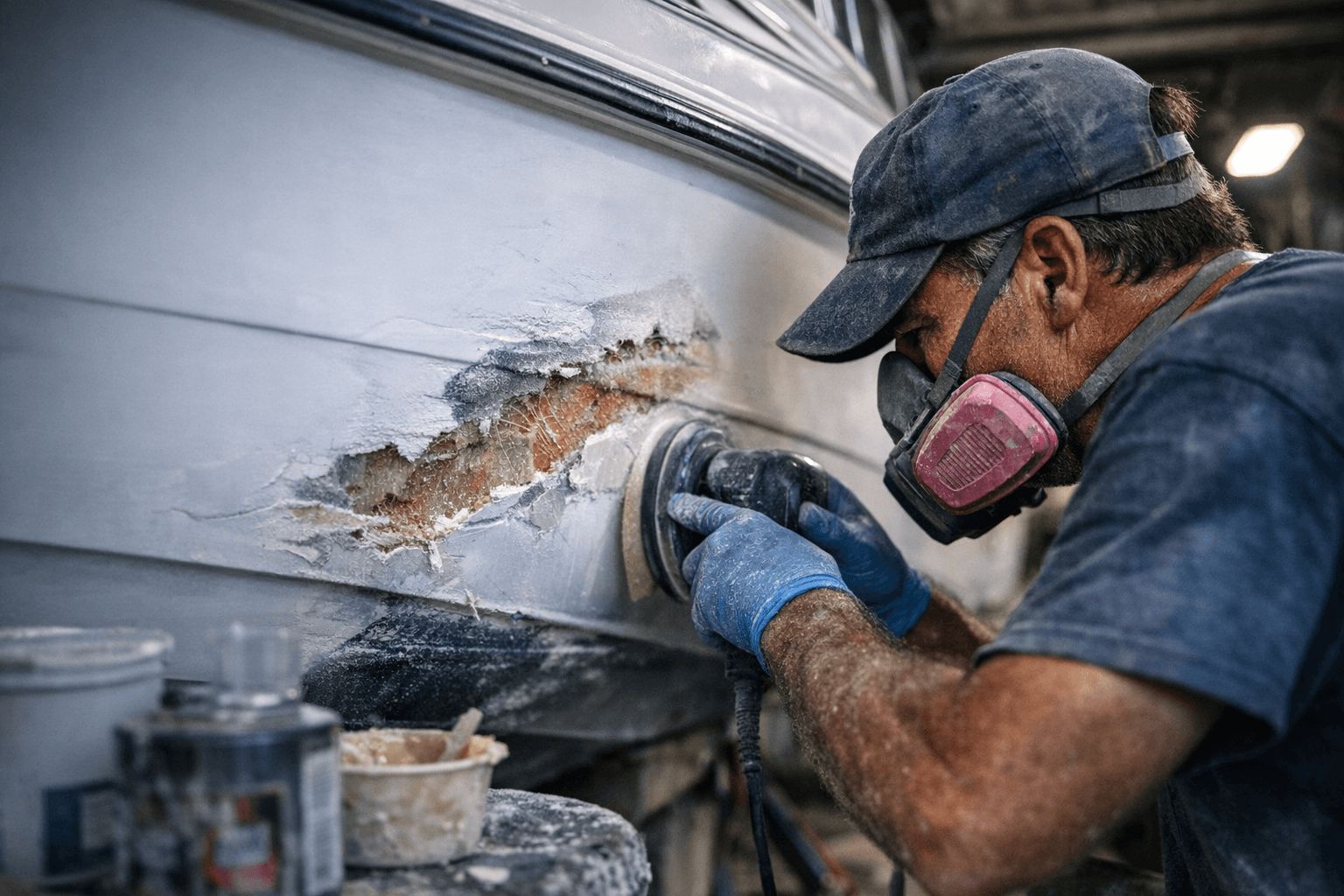
Fiberglass is the forgiving material you've heard about, right up until you treat a structural crack like a cosmetic scratch and launch a boat that's quietly failing below the waterline. Every durable repair starts in the same place: diagnosing exactly what failed. Was it gelcoat only, laminate damage, core rot, or cosmetic pinholes? That single answer determines your materials, your layup schedule, and your finishing steps. Get the diagnosis right and the repair has a real foundation. Get it wrong and you spend a weekend making a structural failure mode invisible.
Diagnose First: Your Four Routes
Before you open a resin container, work out which of these four categories applies. Everything downstream follows from here.
- Gelcoat only: Crazing, chips, or surface scratches that don't flex or visibly penetrate into the laminate. The repair is cosmetic, but it still demands full prep discipline to hold.
- Laminate damage: Cracks that break through the gelcoat and into the fiberglass cloth layers. A whitish, radiating star pattern around an impact point is the tell. This is a structural repair regardless of how small the visible crack looks.
- Core rot or delamination: Tap the hull with a coin or your knuckle. A dull thud instead of a sharp, crisp tone points to water intrusion and degraded core material. This route is the most labor-intensive, and the one where a marine surveyor's assessment almost always pays for itself.
- Cosmetic pinholes: Tiny surface voids from air entrapment, either in original manufacture or from a previous spray job. Manageable, but only with the right filler for the location.
Misrouting here is the root cause of most repair failures. Treating delaminated laminate as a surface fix traps moisture, accelerates core rot, and builds a structural failure point you won't detect until it matters at sea.
Route 1: Gelcoat-Only Repairs
If the damage is surface-only, this is a legitimate weekend repair. What kills most gelcoat jobs is not technique; it is contamination. Remove all loose material and feather back to sound gelcoat using 80-grit on an orbital sander, then wipe down thoroughly with acetone. A single trace of wax, salt residue, or skin oil under fresh gelcoat is enough to cause adhesion failure. That acetone wipe costs three minutes and saves the entire repair.
For color-matching, use prematched gelcoat tint packs rather than trying to blend from scratch. Overfill the repair slightly to account for shrinkage during cure, then wet-sand from 400 through 2000 grit before finishing with polishing compound. Do not spray gelcoat unless you have actual spray experience; without it, orange-peel texture and pinholes are near-certain outcomes. Brushed or dabbed application on small repairs is more controllable and far more forgiving.
One compatibility issue that catches sailors out every season: gelcoat does not bond reliably over cured epoxy. If the underlying laminate is epoxy-based, skip the gelcoat route entirely. Apply an epoxy fairing compound, follow with a compatible primer, and finish with a marine topcoat paint. It won't replicate the original gelcoat sheen exactly, but it will hold.
Route 2: Laminate Damage
Grind back to solid, sound laminate at a minimum 12:1 taper ratio, meaning 12 millimeters of feathered edge for every millimeter of laminate depth. This is not just about removing visible damage; it is about creating a bonding surface with no compromised fibers underneath. Clean the ground area with acetone and allow it to dry fully before any resin contacts the surface.
For structural laminate repairs, epoxy is the correct choice. It bonds more reliably, resists moisture better, and handles the flex cycling a hull sees in service far better than polyester. Measure hardener carefully: most marine epoxy systems run at 1:1 or 2:1 by volume or weight, and even a 10% error in hardener ratio is enough to prevent full cure and permanently compromise the laminate's structural integrity. Use graduated dispensers or accurate scales, not approximate pours.
Cloth orientation matters. Biaxial cloth suits most structural patches; plain weave handles smaller or more contoured areas. Wet out each layer with the minimum resin required to fully saturate the cloth. An excessively resin-rich laminate is actually weaker than a correctly wet-out one, and it adds weight for zero structural benefit. For below-waterline work, ABYC-aligned best practices include sharp edge removal before laminating and dry-vacuum bagging where equipment is available, consolidating the layup and eliminating voids.
Batch size is a genuine hazard. Mixing too large a volume of epoxy generates an exothermic reaction that overheats the resin, shortens pot life unpredictably, and in worst-case scenarios causes smoking. Mix in smaller batches and pour into a roller tray to extend working time and maintain control.
Route 3: Core Rot and Delamination
This is the repair that divides experienced builders from everyone else, and also the one most consistently underestimated at first inspection. If the tap test confirms delamination or you find wet, compressed, or crumbled core material (balsa, foam, or plywood depending on your build), the job requires cutting out the damaged skin, removing and replacing the saturated core, and allowing the area to dry thoroughly before re-lamination begins. In humid conditions, that drying window can take days. There is no shortcut worth taking.
Re-laminate over the new core using epoxy and appropriately sized cloth. For any structural core work where you are not confident in the full extent of the damage, consult a qualified marine surveyor before proceeding. This is not about lacking skill. It is about the fact that structural laminate and core repairs are life-critical in a way that a gelcoat chip simply is not.
Route 4: Cosmetic Pinholes
Pinholes almost always trace back to filler selection. Using a lightweight or water-soluble filler in a below-waterline or high-moisture area guarantees reappearance within one season. For below-waterline or structural areas, use an epoxy-based fairing compound. Above the waterline on a polyester laminate, a compatible polyester fairing product can work if the underlying chemistry matches.
Apply the filler, allow it to cure fully, sand back to 80-grit, inspect for remaining voids, and apply a second skim where needed. Then progress through your grit sequence to the finish level your chosen topcoat requires.
The Four Failure Points That Cause Most Repairs to Fail
Across all four routes, the same small cluster of failure points accounts for the vast majority of re-dos. Eliminating these is the highest-return work in any fiberglass job:
- Surface contamination: Wax, oil, salt, and moisture all defeat adhesion before the resin ever cures. An acetone wipe-down before any resin application is the single highest-return prep step on any repair.
- Bad mix ratios: Under-measured hardener leaves epoxy tacky, structurally weak, and impossible to topcoat reliably. Measure by weight or graduated volume on every batch.
- Wrong filler choice: The location, the chemistry of the underlying laminate, and the exposure environment all determine which filler actually belongs in the repair.
- Sanding grit jumps: Skipping from 80-grit to 400 leaves deep scratches that telegraph through topcoats. Move in logical increments: 80, 120, 180, 220, 320, 400, and up to 2000 for final gelcoat finishing.
The Minimum Viable Repair
For sailors who need a durable result over a single weekend rather than a perfect cosmetic match, the priority order is: accurate diagnosis, thorough surface prep, correct resin measurement, and a full structural laminate where the damage demands it. Finish with an epoxy fairing skim and a brushed or rolled topcoat rather than chasing a mirror gelcoat match. A well-prepped, correctly laminated repair under a compatible topcoat will reliably outlast a rushed gelcoat job that looks sharper on launch day but fails by autumn.
Working Conditions and Materials
Do not underestimate the environment. Most epoxy systems require ambient temperatures between 15 and 25°C (60 to 77°F) for predictable cure. Below that range, cure slows significantly and some systems never fully cross-link. Above it, pot life shortens and exothermic risk in larger batches rises sharply. Avoid direct sunlight for gelcoat work; UV affects working properties and actively promotes pinholing in uncured gelcoat.
Wear nitrile gloves, eye protection, and a respirator rated for styrene fumes or sanding dust throughout the job. Your full kit should include: orbital sander, mixing cups and accurate scales or graduated dispensers, peel ply and release film, biaxial and plain-weave cloth sized to the repair, marine epoxy and/or polyester resin matched to your application, epoxy-based fairing compound, gelcoat and tint packs, and sandpapers running from 80 to 2000 grit with polishing compounds for the final stage.
If you are joining materials with different chemistries, run a small adhesion test on scrap material before committing to the repair. The cost of that test is a few grams of resin and an afternoon; the cost of stripping a failed repair and starting over is considerably higher.
Finishing
Wet-sand through the full grit sequence and use a marine polishing compound to blend the repaired area into the surrounding gelcoat or paint. On gelcoat finishes, apply a UV-protective marine wax after the final buff to seal the surface against oxidation. On painted finishes, a UV-stable topcoat handles that protection role directly.
The three highest-leverage investments for consistent results, synthesized from the combined guidance of BetterBoat, West Marine, FirstChoiceMarine, and Practical Sailor, are the same across every repair type: measuring and mixing accuracy, surface preparation that goes further than feels strictly necessary, and using small practice pieces to calibrate your timing and ratios before touching the repair that actually counts. Get those three right and the chemistry takes care of the rest.
This article was produced by Prism’s automated news system from verified source data, official records, and press releases, then run through automated quality and moderation checks before publishing. The system is built and supervised by the people who set the standards it runs under. Read our full AI policy.
Did this article answer your question?