How to streamline boat maintenance with color-coded tools
Color-coding your tools turns maintenance into a repeatable system, so you catch fuel, alternator, and rigging issues before they turn into offshore failures.

Red tools for the fuel system, blue for the alternator, yellow for rigging: a simple color-coded setup separates the critical work from the cosmetic work and makes a twice-yearly maintenance plan smaller, clearer, and harder to avoid.
Start with the jobs that can ruin a sail
A lean maintenance program should be built around consequence, not clutter. The first questions are blunt: what fails before departure, what fails under load, and what fails so badly that it turns a cruise into a tow. That is why the best maintenance systems do not start with a giant master list. They start with the systems that matter most when the boat is moving, especially fuel, alternator, and rigging.
That is also where a twice-yearly rhythm makes sense. Many sailboats already live on a launch, cruise, haul, recommission cycle, and the boat is often more forgiving of planned work than of surprise repairs at sea. A spring and fall pass through the boat gives you a built-in reset.
Use color to cut the mental load
The color-coding idea works because it removes one layer of decision-making. Each system gets its own kit, which is a fast visual cue that tells you which job family you are in before you even open the locker.
If the fuel-system tools always live in the red group, you spend less time hunting for the right wrench, less time mixing tool kits between jobs, and less time forgetting whether you actually checked the filter, hose clamp, or bleed screw. On a boat, that matters because maintenance often gets skipped when the job feels bigger than it really is.
A color system also helps when more than one person works on the boat. The next person does not need your memory to know which kit belongs to which task.
Build the schedule around a short, repeatable cycle
A twice-yearly routine is enough structure to keep the boat reliable without turning the season into a spreadsheet. The point is to revisit the same critical systems at the same time each year, then tighten the inspection and service intervals for anything that needs more frequent attention. You are not trying to inspect every inch of the boat every month; you are trying to keep the high-consequence systems from drifting out of view.
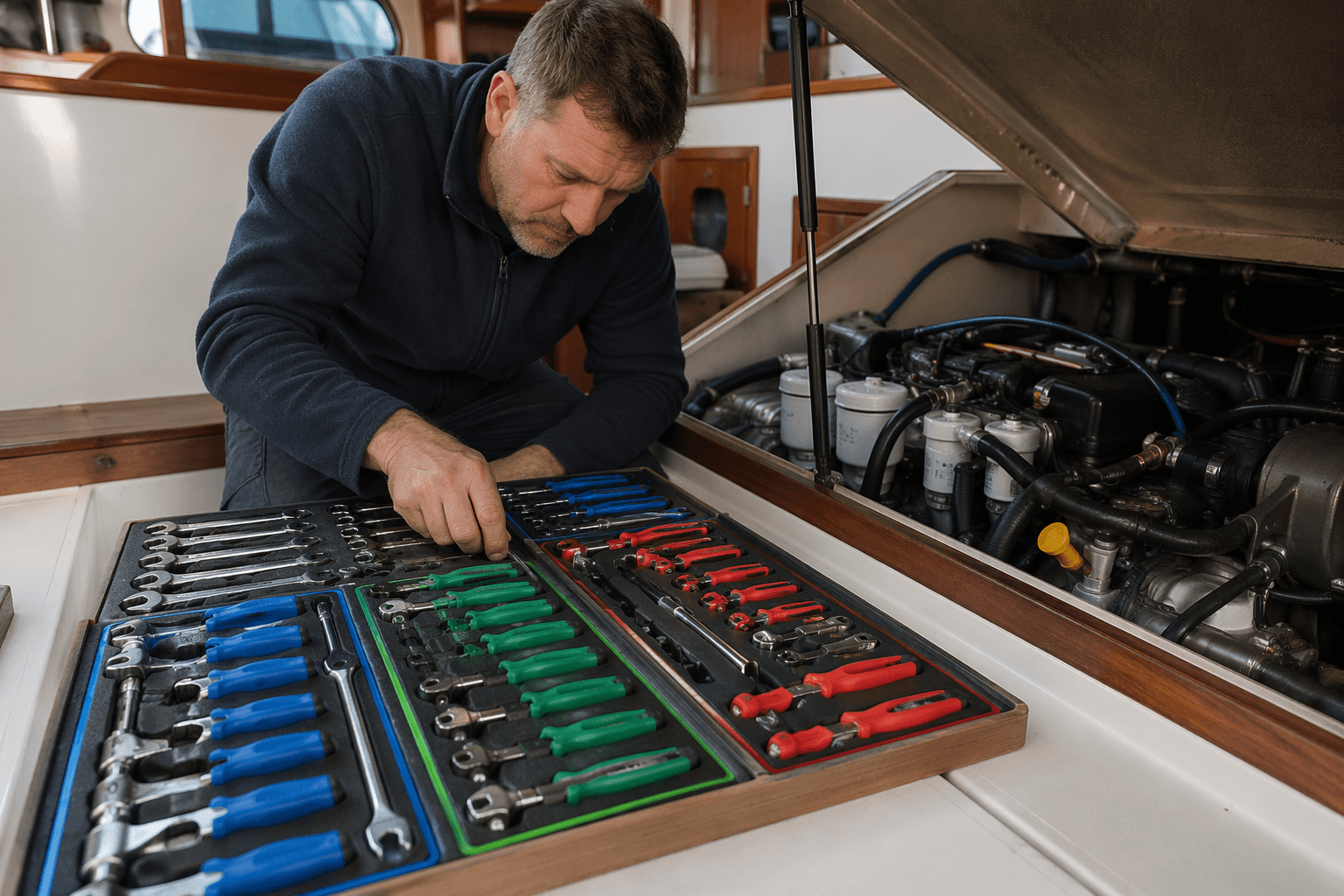
That is where many owners go wrong. They make maintenance feel like a single giant project, then put it off until haul-out or until something breaks. A better system splits work into small, named cycles and treats each cycle as non-negotiable. If the fuel system gets red tools in one cycle and rigging gets yellow tools in the other, the work is already separated into named cycles.
Keep a written log that forces follow-through
The smartest maintenance log is not a diary. It is a checklist that tells you what the job is, how often it comes due, and what you need to finish it. Practical structure matters here: divide jobs into categories, define each task, determine the service interval, note specialized tools or materials, inventory consumables, and record the date the job is actually done.
That last part is the one people skip, and it is the one that keeps the whole system honest. A job that was “basically done” does not count if the filter was never changed or the cotter pin never got replaced. When you write down the completion date, you create the trail you need to see what was serviced, what got delayed, and what is coming due next.
A good log also makes the next round easier. If the fuel system needed a particular hose clamp size, or the rigging check required a specific spanner, you do not rediscover that fact from scratch six months later. You already have it in the system.
Make the boat’s biggest risks hard to ignore
The U.S. Coast Guard’s 2024 Recreational Boating Statistics report recorded 556 boating fatalities, 3,887 incidents, and 2,170 nonfatal injuries. It was the fewest boating fatalities since the Coast Guard began collecting statistics more than 50 years ago, but it still logged 92 alcohol-related deaths, which was 20 percent of total fatalities.
The American Boat & Yacht Council has been developing safety standards for boat design, construction, equipage, repair, and maintenance since 1954, and its standards list includes 84 standards and technical information reports. For sailboats specifically, U.S. Coast Guard guidance in NVIC 02-16 points to post-casualty analysis and follow-up inspections as the reason for a standardized inspection, examination, and maintenance regime for sail vessel rigging nationwide.
This article was produced by Prism’s automated news system from verified source data, official records, and press releases, then run through automated quality and moderation checks before publishing. The system is built and supervised by the people who set the standards it runs under. Read our full AI policy.
Did this article answer your question?