India Rebuilds Ancient Nail-Free Stitched Ship for Ocean Voyages
No nails, no engine, no bolts: India's INSV Kaundinya sailed open water held together by 4,000 metres of coir rope stitched through Malabar Teak.
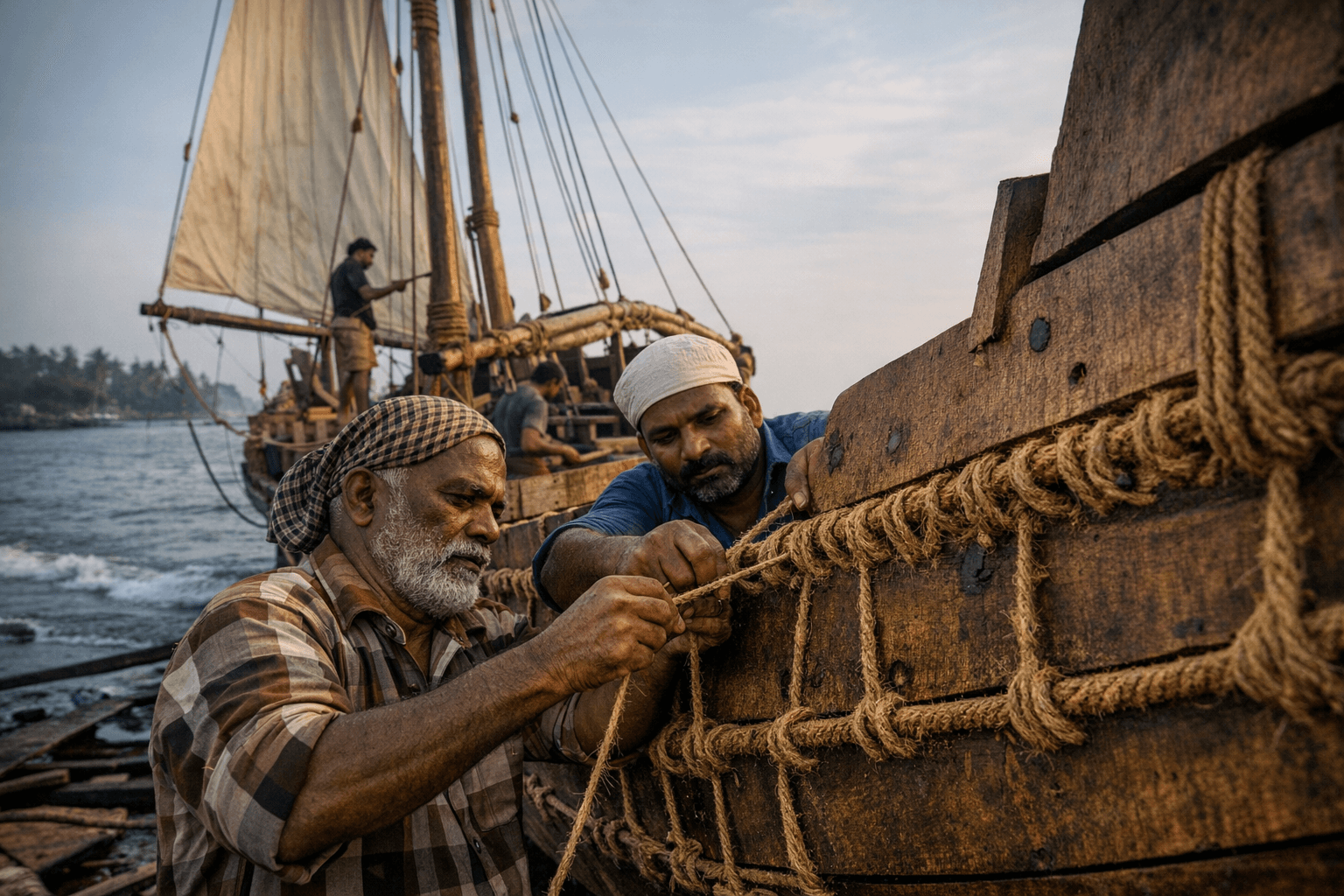
Four thousand metres of coir rope, threaded through drilled holes with specialised needles, holds INSV Kaundinya together where any modern builder would reach for a nail gun. The roughly 20-metre vessel, built entirely from Malabar Teak by traditional shipbuilders in Hunsur, Karnataka, has been inducted into the Indian Navy as what Architectural Digest described as "the first of its kind globally among sailing stitched boats" — and it has already been tested in open water.
The project began as author and researcher Sanjeev Sanyal's effort to reconstruct an ancient Indian merchant vessel depicted in murals inside the Ajanta Caves. Sources variously date the inspiration to circa 4th through 6th centuries CE, with Architectural Digest citing a 5th-century mural and MaritimeIndia referencing a circa 4th-century CE depiction. In July 2023, a tripartite agreement between India's Ministry of Culture, the Indian Navy, and Goa-based Hodi Innovations formalized the build, bringing together archaeological interpretation, hydrodynamic testing at IIT Madras, naval architecture, and traditional craftsmanship under one project.
The construction method is called the Tankai technique, a nail-free stitched shipbuilding tradition that MaritimeIndia traces back over 2,000 years. Unlike contemporary frame-first boatbuilding, the Tankai approach starts with the keel and builds the shell outward: hundreds of planks, individually steamed and bent to shape, were erected by artisans working under master shipwright Babu Sankaran. The planks are not bolted or screwed. Instead, coir rope binds them through drilled holes, with coconut fibre packed between joints as filler and kundroos resin, a natural gum, applied to seal each connection. The hull was then treated with fish oil and limestone powder for durability and finished with a brick-red pigment — matching the aesthetic of the Ajanta mural that inspired the design.
The resulting hull is notably flexible by design. MaritimeIndia notes that the Tankai technique produces hulls with "enhanced flexibility, allowing them to navigate the perilous waters of the Indian subcontinent with ease" — a quality that historically made stitched ships capable of long-distance trade voyages reaching as far as Southeast Asia. Before induction into the Navy, INSV Kaundinya underwent hydrodynamic simulations at IIT Madras to verify its ocean-going capability. The vessel carries no engine and no metal fittings, and its square sails and trailing oars replicate design elements drawn directly from the Ajanta cave imagery.
The Tankai tradition had, by the time this project launched, largely retreated to small fishing boats. Preserving the knowledge required finding shipwrights who still held the skill: MaritimeIndia noted the project's explicit goal of showcasing "the exceptional skills of India's remaining traditional shipwrights." The stitching alone, performed with specialised needles to maintain historical authenticity, consumed more than 4,000 metres of coir rope across the vessel's joinery. Whether the exact hull length is 19.6 metres as MaritimeIndia states or 20 metres as reported elsewhere, the scale of hand-stitched construction is significant by any measure.
INSV Kaundinya is intended to traverse symbolic ancient sailing routes — the same corridors that once carried trade, culture, and ideas across the Indian Ocean world, now sailed again by a vessel built the way those original ships were built: wood, rope, resin, and the craft knowledge to tie it all together without a single nail.
Know something we missed? Have a correction or additional information?
Submit a Tip