Modular DIY dodger and bimini turn costly cockpit enclosure affordable
A $4,000 to $5,000 dodger quote pushed MoonShadow’s owners into a staged build that turned one big canvas bill into a smarter, cheaper cockpit enclosure.
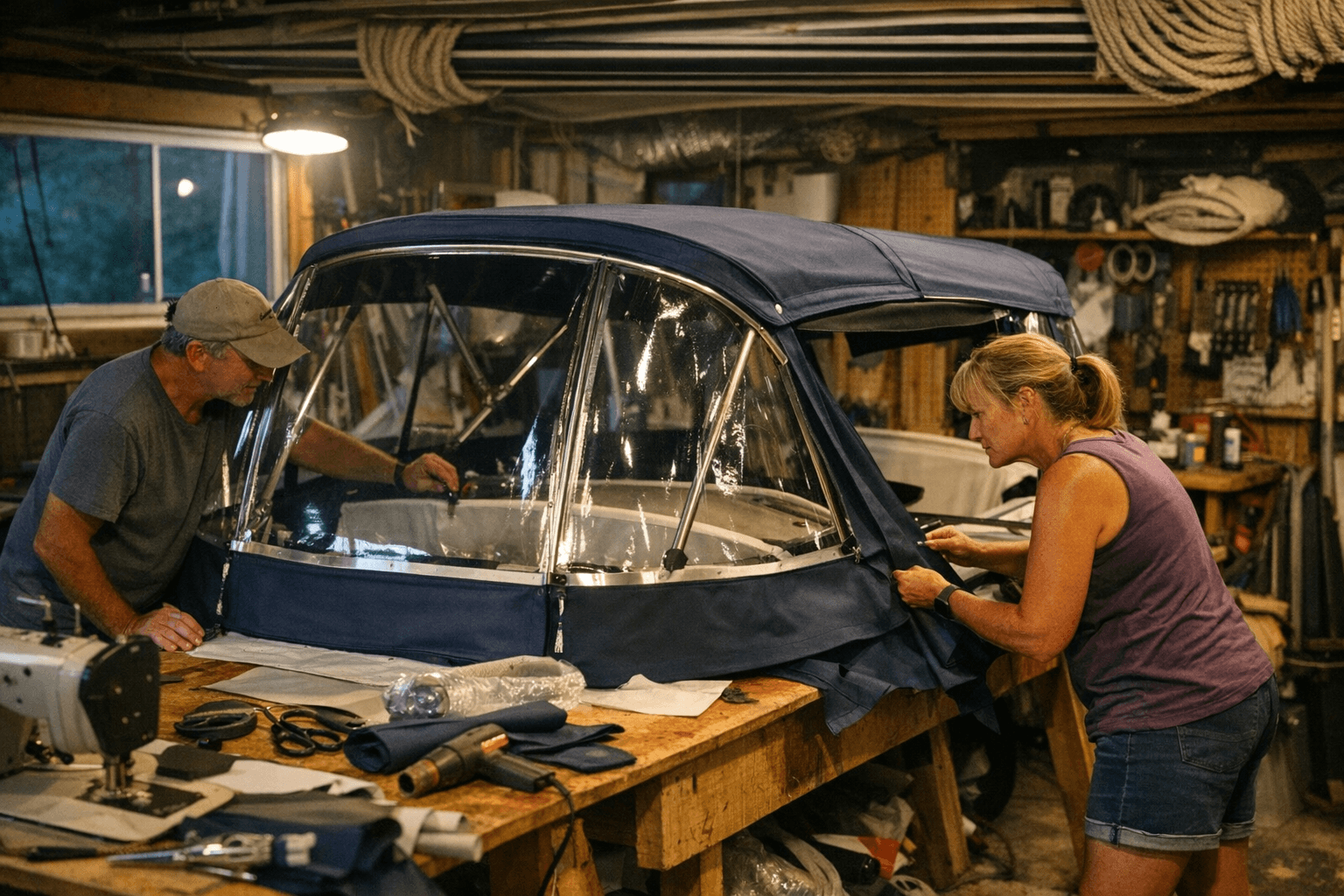
The smartest cockpit canvas project is not the biggest one
A $4,000 to $5,000 quote for a custom dodger is usually where a cockpit enclosure dream starts to feel out of reach. Dale and Wendy Bagnell found a better path on MoonShadow: break the job into smaller wins, build the dodger first, add the bimini later, then connect the two with a panel that ties the whole system together without turning the boat into a clumsy greenhouse.
That staged approach is the real lesson. Instead of treating cockpit canvas as a single, expensive custom-shop order, they treated it as a modular build that could be budgeted, learned, and improved one piece at a time. The result was not just cheaper. It preserved sailing function, kept the boat comfortable in bad weather, and left room to adjust the system as they learned what the boat actually needed.
Start with protection, not perfection
MoonShadow’s owners were chasing a simple problem: the boat was getting cold and wet on passages. That is the kind of complaint that leads many sailors straight to the biggest possible enclosure, but that is also where projects get expensive fast and become awkward to use underway. The Bagnells chose to solve the exposure first, then expand the system only when the next piece made sense.
The first quotes they received for a custom dodger ran from $4,000 to $5,000, which is a serious number for any cruising budget. Sailrite’s own guidance backs up that reality, noting that custom dodgers can be expensive when ordered from a canvas shop. The kit route changes the equation: it keeps the fit custom, but shifts the process toward owner-built labor and staged spending.
Why the dodger comes first
A dodger is the foundation because it does the most immediate work. Sailrite describes it as shelter from rain or spray, which is exactly why it is such a practical first step for a boat like MoonShadow. Once that forward protection is in place, the rest of the enclosure can be designed around real use instead of guesswork.
Dale Bagnell did not sketch the dodger in a vacuum. He studied other boats, walked the docks, and then sketched the design directly over a photo of MoonShadow after hoisting the sails, so he could be sure the canvas would clear the boom and still work with the rig. That is the kind of design check that keeps a pretty canvas job from becoming a sailing problem. If the dodger blocks sail handling or crowds the working side of the boat, it has failed no matter how neat the stitching looks.
Kits make the learning curve manageable
The most useful part of the MoonShadow story is not just that the owners did the work themselves. It is that they used a Sailrite kit that bundled the essentials: fabric, pattern material, support tubes, fasteners, thread, and sewing supplies for the dodger. That package turns a complex marine project into something learnable because the major materials arrive as a matched system.
Sailrite’s current dodger and bimini kit pages take the same approach, describing kits that include marine-grade canvas and the other materials needed to sew a custom enclosure for a vessel. That matters because cockpit canvas is not the place to improvise with random cloth and generic hardware. A kit helps you avoid the common fit errors that happen when the fabric, frame, and attachment points are all sourced separately and then forced to meet on the boat.
A modular kit also gives you control where it counts:
- You can match the enclosure to your actual rig and deck geometry.
- You can spread costs across stages instead of paying for everything at once.
- You can learn the process on the dodger before tackling a larger cockpit system.
- You can replace or rework one section later without rebuilding the whole enclosure.
Add the bimini only after the dodger works
The Bagnells did not stop at the dodger, but they also did not rush straight into the full enclosure. The bimini came next, and only after that did they add the connecting panel. That sequence is what makes the project so useful to other sailors, because it shows how shade, rain protection, and cockpit comfort can be added without locking the boat into a single heavy-handed solution.
Sailrite frames biminis and extension panels as part of a larger weather-protection system, and that matches how many cruising boats actually get used. In hot weather, you may want shade more than enclosure. In rough weather, you may want the full wrap. A modular setup lets you choose the right level of protection instead of living with one fixed compromise all the time.
Sailrite’s dedicated dodger-to-bimini extension panel kit makes that strategy explicit. The company is essentially acknowledging what smart DIY sailors already know: cockpit canvas works best when it can grow with the boat, not against it.
Where fit errors usually happen
The biggest mistake in cockpit canvas is not usually the sewing. It is the planning. If the dodger lands too high, too low, or too far aft, the rest of the enclosure becomes harder to align. If you do not verify boom clearance with the sails up, you risk building a beautiful obstruction instead of a useful shelter.
The MoonShadow project shows the better workflow. Check the sail plan first. Map the structure to the boat’s real geometry. Sketch over a photo so the frame, visibility, and access points all get considered before the first cut. That is how you avoid the expensive kind of rework, where one bad decision forces you to remake panels, shift supports, or live with a cockpit that is awkward every time you tack or reef.
Why the modular approach saves more than money
The appeal of the staged build is not just lower up-front cost, although that is a huge part of it. It also gives the owner more control over how the boat feels underway and at anchor. A full enclosure can be great in a marina or on a cold passage, but a smaller system with removable or add-on panels gives you more ways to tune airflow, access, and sightlines.
That flexibility is the real payoff. You get weather protection, shade, and a more social cockpit without giving up the boom, sail controls, or the working side of the boat. You also avoid the trap of treating cockpit canvas as an all-or-nothing purchase. One good dodger can be a major improvement. A bimini can follow when the budget and the boat are ready. The connecting panel can finish the job when you know exactly how you sail.
A project that still reads like a blueprint
Good Old Boat published the MoonShadow project in Issue 109, July/August 2016, and later coverage in 2017 pointed back to it as the example of adding a dodger, then a bimini, and then the whole cockpit enclosure. That lasting relevance is the best proof that the idea works. The project did not rely on a lucky one-off design or a giant budget. It worked because it treated cockpit canvas as a sequence of smaller, solvable problems.
That is the real takeaway for anyone staring at a bare cockpit and a scary quote. The smarter path is usually not to build less. It is to build in stages, with each piece earning its place before the next one gets sewn in.
This article was produced by Prism’s automated news system from verified source data, official records, and press releases, then run through automated quality and moderation checks before publishing. The system is built and supervised by the people who set the standards it runs under. Read our full AI policy.
Did this article answer your question?


