Norway cruising, anchoring lessons and a mainsail repair at anchor
Norway’s south coast looks gentle until you try to thread it, moor it, and fix it. This route turns scenery into seamanship, from Blindleia’s shelter to a mainsail repair at anchor.
Reading the coast before you read the skyline
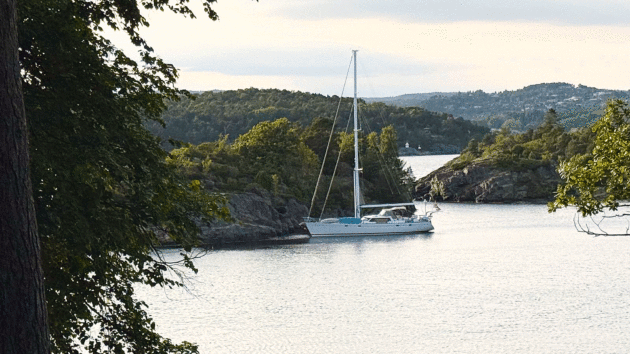
Norway’s south coast is the kind of place that seduces you with white wooden houses, pine-fringed shorelines, and a chain of islands that looks almost soft from a distance. Then you start boating there and the coast shows its teeth: narrow leads, exposed stretches, and anchorages where one wrong assumption about swinging room can turn a pleasant stop into a bad night. That is exactly why this route rewards crews who treat the scenery as part of the navigation plan, not decoration after the fact.
The family route through Stavanger, Rekefjord, Mandal, and Kristiansand is a good reminder that the coastline changes character as you work south. Farther north it can feel more open and rugged, while the southern reach settles into lower rocky shores, hidden harbors, and the kind of sheltered pockets that make local boating feel intimate rather than grand. The lesson is simple: on this coast, the miles matter less than the choices you make inside them.
Blindleia is the kind of passage that teaches patience
Blindleia is about 20 kilometers, or roughly 12 miles, of inland coastal waterway between Lillesand and nearly to Kristiansand. It sits behind a screen of low islets and reefs that protect it from the open Skagerrak, and that protection is exactly why it matters so much to cruising sailors. It is not just a pretty line on the chart. It is a working route through a coast where shelter is often more valuable than speed.
That is also why the route is so closely tied to local boating culture. Visit Norway and Visit Sørlandet describe it as a place you can experience by sightseeing boat, charter, or your own vessel, and Sørlandet even supports it with an activity map and brochure covering maritime coastal culture, nature, outdoor life, and historical sites. In other words, the area is set up to be read both as a passage and as a shoreline community, with enough history in it to keep the route from feeling like a simple transit.
Why narrow-pass navigation matters here
On the southern west coast, the practical issue is not just finding a harbor. It is finding one that is actually usable in the conditions you have. The exposed stretches offer very few places to stop, which is why so much local boating happens inside fjords and skerries rather than offshore. Blindleia compresses that logic into one route: narrow water, protected edges, and constant attention to what lies ahead, not just what is behind the bow.
That is where official information matters. The Norwegian Coastal Administration, Kystverket, is responsible for maritime safety, navigational infrastructure, fairways, pilotage services, and preparedness against acute pollution. Kartverket says the Norwegian Pilot Guide supplements nautical charts for the entire Norwegian coast, Svalbard, and Jan Mayen. For a modest cruising boat, that combination is a practical signal: this coast is beautiful, but it is also a place where chartwork, pilotage knowledge, and route planning are part of the seamanship, not the paperwork.
Weather timing is part of that same discipline. A coast with few easy stopovers and lots of protected pockets rewards crews who wait for the right window rather than forcing a passage because the day looks tempting. On the south coast, the right day is not the one with the nicest horizon. It is the one that lets you make the next narrow lead, the next anchorage, and the next landfall without improvising under pressure.
Anchoring here is not a casual affair
The best anchorages in Norway can be so tight that there is no room to swing. That is where local technique comes in, and the method is more exacting than many sailors expect the first time they see it in action. Instead of relying on a broad circle of water, locals often use rock pins, drop a stern anchor, motor in, and then tie the bow to the rock. It is a neat solution, but only if the crew is comfortable with close-quarters boat handling.
That first learning curve matters. The family’s own attempts show how quickly a pretty hidden cove can become a test of judgment, line handling, and patience. A crew heading this way should be ready for short-handed mooring work, awkward angles, and the need to think in three directions at once: stern anchor set, bow secured, and hull kept off the rocks. In Norway, anchoring is not about getting comfortable fast. It is about getting secure in a place where comfort follows precision.
Gamle Hellesund shows why this style of seamanship developed in the first place. It reached its high point in the 19th century during the sailing-ship era, when ships from many countries visited the outports and the area had both a pilot station and a customs station. Visit Norway also notes that Dutch pilot books and nautical charts from the 16th century already mentioned the harbor, which tells you how long mariners have depended on this shelter. When you tie up in that kind of place, you are joining a traffic pattern that has been shaped by centuries of stopping, waiting, and getting the boat settled properly.
The mainsail repair at Rekefjord is the real lesson
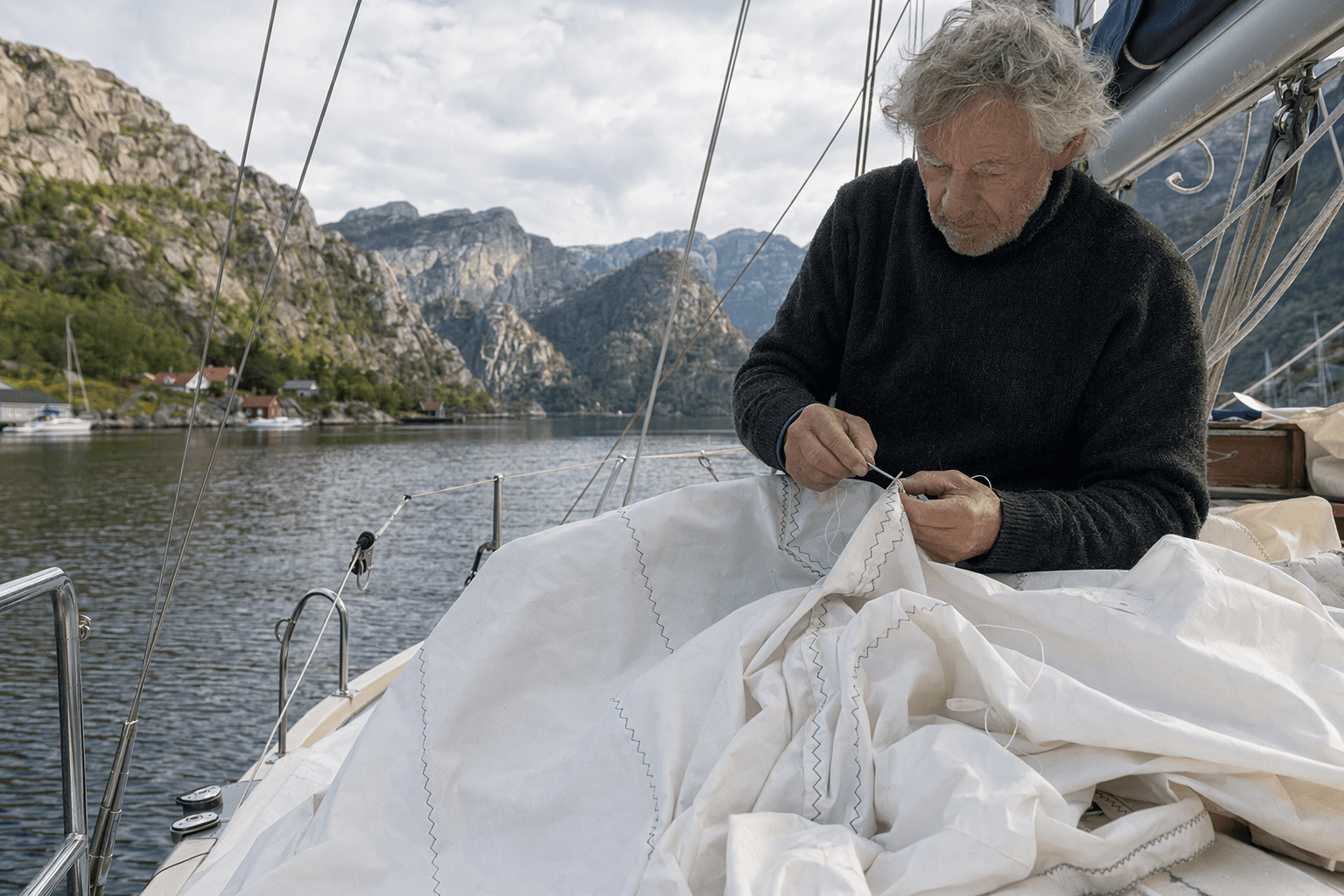
The scene at Rekefjord says almost everything you need to know about cruising this coast. The family arrives with a torn mainsail, and the trip only keeps moving because the problem is handled where it happens, with the children watching their father go aloft to fix it. That is not just a good sailing story. It is the core survival skill of family cruising on a demanding coastline: the ability to keep the boat in the game when the boat itself has decided to complain.
For a small cruising boat, that means preparing for repairs before they are needed. A torn sail is a reminder to inspect sailcloth, check access aloft, and assume that a sheltered anchorage may become a work platform. The coast does not pause for breakdowns, so the crew that does best is the crew that can make the boat serviceable without leaving the passage.
A route shaped by culture as much as by chart lines
Blindleia is not only a navigation problem to solve. It is also one of the most legible ways to experience Southern Norway’s coastal culture. The region is known for picturesque towns, traditional white wooden houses, and thousands of islands, and Blindleia brings those elements together in a way that feels almost curated for sailors. M/S Øya still runs summer service between Lillesand and Kristiansand, one of the few surviving scheduled boats on the route, and Blindleia Charter says the vessel sailed daily year-round from 1940 to 1987 before continuing as a summer service.
That continuity matters because it proves the route is still lived in, not merely admired. People have moved through these waters for shelter, commerce, customs, pilotage, and pleasure for generations, and the modern cruising sailor inherits that same system of knowledge. The coastline is beautiful precisely because it is exacting, and the exactness is what keeps the beauty usable.
By the time a crew leaves Blindleia behind, the lesson is hard to miss. Norway’s south coast is not asking for bravado. It is asking for judgment, a good chart, a weather window, and the humility to tie the bow to the rock when the anchorage says that is the only sensible answer.
This article was produced by Prism’s automated news system from verified source data, official records, and press releases, then run through automated quality and moderation checks before publishing. The system is built and supervised by the people who set the standards it runs under. Read our full AI policy.
Did this article answer your question?