Practical Sailor Tests Five Adhesive Removers for Silicone and Polyurethane Residues
None of the five removers tested could beat Loctite PL S40 on aluminum — a finding that could save your next rebed job from failure.
Grab a tube of silicone or polyurethane caulk remover off the shelf without doing your homework, and you may find yourself scraping just as hard after the application as before it. Drew Frye at Practical Sailor put five of these products through a focused test to find out which ones actually strip silicone and polyurethane residues from real marine surfaces, and the results reveal some important limits that every DIY sailor should know before committing to a rebedding or reseal job.
The Test Field
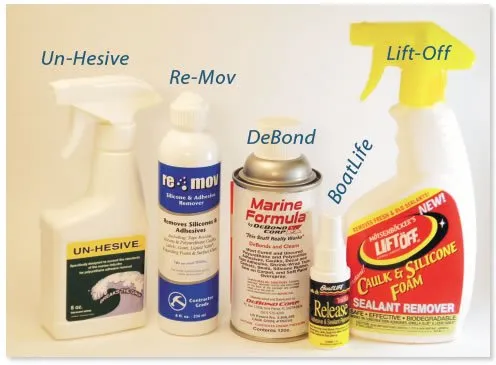
The focus of the test, as Practical Sailor describes it, was straightforward: "five products that makers claim will remove any trace of silicone and polyurethane caulks." Those five are BoatLife Release, Marine Formula DeBond, Un-Hesive, Re-Mov, and Lift-Off Silicone Caulk and Foam Sealant Remover (FSR) from Motsenbocker. Each product enters the test with a specific marketing claim, and Frye's testing presses each of those claims against real-world substrates, including aluminum and textured fiberglass, two surfaces that show up constantly in marine caulking and rebedding work.
BoatLife Release
BoatLife Release enters the test billed as a product "designed to simplify the removal of a wide range of adhesives." That breadth of claim is notable: rather than targeting a specific adhesive chemistry, BoatLife positions Release as a general-purpose remover. The test field includes it among the products making the strongest claims about full trace removal of both silicone and polyurethane residues. Detailed per-product performance results for Release beyond its inclusion in the test group were not published in the available excerpt from the report, so sailors looking for granular substrate-by-substrate data on this one will want to consult the full Practical Sailor article.
Marine Formula DeBond
Marine Formula DeBond is the product with the most specific origin story in the group. As Practical Sailor notes, it is "the lone aerosol in the group" and "the signature product of DeBond Corp., one of the first companies to put these types of products into the hands of do-it-yourselfers." That history matters: DeBond Corp. helped legitimize the DIY adhesive-removal category, and the aerosol format makes it convenient for working in tight spaces like chainplate pockets and hatch frames.
Where DeBond targets is equally specific: its claims are "specifically targeted 3M 5200," the tenacious polyurethane adhesive-sealant that sailors both love for its holding strength and dread when it comes time to disassemble. In testing, however, the results were mixed. According to Practical Sailor, "it helped a little when dealing with silicone caulk, but it was not very effective on polyurethane." That finding is somewhat ironic given the 3M 5200 positioning, though Frye's report does point to a separate Practical Sailor re-test titled "Removing 3M 5200" where DeBond "does perform well." The implication is that DeBond's effectiveness may depend heavily on the specific adhesive and substrate combination, and sailors dealing primarily with 3M 5200 should look closely at that dedicated re-test before dismissing or embracing the product.
Un-Hesive
Un-Hesive is described as "another patented product used to remove cured polyurethane adhesive," meaning its makers specifically designed it to tackle the harder-to-shift chemistry of fully cured polyurethane. The patented formula is a meaningful claim in a category where most products are solvent blends, and the product enters the test with a focused brief.
The results, though, were substrate-dependent in a way that matters a lot on a boat. Practical Sailor's bottom line states it plainly: "Un-Hesive made it easier to clean the aluminum hatch, but its poor performance on textured fiberglass dulled our enthusiasm. It was not effective on polyurethane caulk." That last point is the damaging one — a product positioned for cured polyurethane removal that does not perform effectively on polyurethane caulk is a significant gap. The aluminum hatch result is genuinely useful if that is your surface, but textured fiberglass is everywhere on a production sailboat, from non-skid deck areas around hardware to the textured soles of cockpit lockers, so limited performance there narrows Un-Hesive's practical application considerably.
Re-Mov
Re-Mov takes perhaps the broadest claim of the group, billed as "a product that claims to break the bond of most commercial adhesives." That kind of universal language is ambitious in a marine context, where adhesive chemistries range from flexible silicones to structural polyurethanes to hybrid MS polymer sealants. Re-Mov's inclusion in the test alongside more narrowly targeted products makes it an interesting comparative data point. As with BoatLife Release, the available excerpt from Practical Sailor's report does not publish granular per-product performance details for Re-Mov beyond the test field description, so the full results remain with the complete article.
Lift-Off Silicone Caulk and Foam Sealant Remover (FSR) — Motsenbocker
Motsenbocker's Lift-Off FSR is the most narrowly named product in the group, with "Silicone Caulk and Foam Sealant Remover" built directly into its product title. Motsenbocker "offers a wide range of adhesive removers," meaning the FSR is one tool in a broader product line designed around specific chemistries rather than a single all-purpose formula. Its presence in a test that includes polyurethane-focused products like DeBond and Un-Hesive makes it an interesting comparison point: a product optimized for silicone going head-to-head with products that claim polyurethane removal as their primary function. Again, full substrate-by-substrate results for Lift-Off FSR are not included in the published excerpt.
What the Conclusions Actually Tell You
The most important findings from Practical Sailor's test sit in the conclusion, and they reframe the entire product comparison around substrate and adhesive chemistry rather than brand. "All of the products were more effective at breaking the bond between polyurethane adhesive and aluminum," Frye reports, and that applies across all five removers. Specifically, "two polyurethane adhesives, 3M 5200 and 3M 4200, could be released from aluminum using any of the removers." If your job involves getting polyurethane off aluminum, the test suggests you have real options regardless of which product you reach for.
The harder limit is more specific and more important to know before you start: "none of the products could break the bond between aluminum and Loctite PL S40 or Loctite Marine Caulk." That is a result with real-world consequences. Loctite PL S40 and Loctite Marine Caulk are common on production boats, and if your rebedding project involves either of those adhesives bonded to aluminum, no product in this test field is going to save you from mechanical removal. Knowing that before you buy a $15 bottle of remover and spend three hours waiting for it to work is exactly the kind of information a Practical Sailor test is built to deliver.
The substrate-dependency finding running through these results is the takeaway that most sailors will find genuinely useful: adhesive removers are not universal tools, and matching the product to both the adhesive chemistry and the underlying material is more predictive of success than any single product claim. A separate Practical Sailor re-test focused specifically on 3M 5200 removal is worth tracking down if that adhesive is your primary target, particularly for more nuanced guidance on where DeBond fits into the toolkit.
This article was produced by Prism’s automated news system from verified source data, official records, and press releases, then run through automated quality and moderation checks before publishing. The system is built and supervised by the people who set the standards it runs under. Read our full AI policy.
Did this article answer your question?