Practical Sailor tests marine sealants against mildew, weather, and serviceability
A three-year roof test shows which caulks stay clean, which stay bonded, and which turn re-bedding into a fight when mildew and serviceability matter most.
Why this test matters on a real boat
Mildew staining is not just a cosmetic gripe. Once a sealant starts looking dirty, chalky, or blackened, it can be harder to trust on hatches, ports, deck hardware, and interior seams where water intrusion and future re-bedding already make life difficult. Practical Sailor’s long follow-up turns that everyday frustration into a useful decision guide: the best bedding compound is not always the one with the strongest grab, but the one that fits the job you actually have in front of you.
The big lesson is that sealants live a hard life after the tube is opened. They have to face UV, salt, cleaning chemicals, flexing, and, eventually, the need to come apart without wrecking the surrounding gelcoat. That is why this test is more valuable than a simple initial bond check. It tracks what happens after the installation is old enough to start looking like the rest of the boat.
How the field test was set up
Practical Sailor’s original shear-strength samples were made in 2015, then the team bonded twenty 1.25-inch by 6-inch fiberglass strips at a 90-degree angle and left them on a sunny roof for three years. Every few months, the coupons were flexed and examined for cracking, tearing, peeling, dirt buildup, and mildew-like staining. That setup matters because it mimics the kind of slow abuse cruising boats and trailer sailors deliver in the real world, not just the tidy conditions of a fresh shop install.
The test field included familiar marine and marine-adjacent names: 3M 5200, 3M 4200 Fast Cure, 3M 4000 UV, Sika 291, Sika 295, Loctite PL S-40, Loctite PL Marine, Boat Life Caulk, Boat Life Seal, and Sudbury Elastomeric Sealant. The point was not to crown a single universal winner, but to show how much the results change once weathering, surface texture, and cleanup come into play.
Match the sealant to the job, not the label
If you are bedding deck hardware that may need to come off later, the test pushes you toward products that hold strongly without turning future service into a demolition job. Sika 291 stood out for holding strong after more than three years, and Practical Sailor’s broader coverage also singled out Loctite PL S-40 and PL Marine in a later update. Those are the kinds of products that make sense when you want a dependable bond but still expect to disassemble the fitting one day.
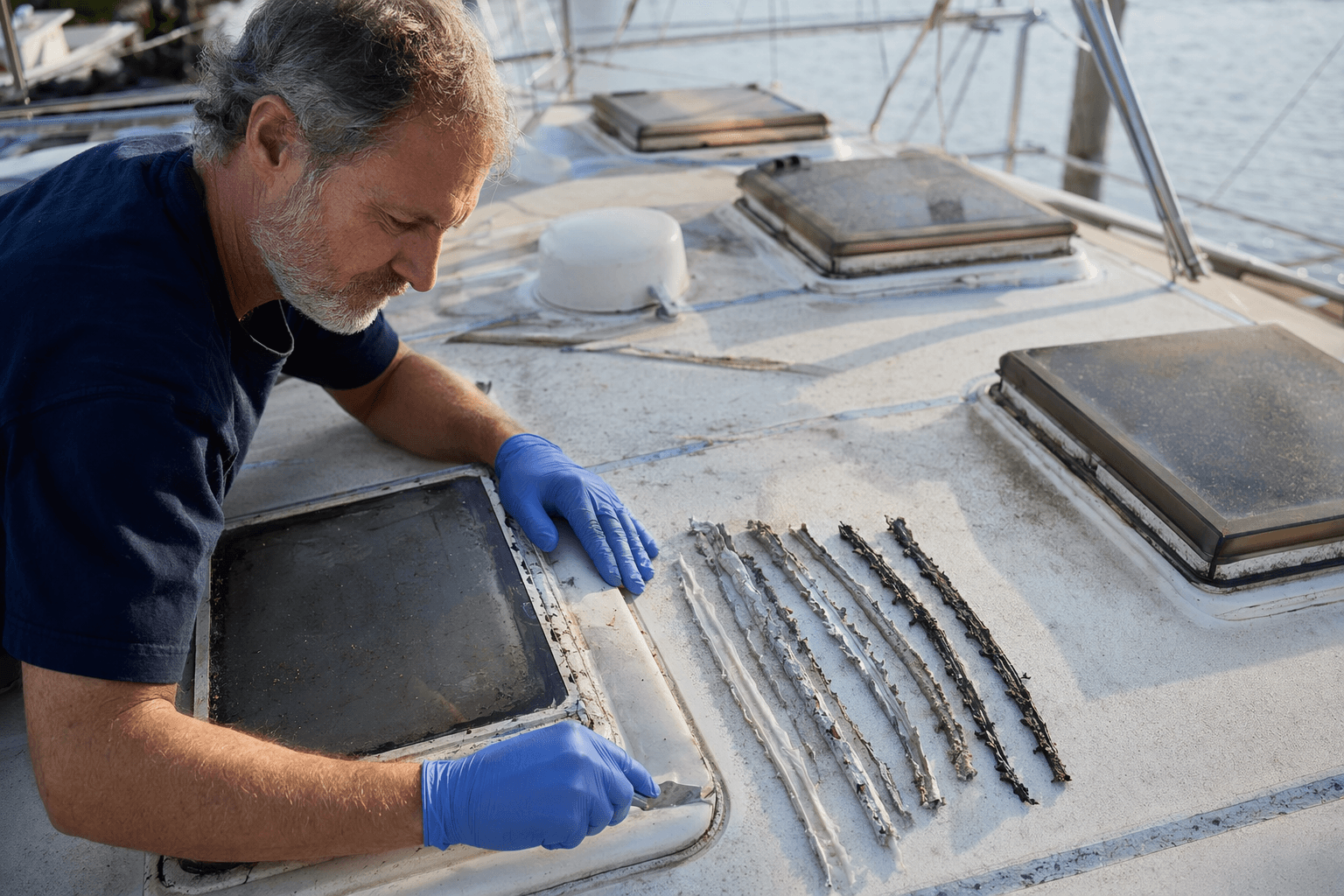
For a more permanent bond, 3M 5200 still behaves exactly like its reputation. 3M describes it as a one-part polyurethane marine adhesive/sealant with strong, flexible bonds and excellent adhesion to wood, gelcoat, and fiberglass. That makes it a serious choice when the joint is meant to stay put, but it also explains why it can be the wrong answer for anything you may need to re-bed without a fight.
If your priority is a more flexible marine sealant developed specifically for boat use, Sikaflex-291 fits that lane. Sika describes it as a one-component polyurethane sealant made for the marine market and cured by atmospheric moisture. In practical terms, that makes it relevant anywhere you need a non-sag marine sealant that can move with the structure instead of fighting it.
What resisted mildew, dirt, and ugly weathering
The surprise in this kind of test is not usually failure, but how fast some surfaces become maintenance problems. Practical Sailor found that rougher sealant surfaces attracted more dirt, while the dirtiest caulks could still be cleaned with normal washing. That is a reminder that appearance and service life are linked: a sealant that sheds dirt better can look fresher longer, and one that starts to hold grime can make the whole deck look tired.
Boat Life Seal, which contains silicone, repelled dirt better than the polyurethane sealants in the field. The tradeoff is familiar to anyone who has tried to re-bed over silicone: future bonding gets harder. That makes it a better fit when dirt resistance matters more than easy rework, and a worse fit when the next owner, or next season, will need to touch the joint again.
Sika 291 and Boat Life Seal were both easier to clean by the final check than some of the rougher, dirtier surfaces. Practical Sailor also identified Sika 291 and 3M 4000 UV as top performers for mildew resistance, bonding, and flexibility in its long-term field test. If you are choosing for exposed areas that stay visible, that combination of cleanability and staying power is hard to ignore.
The cautionary cases tell you just as much
Boat Life Caulk was the clearest warning sign in the group. It failed to bond well and peeled cleanly from gelcoat within months, which is exactly the kind of result that matters when you are counting on a seal to stay intact through weather, flex, and movement. Practical Sailor’s earlier adhesion testing also noted that BoatLife Caulk was the only product to fail the gelcoat 90-degree fillet flex test.
That does not make every BoatLIFE product a problem. BoatLIFE describes Life-Calk as a permanently flexible polysulfide sealant that can be used above and below the waterline and resists teak oils, gasoline, and diesel fuel. It does show why reading the exact product family matters. “Boat caulk” is not one thing, and the wrong tub can turn into a rework job very quickly.
3M 5200 was the opposite extreme. It stayed bonded and delivered the kind of staying power boat owners expect from a permanent adhesive, but that same strength came with the usual downside: inflexibility under strain and the potential to neck or tear when the joint is stressed. Strong is not the same as serviceable, and on a boat those two traits are often in tension.
What to choose when you are standing at the bench
A clean way to think about the decision is this:
- For permanent bonding where removal is not the goal, 3M 5200 lives in that category.
- For a strong marine seal on hardware that still needs future service, Sika 291 is the more practical style of choice.
- For dirt resistance and a cleaner look over time, Boat Life Seal showed an advantage, but future bonding becomes harder.
- For joints that need broad flexibility and chemical resistance, BoatLIFE Life-Calk brings a different polysulfide profile to the table.
- For spots where mildew resistance, bonding, and flexibility all matter, 3M 4000 UV and Sika 291 were the most encouraging names in the long-term field check.
That is the real takeaway from the three-year roof test. The right caulk is not just the one that holds today. It is the one that still looks acceptable, still cleans up, and still lets you service the boat without destroying the job you already did.
This article was produced by Prism’s automated news system from verified source data, official records, and press releases, then run through automated quality and moderation checks before publishing. The system is built and supervised by the people who set the standards it runs under. Read our full AI policy.
Know something we missed? Have a correction or additional information?
Submit a Tip