Practical Sailor Tests Screw-On Rigging Terminals for Reliability and DIY Ease
Practical Sailor tested Sta-Lok, Norseman and Hi-Mod screw-on terminals on Feb 24, 2026; mechanicals install with "a couple of wrenches" and let cruisers inspect and repair in the field.
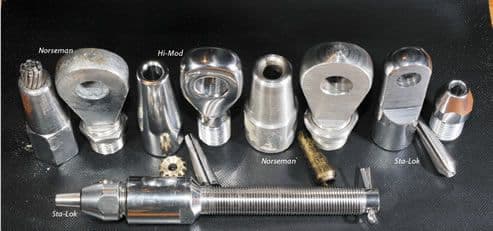
Because so many failures occur at the terminals, Practical Sailor published an in‑depth comparison on February 24, 2026 testing screw-on mechanical rigging terminals from Sta‑Lok, Norseman and Hi‑Mod to see which best balances reliability, ease of installation and long‑term value. Practical Sailor contrasts those screw-on mechanical or compression fittings with swaged terminals and flags the core operational trade-off: swages require a hydraulic press while mechanicals "can be attached to the wire with a couple of wrenches," according to Sailmagazine.
Practical Sailor places the terminal question in a long arc of rigging history and persistent engineering challenge. "Standing rigging has been evolving ever since natural fiber lines were lashed, knotted or spliced to wooden spars, and led down to crudely fashioned, iron deck hardware. The challenge has always been the transition point where the straight-line pull (tension) changes direction, creating a stress riser in the rope, wire or rod. Today, the materials have changed, but the challenge remains the same," Practical Sailor writes, and it points to a rigger’s rule of thumb: "The rigger’s rule of thumb is that a swaged shroud or stay can deliver a decade of reliable life."
Practical Sailor underscores why swage remains mainstream. "They are fast and easy to fabricate, which keeps cost down, and for most sailors, they can provide long, reliable service," the magazine reports, and it explicitly notes "Day sailors and coastal cruisers do fine with wire rigging fitted with swage terminals." That snapshot of durability and cost helps explain the industry’s default to swaging even as terminal failures remain a persistent cause of casualties.
Sailmagazine supplies the hands-on comparison and the how-to details that set mechanical terminals apart for cruise crews who need field serviceability. "Swaged terminals are crimped onto rigging wire with a hydraulic press. This makes for a very strong terminal-to-wire join, but cannot be performed by do-it-yourselfers. A mechanical terminal, also called a compression terminal, on the other hand, can be attached to the wire with a couple of wrenches," Sailmagazine writes, and it adds that "Also, unlike swaged fittings, mechanical terminals can be disassembled to inspect wire ends for corrosion."
Sailmagazine lays out installation checkpoints that decide success or failure with screw-on fittings. Installers must form the outer strands over the compression cone while inner strands pass through the cone’s center, then "After you’ve tightened up the terminal all the way, immediately open it again to check that the outer strands of wire have properly formed around the base of the cone, as shown. Again, be sure no strands have fallen in the slot." The excerpt also cautions, "Here you also see why you must use wire with a left-hand lay, the outer strands must lay around the cone in the same direction as the terminal body screws on the head," and concludes the procedure with "The final step is to drop a marble-size dab of sealant into the terminal body. Then screw the body back on the head, tighten it all up nice and snug, and you’re done," paired with the explicit warning, "Do not tighten it up as hard as you can! Overtightening the terminal will damage the wire and cone inside."

Product detail in the testing mix is limited but specific. Practical Sailor names Sta‑Lok, Norseman and Hi‑Mod as the brands compared on February 24, 2026, while Sailmagazine provides a photo-caption level note: "This is a Sta-Lok terminal disassembled. Sta-Loks are very similar to Norseman terminals. In a Norseman terminal, however, the forming cup (center) is an integral part of the terminal body (left). Otherwise, the two go together in much the same way." Hi‑Mod appears on Practical Sailor’s comparison list without further detail in the supplied excerpts.
A practical anecdote in Sailmagazine illustrates hybrid choices at sea. "So, when we got to the Canaries, where there are several rigging shops, I bit the bullet. I took down the two cap shrouds and ordered replacements with swaged fittings at the top. Then, using new internal compression cones, I reinstalled my old Sta-Loks on the bottom," the author recounts, adding, "It was an expensive lesson about chafe. But at least this time I knew what I was doing. The main thing is I can once again trust my rig."
Practical Sailor closes the loop on trade-offs by asking the industry question plainly: "Because so many failures occur at the terminals, the big question is why the industry settled on swage fittings for mainstream boaters." The testing and commentary published February 24, 2026 make the trade-off explicit - swage delivers speed, cost and often a decade of service; mechanical terminals deliver inspectability and field repairability - and Practical Sailor sums the operational recommendation succinctly: "If a hairline crack shows up, the local rigger has quick access to a suitable replacement. However, those halfway across an ocean are better off with another approach. For the self-sufficient sailor, a better bet is a versatile mechanical terminal.
This article was produced by Prism’s automated news system from verified source data, official records, and press releases, then run through automated quality and moderation checks before publishing. The system is built and supervised by the people who set the standards it runs under. Read our full AI policy.
Did this article answer your question?