Practical Sailor Tests Top 12-Volt Watermakers on Performance, Noise, and Power
Practical Sailor just put 12-volt watermakers head-to-head, testing the Spectra Ventura 200T and Racor Little Wonder on performance, noise, and power draw.
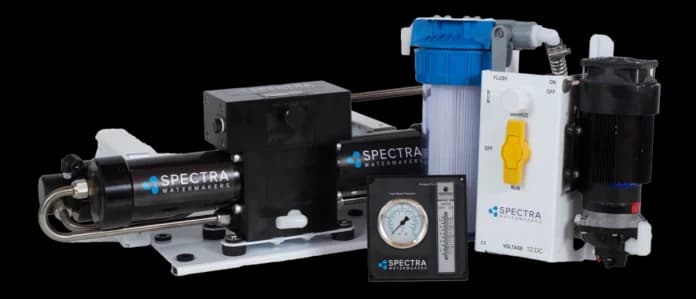
Fresh water is the one resource you can't negotiate with offshore, and how you make it aboard shapes everything from battery budgets to passage planning. Practical Sailor's latest head-to-head test, published March 10, 2026, digs into the real-world performance of DC watermaker units running on 12-volt power, putting models like the Spectra Ventura 200T and the Racor/Village Marine Tec Little Wonder (LWM-145) through a rigorous evaluation. The results give cruisers and liveaboards a data-backed framework for one of the most consequential gear decisions you'll make for an offshore-capable boat.
Why 12-Volt Watermakers Deserve Serious Scrutiny
The appeal of a DC watermaker is straightforward: it runs directly off your house bank, integrates cleanly with solar or wind charging systems, and eliminates the need to run a generator every time you need potable water. But not all 12-volt units are built equally, and the gap between a well-engineered watermaker and a mediocre one shows up in three places almost immediately: how much water it actually produces versus what the spec sheet claims, how loud it is in a confined cabin environment, and how hard it hammers your battery bank per gallon produced. Practical Sailor's testing methodology addresses all three of those variables directly, making this one of the more actionable watermaker evaluations available to the DIY sailing community.
The Contenders: Spectra Ventura 200T and the Little Wonder LWM-145
The Spectra Ventura 200T is one of the better-known names in the 12-volt watermaker space. Spectra has built its reputation on Clark Pump energy recovery technology, which recaptures hydraulic energy from the high-pressure brine discharge and feeds it back into the system. That architecture is specifically designed to reduce amp-hour consumption per gallon, which is the number that matters most when you're trying to balance watermaker use against solar input on a passage. The Ventura 200T targets the mid-size cruising boat market and is frequently recommended as a complete, installable system.
The Racor/Village Marine Tec Little Wonder LWM-145 comes from a different lineage. Village Marine Tec has deep roots in military and commercial watermaker production, and the Little Wonder represents their translation of that engineering heritage into a recreational marine package. The LWM-145 designation points to a unit designed to produce in the range of 145 gallons per day under rated conditions, which puts it in direct competition with the Spectra for passage-making use cases. Racor's involvement in the product brings filtration credibility to the pre-treatment side of the system, which matters significantly for membrane longevity and consistent output quality.
What the Test Evaluates
Practical Sailor's evaluation framework covers four core areas, each of which maps directly to how a cruiser actually lives with a watermaker over time.
Performance is the first and most obvious metric. Rated output numbers from manufacturers are typically measured under ideal conditions, including specific water temperatures and salinity levels. Real-world testing in variable conditions frequently reveals a gap between claimed and actual production rates. Understanding how much water a unit genuinely makes per hour under realistic conditions is essential for passage planning and provisioning decisions.
Construction quality determines whether a system survives the marine environment over the long haul. Watermakers live in wet, salt-laden spaces, often in engine rooms or under settees where airflow is limited and exposure to spray is possible. The quality of fittings, the grade of materials used in the high-pressure plumbing, the robustness of the membrane housing, and the thoughtfulness of the overall assembly all factor into whether a system is a five-year investment or a ten-year one.
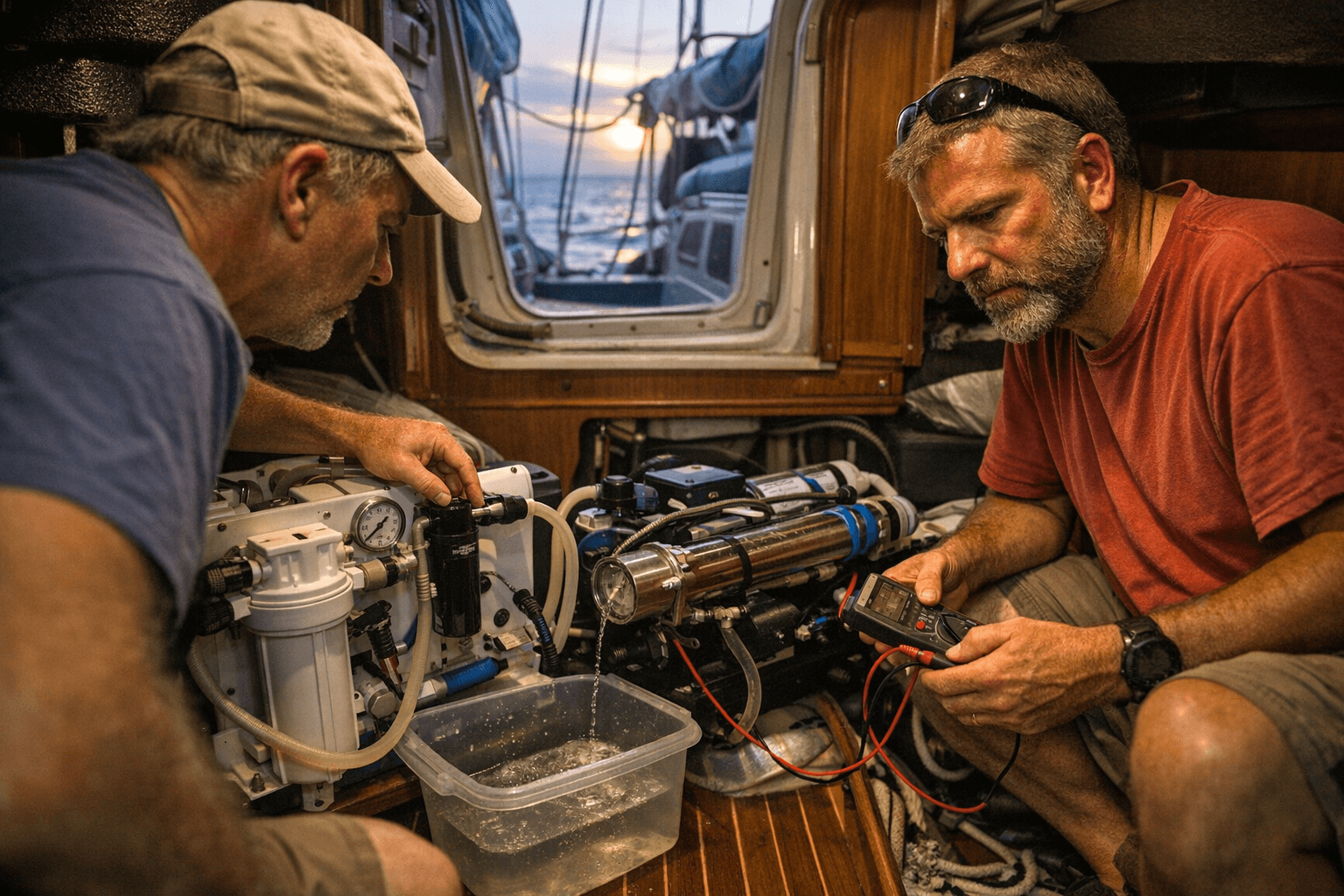
Noise testing is where cruisers who haven't owned a watermaker sometimes get surprised. High-pressure pumps generate significant mechanical noise, and in a 35- to 45-foot boat, that sound travels. The difference between a unit that lets you run water during a quiet anchorage evening and one that sounds like a jackhammer in the bilge is a genuine quality-of-life distinction. Practical Sailor's inclusion of noise as a formal test category reflects how seriously the cruising community takes this factor.
Power consumption, measured in amp-hours per gallon, is arguably the most technically important metric for sailors operating on solar or wind power without a generator. A unit that draws 8 amps per gallon is a fundamentally different proposition than one drawing 12 or 14 amps per gallon when you're trying to run it midday off a 400-watt solar array. This number, more than rated output, determines whether a watermaker fits your boat's energy ecosystem.
Installing and Living With a 12-Volt System
For those considering a DIY installation, the test results from Practical Sailor feed directly into several practical decisions. Wiring gauge and run length matter enormously with 12-volt systems because voltage drop under load can degrade pump performance and stress motor windings over time. Both the Spectra Ventura 200T and the Little Wonder LWM-145 are complete system packages, but the installation environment you create around them, including vibration isolation, pre-filter accessibility, and flush water routing, will affect how closely your real-world results match what Practical Sailor measured in testing.
Pre-treatment filtration deserves particular attention. Both units rely on multi-stage pre-filtration to protect the reverse osmosis membrane from particulates and biological matter. Keeping that filter stack maintained on a regular schedule is the single most important maintenance habit for preserving membrane life and sustaining rated output. A partially clogged pre-filter is one of the most common reasons a watermaker underperforms against its spec sheet numbers.
Flushing protocols matter just as much as filtration. When a watermaker sits unused for more than a few days, the membrane needs to be either preserved with a biocide solution or flushed with fresh water on a regular cycle to prevent biological fouling. Both the Spectra and Village Marine Tec systems have established flushing procedures, and understanding those procedures before installation, rather than after your first fouling event, pays dividends.
Putting the Data to Work
Practical Sailor's testing provides the kind of side-by-side data that's genuinely hard to replicate on your own. You're unlikely to run a calibrated noise test in decibels on your own boat, and measuring true amp-hour consumption per gallon requires precision metering under consistent load conditions. What the test gives you is a comparative baseline: how these two well-regarded 12-volt systems stack up against each other across the metrics that define daily life aboard a cruising boat.
For anyone in the middle of a refit or building out systems on a new-to-them passage maker, watermaker selection sits near the top of the decision list precisely because it touches so many other systems: battery bank sizing, solar array capacity, tank volume, and fresh water usage habits. The Practical Sailor evaluation of the Spectra Ventura 200T and the Racor/Village Marine Tec Little Wonder LWM-145 gives that decision the empirical grounding it deserves.
This article was produced by Prism’s automated news system from verified source data, official records, and press releases, then run through automated quality and moderation checks before publishing. The system is built and supervised by the people who set the standards it runs under. Read our full AI policy.
Did this article answer your question?