Proper fogging helps sailboat outboards start cleanly after storage
A proper fogging routine turns a forgotten outboard into a dependable spring starter, instead of a dead weight at the dinghy dock.
The dockside failure usually starts months earlier
The outboard that refuses to light off at the dinghy dock is rarely “suddenly” bad. More often, it was put away dry, dirty, or half-prepared after a season of easy duty, then expected to wake up months later like nothing happened. Perry Olds’ point in Good Old Boat is the one that matters to every sailboat owner who uses an outboard only intermittently: lightly used motors still need deliberate storage care if you want them to start cleanly after layup.
That matters even more on sailboats, where the outboard often lives a soft life until it doesn’t. Small auxiliary motors may only run into and out of slips, while dinghy motors can take harder abuse hauling people, provisions, and fuel between shore and the mothership. The difference between a dependable spring start and a humiliating no-start is often a controlled pre-storage run and a real fogging routine, not wishful thinking.
Start with the low-cost jobs that prevent the expensive ones
The highest-value maintenance is the boring stuff that keeps water, fuel, and corrosion from winning the winter. BoatUS says off-season storage should include fuel conditioner, grease, gearbox lubricant, and storage fogging oil. Mercury Marine makes the same basic point in plainer language: proper winterization helps ensure reliable spring performance and can help avoid costly repairs.
That expensive failure usually comes from water left where it should not be. BoatUS warns that if water is inside the engine or gear case when temperatures drop below freezing, the result can be a cracked block or housing, with repairs that run into the thousands. That is why layup prep is not a cosmetic ritual. It is damage control.
For most sailors, the practical checklist starts here:
- Stabilize the fuel before storage
- Warm the engine before fogging
- Grease the fittings that need it
- Change gearbox lubricant as part of off-season service
- Use storage fogging oil on the internals
Those steps are cheap compared with a spring rebuild, and they are the ones most likely to keep the motor from giving you that dead, reluctant crank when the tide is falling.
Fogging is the heart of the job, not an optional extra
Fogging is not just spraying mysterious oil around the cowling and hoping for the best. Discover Boating describes fogging as coating the internal components of the motor with a specialized, thick aerosol oil. The point is simple: you want a protective film on the parts that would otherwise sit exposed while the engine rests.
The sequence matters. Discover Boating recommends stabilizing the fuel first and warming the engine before fogging. That lines up with the logic in Olds’ piece: run the motor under controlled conditions, confirm it is cooling properly, then protect the internals while everything is still alive and running as it should.
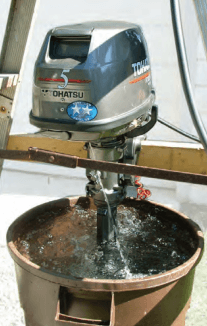
On Olds’ garage-friendly setup, the motor hangs prop shaft down from a makeshift stand built with a stepladder, a 2 x 4, clamps, and a garbage can. The water intake is submerged in the can, the fuel tank sits above, and the hose runs down to the motor. That arrangement lets him prime the system, confirm the fuel bulb is oriented correctly, and check for a steady telltale stream. That stream is the whole point of the test: it tells you the pump is doing its job before you commit to fogging.

Once the engine is warm, he briefly puts it in gear and sprays engine fogger into the air intake until the motor stalls. Then he removes the spark plug, fogs the cylinder directly, and turns the motor over several times so the internals get coated. He finishes by installing a new properly gapped plug. That is the kind of simple, disciplined maintenance that keeps an intermittent outboard from becoming a spring mystery.
Four-strokes need the right storage position, too
If you own a newer four-stroke, fogging is only part of the story. Tohatsu says four-stroke outboards should be transported in the normal running position or on a transom saver bar, which is a good reminder that oil and gravity do not always care about your convenience. Store or move the motor the wrong way and you risk putting oil where it does not belong.
Discover Boating also notes that four-stroke outboards generally need oil changes every 100 hours of operation or at least once a year. That gives you a simple benchmark for engines that may not see big hour counts but still age through the calendar. For sailboat auxiliaries, calendar-based service often matters more than raw hours, because the motor can sit long enough for fuel and oil problems to develop quietly.
Fuel matters too. Discover Boating says current gasoline marine engines are designed for fuel with no more than 10 percent ethanol, or E10. If your fuel is older than you think, stale gasoline can be just as much of a spring-start problem as a dry cylinder. Stabilize it, use it up, and do not assume the tank is fine because the engine ran once last season.
Know what you can do yourself and where to stop
The best DIY wins are the ones that are visible, repeatable, and easy to verify. Warming the engine, checking for cooling water, fogging the intake, fogging the cylinder, changing the spark plug, and servicing fuel with conditioner are all straightforward if you follow the manual and stay organized. So are gearbox lubricant checks and routine grease points.
The jobs that push you toward professional service are the ones tied to unknown history, model-specific procedures, or signs that something is already off. If the telltale stream is weak or absent during your pre-storage run, stop and get the cooling system checked before you fog anything. If you are not sure the correct storage orientation applies to your exact four-stroke, or the manual calls for special steps and supplies, have a dealer or marine mechanic handle it. Mercury Marine’s advice to check the owner’s manual for model-specific supplies and steps is the right attitude here.
That is also where Tohatsu’s broader warning lands with some force: the efficiency and longevity of an outboard depend heavily on proper operation and periodic maintenance. The hidden cost in skipping storage prep is not just a hard start. It is the slow damage that turns a simple spring tune-up into a parts hunt, a tow, or a bill that could have bought a lot of fuel.
The spring payoff is a motor that wakes up without drama
Olds’ article is really about discipline, not theatrics. A sailboat outboard does not need pampering, but it does need a controlled shutdown after the season so it can come back cleanly when you need it. That means fuel stabilized, engine warmed, internals fogged, plug refreshed, cooling flow confirmed, and the storage position respected on four-strokes.
If you get those pieces right, the motor that usually lives in the background will be ready when the harbor is busy, the dinghy dock is crowded, and you would very much prefer not to discover neglect in front of everyone else.
This article was produced by Prism’s automated news system from verified source data, official records, and press releases, then run through automated quality and moderation checks before publishing. The system is built and supervised by the people who set the standards it runs under. Read our full AI policy.
Know something we missed? Have a correction or additional information?
Submit a Tip