Refitting a Stevens 47 saloon table with patina copper and epoxy
A tired almond Formica table becomes a smart refit lesson: save the teak, use copper where laminate failed, and let epoxy level the rest.
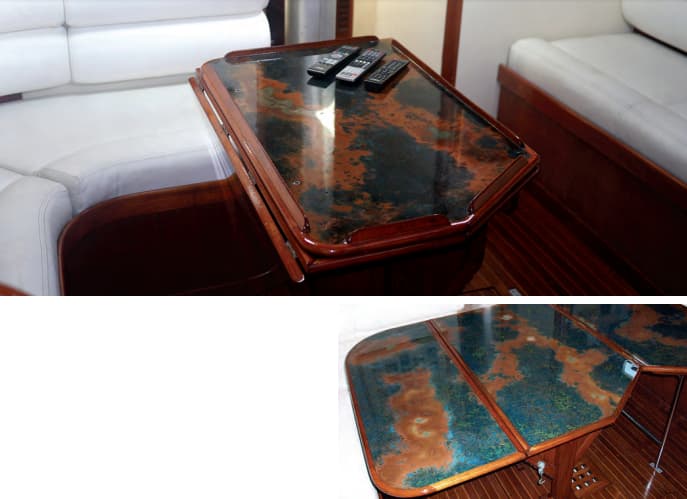
Preserve the bones before you chase the shine
The first move on Jammin was not to order a prettier top. It was to lift a corner of the old Formica, break the bond of tired contact cement, and figure out what still deserved to stay. That is the right way to approach an older cruiser: keep the structure that gives the boat its character, rebuild the weak spots, and only then choose a finish that earns its place.
Jammin is a 1981 Stevens 47, and the saloon table is exactly the kind of piece that forces that decision. It is an elegant three-leaf affair with four surfaces, two of them hidden when the table is folded up. The whole assembly is teak except for the tops, which were plywood skinned in almond Formica with teak trim. That once looked sharp and practical, but after roughly two decades it had aged into a refit problem, not just a cosmetic one.
What was worth keeping
The smart part of this project is what Scott St. Clair did not tear out. The teak structure and trim were still the useful part of the table, and on a boat like this, that matters. A Stevens 47 is not a mass-market weekend cruiser. It is a Sparkman & Stephens-designed fiberglass cutter built by Queen Long Marine in Taiwan, with references putting it at about 46.83 feet LOA, 14.25 feet of beam, and roughly 32,000 pounds of displacement. About 56 were built, and the molds later went on to produce the Hylas 47 and later the Hylas 49.
That rarity changes the refit math. On a boat built in that limited number, original interior details are not disposable filler. They are part of the boat’s identity, especially on a design that was marketed as a serious passagemaker with a solid-fiberglass hull, a balsa-cored deck, and a reputation for a relatively smooth, stiff motion offshore. If the teak is sound, keep it. If the fiddles are still doing their job, repair them. If the surface is the weak link, replace only the surface.
Why the old laminate had to go
Almond Formica was once the answer because it looked modern, cleaned easily, and held up better than many alternatives of the era. Before Corian came along, it was the kind of material people expected to see in a well-finished interior. DuPont says Corian was introduced in 1967 as a higher-performance alternative to conventional surfacing materials, and that gives you a useful marker for how dated the original table finish had become.
The point is not that Formica was bad. The point is that it had done its job and worn out in a very specific way. On an older cruiser, that is often the real decision point. You are not choosing between "old" and "new." You are choosing between a surface that has already given up and a frame, trim package, and joinery that still have years left in them.
The teardown was careful, not dramatic
St. Clair did the sort of teardown that saves money because it avoids unnecessary destruction. He started by carefully lifting a corner of the Formica and using lacquer thinner to weaken the contact cement before prying it away. That is the kind of boring detail that separates a clean refit from a day spent repairing avoidable damage.
He also pried off teak fiddles that were only pinned and varnished in place, which is another reminder that not every part of an old interior is permanently bonded. One fiddly piece cracked, but instead of replacing the whole assembly he repaired it with thickened epoxy. That is the budget move worth copying: if a part is repairable, repair it. Replacing the whole thing is expensive, often unnecessary, and usually less faithful to the boat.
Why copper beat veneer
Before settling on copper, he considered a teak veneer and even an inlaid compass rose. Both ideas had the right spirit, but thickness differences made them awkward. That is the hidden trap in a lot of interior refits. A surface material can look right in isolation and still fail the moment you try to fit it into an existing piece of joinery.
Patina copper solved that problem because it was not just decorative. It gave the table a distinctive new face and helped bridge the thickness gap between the old Formica and the new copper sheet. The chosen finish included an azul tone that matched the boat’s topsides, which makes the result feel thought-through rather than trendy. It is a good example of modernizing a saloon without erasing the boat underneath it.
The epoxy is doing real work here
The bar-top epoxy was not a gimmick. Modern tabletop epoxy products are marketed as self-leveling, UV-resistant, and suitable for bar tops, counters, and tables, which is exactly the kind of duty cycle a saloon table sees. On a marine interior surface, that means you are not just chasing shine. You are buying leveling, protection, and day-to-day survivability in a single pour.
That matters because the copper skin and the epoxy are doing two jobs at once. They create the finished look, and they turn an awkward thickness transition into a usable build-up. For anyone refitting an older boat on a budget, that is the right lesson: the best material is often the one that solves the most problems at once.
A practical checklist for your own saloon table
If you are standing in front of an old cruiser interior and trying not to blow the budget, use Jammin’s table as the template:
- Preserve the teak structure, fiddles, and trim if they are still sound.
- Remove laminate carefully, and use solvent to help break down old contact cement before prying.
- Repair cracked, pinned pieces with thickened epoxy instead of replacing whole assemblies when the damage is local.
- Measure thickness changes before choosing a new surface, because veneer, inlays, and metal sheet all behave differently.
- Pick a finish that fits the boat’s lines and colors, not just a catalog trend.
- Use a topcoat that is meant to live with spills, sunlight, and daily use, not just to look glossy in the yard.
That is the real triage story here. The table on Jammin did not need to become something else. It needed to stop pretending the old laminate was still the right answer, while keeping the teak foundation that made the piece worth saving in the first place.
The moment you lift that corner of tired laminate and smell the lacquer thinner, the temptation is to think the whole table is coming apart. On Jammin, that was the exact point where the refit got smarter: save the teak, repair the crack, and let copper and epoxy carry the modern load without sanding away the boat’s original strength.
This article was produced by Prism’s automated news system from verified source data, official records, and press releases, then run through automated quality and moderation checks before publishing. The system is built and supervised by the people who set the standards it runs under. Read our full AI policy.
Did this article answer your question?