Sailboat Refit Upgrades House Bank to Lithium, Redesigns Charging System
A tired 2014 gel house bank became a lithium refit that forced a new charging architecture, not just new batteries.
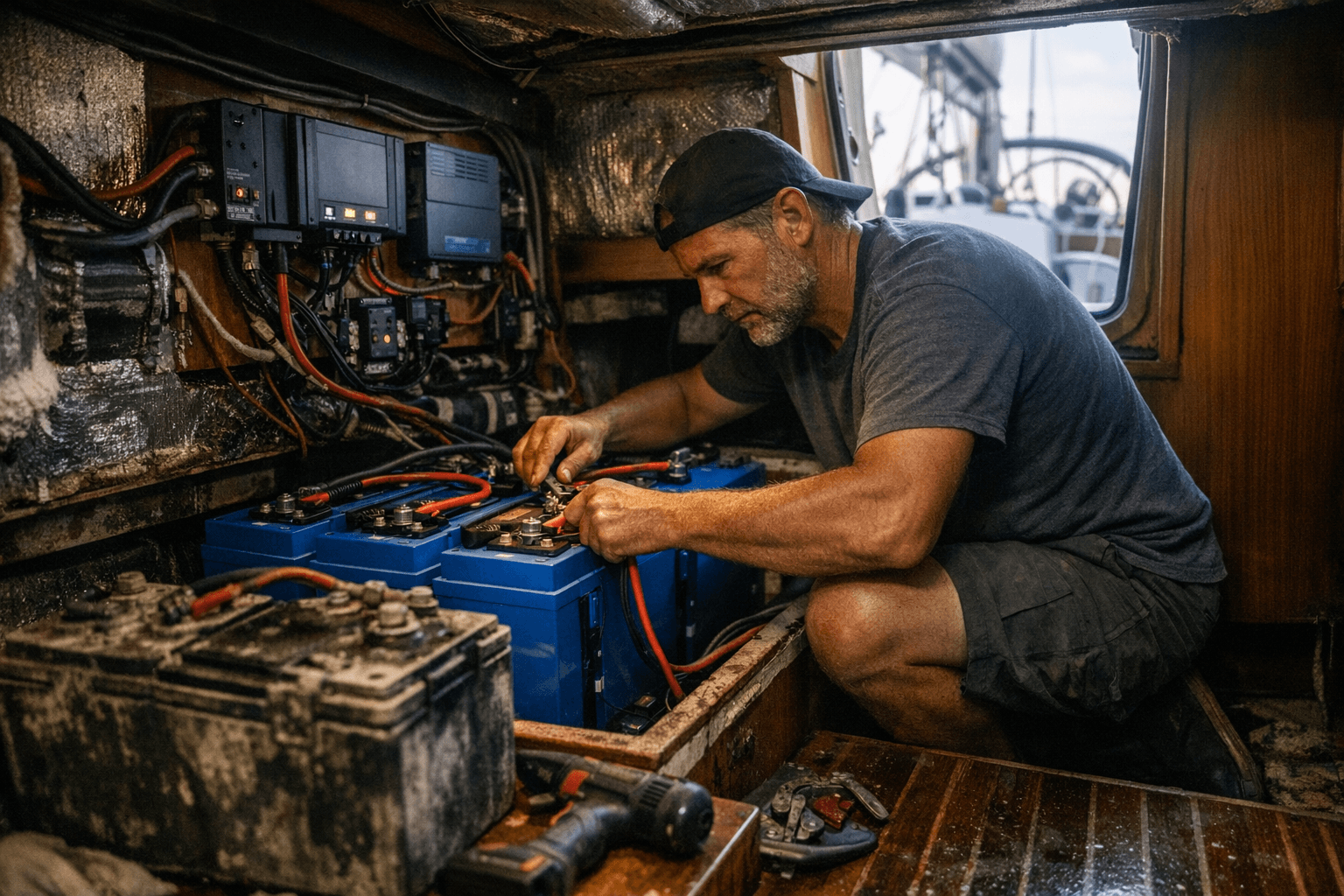
The tempting part of a battery upgrade is the chemistry. The real work is everything the chemistry forces you to rethink. In this sailboat refit, a house bank that had been aboard since March 2014 was finally giving up the ghost, and that wear turned into a full redesign of charging, isolation, and cabling rather than a simple swap.
Why the old bank had to be more than just replaced
The existing Deka Solar 8GGC2 gel batteries were 6-volt, 180Ah deep-cycle units made by East Penn Manufacturing and distributed by MK Battery. The boat’s 360Ah house-bank figure points to a two-battery 6-volt setup, and after more than a decade of service, the owners describe the bank as simply tired. That matters because tired batteries are rarely the only problem in an aging cruising electrical system. By the time a bank starts fading, the charger, selector switches, cable sizing, and charging logic have usually aged with it.
The owners are not throwing out every lead-acid battery on board. The engine bank stays on newer Deka Solar gel batteries, which keeps starting power on a familiar, reliable chemistry while the house side gets the more ambitious upgrade. That split is the first clue that this is a systems decision, not a battery shopping decision.
Lithium changes the job description of the electrical system
The house bank jumps from 360Ah to 460Ah with the move to LiFePO4, but the bigger change is usable capacity and how the boat will draw and recover energy day after day. On a cruising boat, that means refrigeration, lights, water systems, electronics, and all the loads that make modern life afloat easier to live with. A lithium house bank can support that better, but it also demands a charging strategy that is much less forgiving of old shortcuts.
That is why the old combined OFF-1-BOTH-2 thinking gets replaced. When the house and engine banks are assigned different jobs, the system needs to treat them differently, and combining them casually can create exactly the kind of cross-feeding and confusion that leads to failures at the worst possible time. The cleanest refits separate the functions first and only then decide how energy should move between them.
The charger swap is really a charging-architecture swap
The old ferrite charger is coming out, and that is the kind of detail that tells you the project is deep, not cosmetic. In its place, the boat gets a Victron dual-purpose inverter/charger, a choice that fits the refit’s larger goal of building a more integrated onboard power system. Victron’s inverter/chargers are aimed at marine and off-grid use, which makes sense here because the boat needs gear that can live in a real cruising electrical environment, not just on a bench in a workshop.
Once lithium enters the picture, alternator protection stops being optional. Victron’s charging guidance notes that controlled charging can protect alternators in lithium systems by preventing alternator and battery overload, and Victron also offers Smart BMS and DC-DC charging solutions for 12V alternator-to-lithium integration. In plain boat terms, the alternator still has to do the work, but it needs guardrails so the new house bank does not push the charging system beyond what it can safely deliver.
The components that most often become the danger points
This refit shows the usual suspects. Old chargers, bank-combining switches, and undersized cabling are the parts that quietly turn a straightforward upgrade into a safety problem. The old selector arrangement encouraged a single system to do too many jobs, while the new layout separates the house and engine banks so each has a clear role and a clearer charging path.
The cabling upgrade to 4/0 is just as important as the battery chemistry. If the system is going to support the potential capacity of the lithium house bank, the conductors have to match that ambition. Otherwise, the boat ends up with a modern battery sitting behind old wiring, and that is how DIY refits create new weak points while trying to remove the old ones.
How to sequence a refit so you do not create new faults
The smartest order is to design the system first, then install the parts around that design. A refit like this works best when the bank roles are defined before the new batteries go in, the charging gear is replaced before it is asked to manage lithium, and the alternator path is protected before the boat returns to service.
1. Separate the house bank and engine bank functions.
2. Replace the aging charger and build around the new charging plan.
3. Add lithium-aware control, such as a BMS or DC-DC strategy, for alternator charging.
4. Upgrade the wiring, including the 4/0 cabling, so the conductors fit the new load.
5. Verify that the engine bank still does starter duty without being dragged into the house-load side of the system.
That sequence matters because every step affects the next one. If the batteries go in before the charging logic is sorted out, the refit can create new faults faster than it solves the old ones.
Why this refit feels like the future of cruising power
The larger lesson is that lithium retrofits are now mainstream enough to demand standards, not improvisation. The American Boat & Yacht Council has established ABYC E-13 for lithium battery installations, which reflects how seriously the boating world now treats battery chemistry, installation, and maintenance. That standard-setting matters because the hard part of lithium is not the battery itself. It is the discipline required to integrate it safely with alternators, chargers, switches, and conductors that were designed for a different era.
This refit gets that right. It does not pretend that a house-bank upgrade is just a matter of swapping boxes. It treats the boat’s electrical backbone as a system that has to be redesigned around how the boat actually lives, charges, and starts. That is the kind of upgrade that keeps paying off long after the new batteries are bolted down.
This article was produced by Prism’s automated news system from verified source data, official records, and press releases, then run through automated quality and moderation checks before publishing. The system is built and supervised by the people who set the standards it runs under. Read our full AI policy.
Did this article answer your question?