Small Outboard Maintenance Checklist Covers Every Trip to Annual Tasks
Skip one gear-oil check and milky fluid tells the whole story: water got in. SeaSierra's tiered outboard checklist closes every gap before the season does.
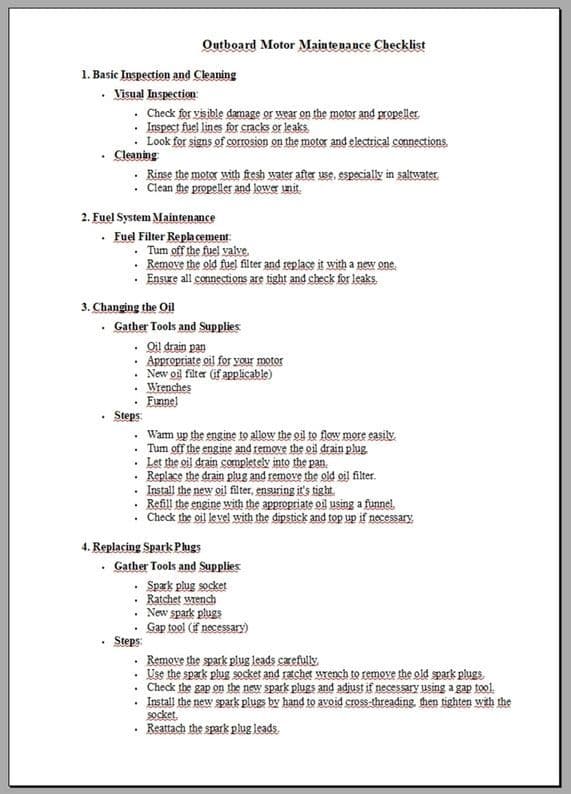
A neglected outboard doesn't fail loudly. It fails quietly, one skipped check at a time, until the morning you need it most. SeaSierra's illustrated "Monthly Outboard Maintenance Checklist" is built around exactly that reality: small, consistent actions performed on a clear schedule are what keep a tender or small sailing vessel's engine running through the season and into the next. Organized into every-trip, monthly, quarterly, and annual tiers, the checklist is designed to be printed, laminated, and kept in the bilge locker or toolbox so that good habits don't depend on memory.
Before You Leave the Dock
Every departure starts with a visual sweep, and this one has a specific sequence. Check for fluid leaks around the cowling and lower unit, inspect the propeller for nicks, dings, or anything wrapped around the shaft, and confirm the kill-switch lanyard is clipped and functional. Navigation lights and battery connections get the same pre-launch attention: corroded terminals are one of the most common sources of ignition failure, and they're also one of the easiest things to catch before they strand you.
Once the engine is running, watch the telltale. That steady stream of water from the cooling-water indicator is your real-time confirmation that the raw-water pump is moving water through the system. No telltale flow means no cooling, and an unattended overheat can score cylinder walls before the temperature gauge has time to climb. Unusual vibration at the helm is another running check worth building into every departure: prop imbalance and shaft deflection both show up as vibration, and catching either early costs far less than ignoring it.
After Every Trip: Flush, Dry, Disconnect
Saltwater use makes post-trip flushing non-negotiable. Running fresh water through the cooling system for the manufacturer-recommended flush cycle pushes salt and debris out before it can accumulate in cooling passages or attack aluminum surfaces. Wipe down the exterior while the engine is still accessible; salt that dries on cowlings and clamps attacks fasteners over a season faster than most owners expect.
For any period of extended storage, even a week between trips in a corrosive environment, disconnect the battery. This isn't just about preventing parasitic draw; it's about removing one more source of potential ignition risk and giving the battery a defined rest cycle that supports its long-term health.
Monthly Tasks: The 20-to-30-Hour Window
The monthly cadence, or every 20 to 30 hours of running time, is where most mechanical problems are caught before they escalate. Spark plugs are the starting point: pull them, read the color and condition of the electrode, and replace on the criteria specified in your engine manual rather than on a fixed calendar. A fouled plug is a symptom; replace it, but also look for what fouled it.
Fuel lines deserve the same attention. Cracked hoses and a soft or collapsing primer bulb are early-stage fuel delivery problems that become hard starting, rough running, or fuel leaks if ignored. Squeeze the bulb, flex the line, and look for any surface checking along the hose length. Fuel system deterioration is progressive; ethanol-blended fuels accelerate the degradation of older rubber components, so lines that looked serviceable last season may not be this one.
Gear oil gets topped up at this interval too, not just at the annual service. Check the level through the lower-unit fill and drain plugs using the manufacturer's procedure, and pay close attention to the oil's appearance. Clean gear oil is translucent and amber-colored. Milky or white oil means water has entered through a seal, and that's not a condition to monitor; it's a condition to act on.

Two more monthly tasks round out the service interval: grease the tilt-tube and any zerk fittings on the steering or tilt mechanism, and apply corrosion inhibitor to electrical connections. Both are low-cost steps that prevent the kind of seized hardware and corroded connectors that turn routine maintenance into a multi-hour repair.
Lower-Unit Inspection: Reading the Oil
The lower unit contains the gear set that transfers power from the driveshaft to the propeller, and its condition is readable through the oil. Checking gear oil level is a two-plug operation: remove the vent plug first, then the fill plug at the base, and use a syringe or squeeze bottle to bring the level up to the vent-plug port. The procedure keeps air from getting trapped and gives you a clean read on how much oil the unit is consuming, which in itself is diagnostic information.
Milky oil is the finding that changes the service calculus entirely. Water intrusion through a worn prop-shaft seal or input-shaft seal means the gears are running in an emulsion instead of lubricant, and every hour of operation accelerates wear. The appropriate response is immediate haulout and seal replacement by a qualified marine mechanic, not a top-up and a hope. Catching milky oil at a monthly check is the difference between a seal job and a gear-set replacement.
When to Call a Professional
The checklist draws a clear line between owner-level maintenance and work that requires a shop. Evidence of water in the gear oil is the clearest signal: the seal replacement that follows is a precision job requiring special tools and torque specifications most owners don't have on hand. Ignition failures that persist after fresh plugs, clean connections, and confirmed fuel delivery suggest an electrical or timing fault that warrants a proper diagnostic. Internal overheating that continues after a confirmed clean telltale and fresh coolant flush points to a water pump impeller or thermostat failure, jobs that are straightforward for a mechanic and expensive to defer.
The broader principle is that the checklist is designed to handle everything that should be handled by the owner, and to identify clearly when the threshold has been crossed. That clarity is as valuable as the maintenance itself.
Annual Service and Seasonal Commissioning
Annual tasks complete the maintenance pyramid. A full impeller replacement on a seasonal schedule is standard practice regardless of apparent condition; impeller blades develop compression set over time and can fail without visible warning. Complete lower-unit oil changes, zincs, and a thorough inspection of all external fasteners for corrosion round out the once-a-year work. For owners doing seasonal commissioning, running through the checklist tier by tier before the first departure of the year functions as a full system audit.
The laminated checklist format is purpose-built for this kind of disciplined routine. Kept in the toolbox or tucked into the bilge-locker door, it removes the friction from consistency; the question isn't whether you remember to check the telltale or inspect the fuel line, it's simply a matter of working through the list. That kind of structured habit is what separates an outboard that runs reliably for fifteen years from one that becomes a liability after five.
This article was produced by Prism’s automated news system from verified source data, official records, and press releases, then run through automated quality and moderation checks before publishing. The system is built and supervised by the people who set the standards it runs under. Read our full AI policy.
Did this article answer your question?


