Top EPIRBs, PLBs, and AIS Rescue Beacons for DIY Sailors in 2026
One critical gap in most sailors' safety kits could cost them their life: EPIRBs alone won't save you in a man-overboard emergency.
Picking the wrong distress beacon isn't just a gear mistake — it's the kind of oversight that leaves rescuers working with incomplete data while you're drifting in open water. The three device categories covered here — EPIRBs, PLBs, and Personal AIS Beacons (PABs) — each serve a distinct role, and understanding those roles is as important as the hardware itself. As Ocean Signal Managing Director James Hewitt put it: "Most required safety gear, like marine flares, is essential, but this mandated marine safety equipment is mainly to enable leisure vessels to let nearby boats know you need help. The products are not designed to alert others far away that you are in an emergency. What boaters really need is technology that can quickly and easily alert search and rescue agencies around the world that they are in an emergency situation and need immediate help."
EPIRBs transmit on 406 MHz via the Cospas-Sarsat satellite network and are required to float and include a strobe light. PLBs work on the same frequency and network but are designed to be worn or stowed in a lifejacket — and, crucially, are not required to float. PABs skip the satellite relay entirely and instead broadcast GPS-position alerts over AIS and VHF directly to nearby vessels, making them the only category built for immediate crew-overboard response. Here are the seven top picks for 2026, plus notable alternatives worth knowing.
1. ACR GlobalFix V6 Category I EPIRB with Return Link Service and NFC (SKU: ACR-2853)
The flagship Category I model auto-deploys from its bracket when submerged and transmits on 406 MHz with Return Link Service confirmation and Near Field Communication for streamlined registration and testing. RLS tells the vessel that the distress signal has been received by the Cospas-Sarsat network — a critical feedback loop when every minute counts offshore. This is the unit for blue-water sailors and anyone running an offshore passage where automatic deployment is non-negotiable.
2. ACR GlobalFix V6 Category 2 EPIRB with Return Link Service and Mobile App (SKU: ACR-2854)
Not every boat needs an automatic release bracket, and the Category 2 version of the GlobalFix V6 is built around that reality. According to BOE Marine's buyer's guide: "It is a strong fit for owners who want a modern 406 MHz distress beacon with updated return-link style features in a more flexible manual package. We like it for coastal cruisers, passagemakers, and sportfishing crews who want offshore-grade safety without overcomplicating the install." The mobile app integration adds a practical layer for registration and pre-departure checks without hunting for paperwork.
3. ACR ResQLink AIS GPS Personal Locator Beacon PLB-450 with AIS and RLS (SKU: ACR-2933)
This PLB bridges the gap between traditional 406 MHz satellite alerting and AIS-based local response by incorporating both in a single wearable unit. The AIS component broadcasts your position to nearby vessels on VHF frequencies while RLS confirms the satellite uplink — two independent alert paths running simultaneously. For crew members who want maximum redundancy in a device that lives in a lifejacket pocket, the PLB-450 is a compelling 2026 pick.
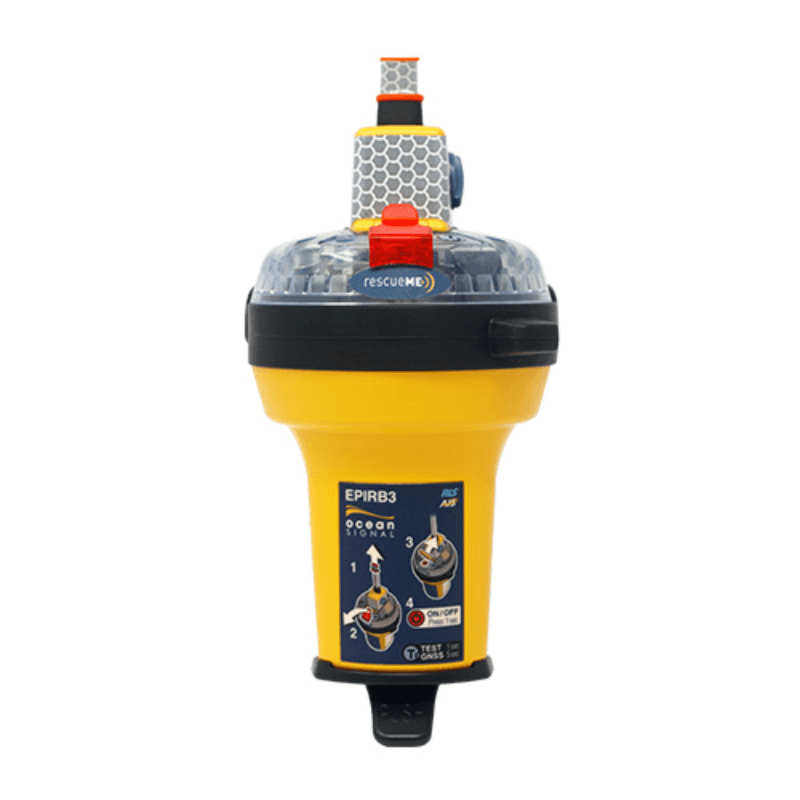
4. Ocean Signal SafeSea EPIRB3 Pro Category I
Ocean Signal markets the EPIRB3 line as "the world's most compact EPIRB," claiming a 30% reduction in size compared to other EPIRBs along with a 10-year battery life. The Category I designation means automatic hydrostatic release, and the AIS integration means it's alerting both satellite networks and any AIS-equipped vessel in the vicinity from the moment it activates. The size claim is a manufacturer statement and worth verifying against current vendor spec sheets, but the combination of compact form factor, decade-long battery, and AIS output makes this a strong contender for cruisers where locker space is always at a premium.
5. Ocean Signal rescueME EPIRB2 Pro Category I with RLS and NFC
Where the EPIRB3 Pro leads on size, the rescueME EPIRB2 Pro Category I adds Return Link Service and Near Field Communication to the standard Cat I automatic-release package. NFC simplifies on-boat registration and allows you to interact with the beacon using a compatible smartphone without removing it from its bracket — useful for confirming registration details before a long passage. RLS confirmation puts this on the same feedback-loop level as the ACR GlobalFix V6 Cat I.
6. Ocean Signal RescueME PLB1 Personal Locator Beacon with 7-Year Battery Storage Life
Ocean Signal calls the RescueME PLB1 "the world's smallest Personal Locator Beacon," and the 7-year battery storage life is the operational detail that makes it practical for crew kitting. Most cruising crews replace safety gear on maintenance cycles that stretch toward five years; a 7-year storage life means this PLB stays current through that window without a battery swap. Note that PLBs are not required to float or include strobes — if those features matter to your kit, look at the ACR ResQLink options below.
7. Ocean Signal rescueME MOB1 Personal AIS Beacon
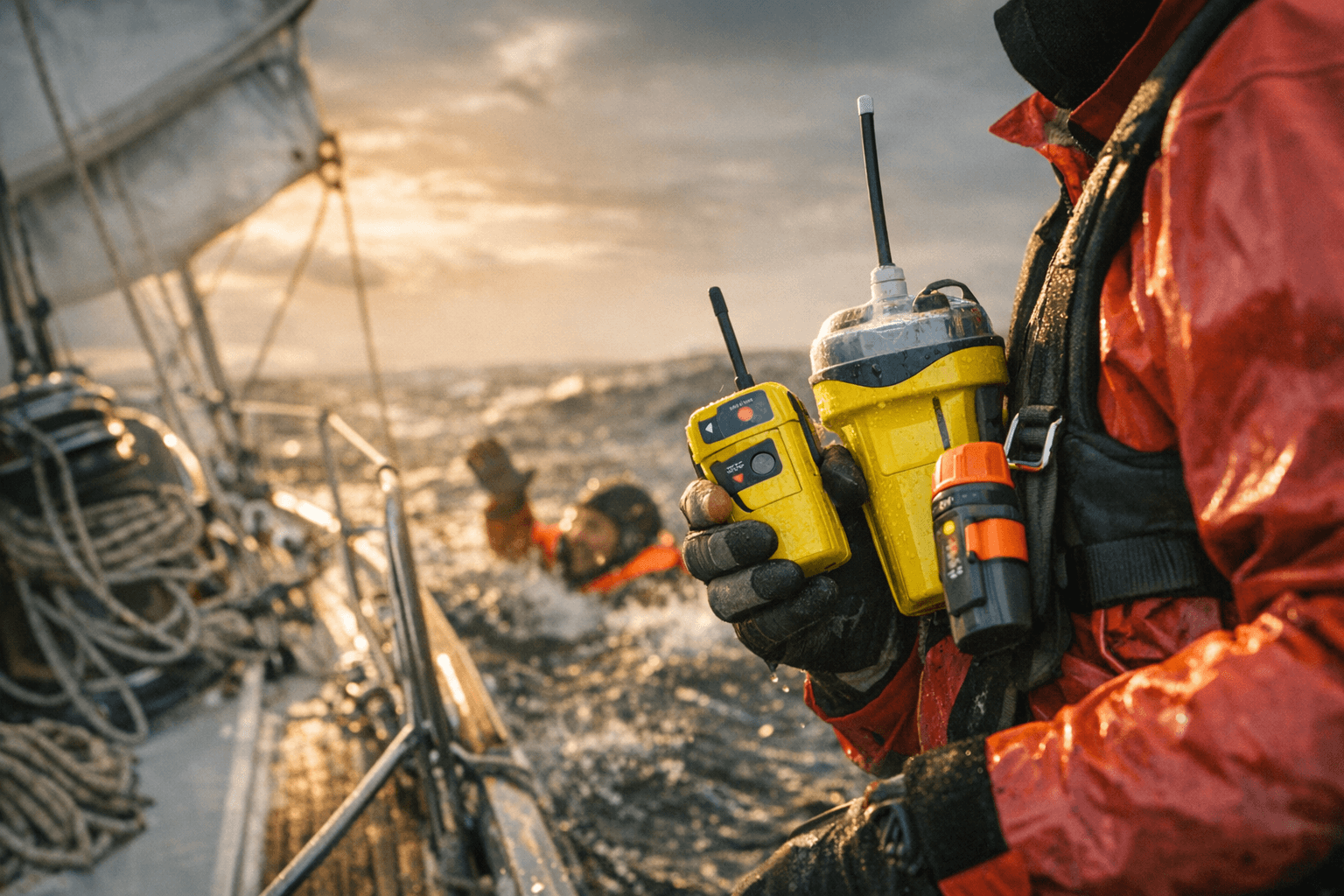
This is the one that fills the gap EPIRBs and PLBs cannot: immediate man-overboard response. The MOB1 is described as the smallest AIB MOB Device with an inbuilt DSC, compatible with inflatable lifejackets, and capable of sending signals to the vessel and other AIS-equipped ships operating within a range stated as 5 miles by MarineInsight and a "typical four-mile radius" by BOE Marine — a discrepancy worth checking against specific installation conditions and local vessel traffic. It automatically activates and fires a Digital Calling Alarm directly to the vessel's VHF, and it can be purchased with an automatic release frame that triggers when submerged. For any boat running offshore watches, this belongs clipped to every crew member's lifejacket alongside an EPIRB or PLB, not instead of one.
Notable alternatives worth comparing:
The McMurdo SmartFind EPIRB (model 23-001-001A) makes a strong case as a multi-signal unit: according to MarineInsight, it is "the only EPIRB that can send all three signals — a 406 MHz GPS signal, 121.5 MHz homing signal, and AIS signal over VHF radio frequencies." It weighs 2.68 pounds, runs on six lithium-ion batteries, delivers 48 hours of fully operational battery life, and carries a 10-year storage life span. The optional 406 Link subscription lets you send GPS test messages to contacts via text and email before departure. It meets all US and international standards per its manufacturer documentation.
The ACR ResQLink View (Model PLB 425, ACR 2922) stands out among PLBs for its built-in digital display, which shows self-test results, remaining battery power, operating instructions, transmission bursts, and your LAT/LON position in real time. Both the ResQLink View and the ResQLink 400 include buoyant designs and built-in conventional and infrared strobes — features that matter to SAR personnel working at night or in low visibility, and features that are not standard requirements for PLBs as a class.
Ocean Signal's PLB3, not yet fully detailed in available spec sheets, is positioned as "the first AIS enabled satellite PLB," combining satellite uplink with AIS alerting in a worn device. If that claim holds, it represents the same dual-path architecture as the ACR PLB-450 but from the Ocean Signal side of the market.
The Garmin InReach Mini (model 010-01879-00) rounds out the category as a satellite communicator rather than a dedicated distress beacon. At 4 inches tall, 2 inches wide, and 4.23 ounces, it uses the Iridium satellite network to send and receive text messages from anywhere with no cellular dependency. It is not a Cospas-Sarsat 406 MHz device, but for crews who want two-way communication capability layered on top of a dedicated EPIRB or PLB, it earns its place in the ditch bag.
The practical takeaway across all seven primary picks: no single device covers every scenario. An EPIRB or PLB handles the global satellite alert; a PAB like the MOB1 handles the first critical minutes of a crew-overboard situation when nearby vessels and your own AIS receiver are the fastest path to recovery. Building a layered kit from this 2026 list is a more defensible approach than picking one device and calling it done.
This article was produced by Prism’s automated news system from verified source data, official records, and press releases, then run through automated quality and moderation checks before publishing. The system is built and supervised by the people who set the standards it runs under. Read our full AI policy.
Did this article answer your question?