Top Marine Waxes for Fiberglass Hulls, Chosen for Spring DIY Protection
Wrong wax choice costs a full weekend of rework; the right polymer can hold water beading for a full season versus the weeks you get from straight carnauba.
Skip the wax aisle long enough and gelcoat will remind you exactly what it is: a thin, porous outer layer that sacrifices itself to UV, salt, and grit so the laminate underneath stays intact. When that layer goes chalky white from oxidation, you are not looking at a cosmetic problem anymore. You are watching the clock on structural vulnerability. Choosing the right wax this spring is not about shine; it is about how long your gelcoat stays sealed, and whether you are doing this again in six weeks or six months.
The real difference between wax and polymer: a number worth knowing
Here is the testable fact that should drive your product decision: pure carnauba-based waxes need reapplication every few weeks to a month under typical sun and salt exposure, because the wax sits on top of the gelcoat rather than bonding to it. Polymer sealants, by contrast, form a molecular bond with the surface and can hold active protection for months, sometimes through an entire season. That gap matters more than gloss depth for any boat kept in a slip or on a trailer in a sunny yard. Choosing a product based on how it looks on the shelf, rather than how long it actually beads water under UV load, is the single most common mistake in a spring refit.
Matching the product to the hull's actual condition
Not every hull needs the same treatment. Before you buy anything, look at the surface in direct sunlight at a low angle. Dull, flat patches that smear when you wipe with a damp cloth are oxidation; swirl marks and fine scratches are surface defects; a chalky film that comes off on your hand is heavy oxidation requiring compounding before any wax will bond correctly.
For hulls that are reasonably clean with only light oxidation and haze, the Meguiar's M5032 Marine/RV One Step Cleaner Wax handles the full job in a single pass. Its mildly abrasive formula cleans, polishes, and protects fiberglass gelcoat simultaneously, removing light oxidation, fine scratches, and swirl marks while depositing UV and salt-air protection. It works by hand, dual-action polisher, or rotary buffer, which makes it genuinely flexible for the boat owner who does not own a machine. This is the right product for a hull that wintered well and just needs a seasonal refresh before launch.
For moderate oxidation, staining, and surface defects that a cleaner wax will not fully resolve, the Meguiar's Marine/RV Fiberglass Restoration System (M4965) is the structured answer. The kit runs three dedicated steps: the M49 Heavy Duty Oxidation Remover addresses moderate oxidation and defects while enhancing gloss; the M45 High Gloss Polish uses rich polishing oils to rebuild brilliance and create a smooth substrate; and the included Pure Wax seals the corrected surface. Each bottle is 16 oz, and the system is designed to be worked section by section rather than rushed across the full hull. This is the correct product for a boat that spent a full season in a slip without being touched, or one that has never had a proper restoration.
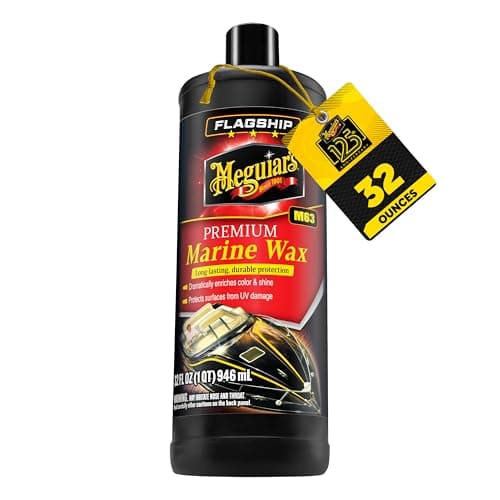
For a hull that has already been cleaned and corrected to a near-new finish, the Meguiar's Flagship Premium Marine Wax steps in as the top-coat protectant. It comes in a 32 oz liquid format (M6332) and a 16 oz paste (M6316), both delivering long-lasting polymer protection and deep gloss over fiberglass and gelcoat. The polymer blend handles light oxidation and fine scratches while adding durable UV resistance, and it is designed specifically to follow a compounding job rather than substitute for one.
The 3M Perfect-It Boat Wax (36113) occupies a distinct position in the lineup. Its formula combines pure Brazilian carnauba wax with silicones, polymers, and resins, giving it the warm, deep gloss associated with carnauba alongside the durability boost of synthetic components. It applies easily from the bottle even on warm surfaces and is safe across gelcoat, topside paint, fiberglass, and metal, which makes it a good choice for owners who want a single finish product that covers the full hull and deck. The carnauba component does mean more frequent reapplication than a pure polymer sealant; for high-UV or high-spray environments like saltwater slips or trailering on coastal highways, stepping up to a polymer-dominant product will reduce the maintenance frequency significantly.
Buy or skip: a quick reference
- Buy M5032 One Step Cleaner Wax if your hull has light oxidation and you want a one-day job by hand or machine.
- Buy M4965 Restoration System if you see moderate oxidation, staining, or scratches and cannot bring the surface up with a cleaner wax alone.
- Buy Flagship M6332/M6316 as your top-coat wax after compounding; do not waste it on an unprepped, oxidized surface.
- Buy 3M Perfect-It 36113 for a warm carnauba-blend gloss finish on hulls in good condition; factor in more frequent reapplication in high-UV environments.
- Skip any straight wax as your only product on a boat that lives in a saltwater slip year-round; add a dedicated polymer sealant over the wax stage, or go straight to a polymer-dominant product.
Application checklist: the failures that happen before the wax goes on
The research behind this guide consistently points to pre-application errors as the source of most rework. Work through this list before opening a single bottle:
1. Work in shade, not direct sun. Heat causes flash curing: the wax skins over before it bonds properly, producing streaks that require full removal and restart. A garage bay, a covered slip, or the shadow of the boat on its trailer are all adequate.
2. Wash and clay the surface first. Wax applied over embedded grit or salt residue traps contamination and reduces bonding. A thorough wash followed by a clay bar pass on neglected surfaces takes less time than stripping a botched wax job.
3. Work in small sections. Applying product across large areas before buffing is the other main cause of streaking. A two-foot-by-two-foot section discipline keeps cure time consistent.
4. Use a clean, dedicated applicator. A foam pad that has seen compound, polish, and wax in sequence, without being cleaned between stages, transfers abrasive residue back into your wax layer.
5. Respect cure time. Each product specifies the haze-to-buff window. Buffing early removes product rather than bonding it; buffing late on a hot day produces hard residue that requires aggressive removal.
6. Check for compatibility with previous products. Some silicone-heavy finishes create adhesion problems for waxes applied on top. If the hull has received a spray sealant or ceramic coating in the last year, verify compatibility before layering a new wax over it.
Planning your spring timeline
For a one-day effort: the M5032 One Step Cleaner Wax is the product. Budget four to six hours on a mid-size boat and treat it as a maintenance pass, not a restoration.
For a two-to-three-day refit: the M4965 Restoration System handles day one (oxidation removal) and day two (polish and pure wax seal). If you want added durability, follow the kit's pure wax with a dedicated polymer sealant on day three. This staged approach spreads the labor, lets each step cure fully, and delivers a surface that will hold up through an active season.
The economics here favor spending more upfront on durable polymers. A weekend of labor is worth more than the price difference between a basic carnauba and a polymer-blend product, and the difference in reapplication frequency over a full season can easily flip that math. A boat that gets one proper spring treatment and holds protection through October costs less in total time than one that gets three quick one-step passes by August.
The gelcoat you protect this spring is the same one that defines your hull's resale value and structural longevity five years from now. Give it a product that matches what it actually needs.
This article was produced by Prism’s automated news system from verified source data, official records, and press releases, then run through automated quality and moderation checks before publishing. The system is built and supervised by the people who set the standards it runs under. Read our full AI policy.
Did this article answer your question?