Why marine wire matters for sailboat safety and reliability
The cheapest wire on the shelf can become the costliest failure at sea; the right marine cable cuts corrosion, voltage drop, and hot spots before they start.
Start with the wire, not the gadget
If a light flickers, a pump slows, or a chartplotter resets, the problem is often hiding in the cable run, not the device at the end of it. On a sailboat, wire lives a harder life than it ever does in a house or car, because the boat vibrates, flexes, heats up, and takes on moisture in ways land vehicles do not. That is why the best buying decision at the chandlery starts with a simple question: is this actually marine wire, or just wire that happens to fit?
What to buy, and what to leave on the shelf
The quickest way to avoid a bad purchase is to compare the three wire families side by side before you spend a dollar.
- Household wire is the wrong choice for most boats. It is built for stable, dry spaces, not repeated movement, water intrusion, or engine-room heat.
- Ordinary automotive wire is closer, but still not the same. SAE J1128 covers low-voltage primary cable for surface vehicles with limited fluid exposure and physical abuse, which is a very different job from life aboard a sailboat.
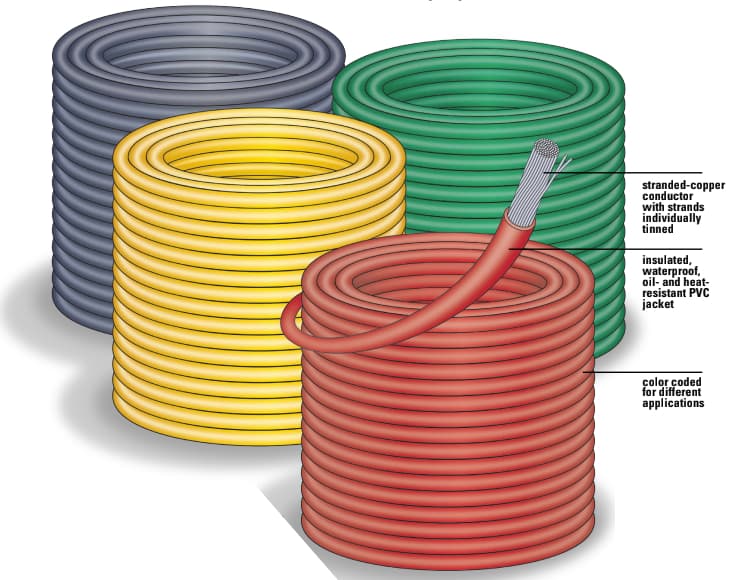
- Marine wire is the right target. Look for stranded, tinned copper with PVC insulation that is built to resist water, oil, and engine-room temperatures. UL 1426 boat cable also carries wet and dry temperature ratings and a 600-volt rating.
That last point matters because wire is not just a commodity. It is the path your boat depends on when the battery bank is low, the bilge is full, or the autopilot is drawing hard under load. A wire that seems serviceable on a bench can be a weak link once it is installed under a settee or routed through a warm, damp compartment.
Why stranded, tinned copper earns its keep
Don Launer’s refresher for Good Old Boat gets to the heart of the matter: boats move, and wire that cannot move with them eventually fails. Marine wire uses many fine strands instead of a single solid conductor, which helps it survive repeated bending without breaking from work hardening or metal fatigue. In other words, the wire is designed to live with vibration instead of resisting it until it snaps.
Tinning the copper adds another layer of defense. If water reaches the jacket, the tin helps slow corrosion, which is a big deal in a wet sailing environment where one leaked fitting or a little condensation can turn into green, crusty trouble inside a wire bundle. The outer PVC jacket is part of the system too, not just a sleeve, because it is built to stay waterproof and handle oil exposure and heat that would be routine in an engine space.
Gauge markings can fool you if you do not slow down
This is where a lot of DIY rewires go sideways. Wire sizing on boats is usually discussed in AWG, and in that system a larger gauge number means a smaller conductor. SAE wire is not directly interchangeable with AWG even when the labels look similar, so matching by appearance alone is a bad habit.
That matters even more on sailboats because most DC systems are 12-volt or 24-volt systems, and low voltage makes voltage drop a real design constraint. A wire can be “big enough” to carry the current without overheating and still be too small for the run if the voltage loss robs the load of performance. For a chartplotter, lighting circuit, pump, or any older branch circuit you are cleaning up, the right conductor has to be chosen for the actual current and the actual distance, not just the easiest spool on the rack.
A practical buying sequence keeps mistakes down:
1. Identify the load and its current draw.
2. Measure the full circuit length, not just the straight-line distance.
3. Check both ampacity and voltage-drop limits.
4. Buy marine cable in the correct AWG size, not an SAE lookalike.
5. Verify the jacket and conductor construction before cutting anything to length.
That process sounds fussy until you compare it with the cost of a dead circuit at sea.
Why ABYC standards are part of the mainstream, not the edge cases
It is tempting to treat marine wiring as a niche obsession, but the American Boat & Yacht Council has been pushing boat electrical practice toward a common standard for decades. ABYC says its standards and technical reports cover the major boat systems and have been part of a long-term reduction in boating accidents over the past six decades. It also says more than 90% of boats built in North America use its standards.
That puts wire choice in a very practical light. This is not about buying boutique cable because it feels premium. It is about following the wiring practice that dominates the boats already on the water and the standards environment they are built to. ABYC also recommends compliance with its E-11 AC and DC electrical systems standard for systems manufactured or installed after July 31, 2019, which is another reminder that electrical work aboard is expected to be inspectable, orderly, and built for service life.
Wire choice shapes corrosion, heat, and fire risk
Bad wire is not just an inconvenience. In a damp boat, the wrong conductor can corrode from the inside, raising resistance and turning current into heat. That heat can become a voltage-drop problem long before it becomes a visible safety issue, which is exactly why the wire has to be chosen with the whole installation in mind.
On the other end of the spectrum, oversized confidence can be a problem too. A cable that is the wrong type but “roughly the right size” still leaves you with the wrong insulation, the wrong strand count, and the wrong resistance to vibration and moisture. Fire risk in a real installation is often less about one dramatic event and more about a series of small compromises: too much resistance, too much heat, too much corrosion, and too little attention to the cable jacket and terminations.
Keep the diagram current
One of the easiest habits to adopt is also one of the most overlooked: keep diagrams of the low-voltage DC and AC wiring aboard, and update them whenever you change a circuit. The next person to open the panel, whether that is you in six months or a technician after a failure, needs to trace the system quickly without guessing where the feeder runs or what got rerouted during a refit.
That is the difference between a clean electrical system and a mystery bundle. If the boat already has a mix of old wire types aboard, a current diagram turns a frustrating detective job into a straightforward repair. It also makes it much easier to spot the wires that should be replaced before they become the reason a new piece of gear underperforms.
When you are standing at the workbench with a spool in one hand and a terminal in the other, the smartest move is rarely the cheapest one. The right marine wire is the one that can handle motion, moisture, heat, and long-term service without asking for a second chance, and that is what keeps the boat safer, the voltage steadier, and the next repair simpler.
Know something we missed? Have a correction or additional information?
Submit a Tip