Winter Cove, a favorite Gulf Islands anchorage for cruising sailors
Winter Cove looks idyllic, but the real story is its current, shallow water and Boat Pass. Get the setup right, or the anchorage stops being forgiving.
Why Winter Cove makes the cut
Winter Cove earns its reputation because it solves the problem cruising sailors actually have: where to stop when the weather turns, the tide is moving, and you want shelter without giving up access. Tucked at the north end of Saturna Island, where Saturna meets the southern end of Samuel Island, it has long been one of the Gulf Islands stopovers that delivers real protection rather than just pretty water.
That matters even more on Saturna, where the Trust Area had just 1,465 residents in the 2021 census, with a median age of 63.6 across 35.71 square kilometres. On an island that small, a protected cove with a dinghy dock, trail access, and a community gathering point becomes more than a scenic waypoint. It becomes part of the island’s daily rhythm, and part of your cruising decision-making too.
What the cove gives you, and what it does not
Parks Canada lists Winter Cove as one of the Gulf Islands National Park Reserve day-use areas with a free dinghy dock, which makes it especially useful for crews who want to come ashore for a walk, picnic, or quick look around. It also helps explain why the anchorage matters even though the park reserve has only one overnight dock, at Sidney Spit. If you are planning to rely on a dock rather than your own hook, Winter Cove is a day-use convenience, not an overnight marina substitute.
That distinction is important when you are deciding whether this stop fits your boat and your crew. Parks Canada says the Gulf Islands National Park Reserve was established in 2003, and its waterfront protection extends 200 metres into the sea. In practical terms, that means you are anchoring in a managed, sensitive coastal space where wildlife, shoreline use, and visitor traffic all overlap. Winter Cove works best when you treat it as a sheltered working anchorage with shore access, not as a casual drop-and-forget stop.
The real hazard is not the view, it is the water
Joe Cline’s description of Winter Cove makes the central point clearly: the anchorage can be excellent, but it is not equally happy in every wind. He notes that it has strong protection, yet it is not quite as ideal in a hefty northwesterly. That is the first decision point for any skipper arriving here, because the cove’s appeal depends on whether the forecast matches the shape of the basin.
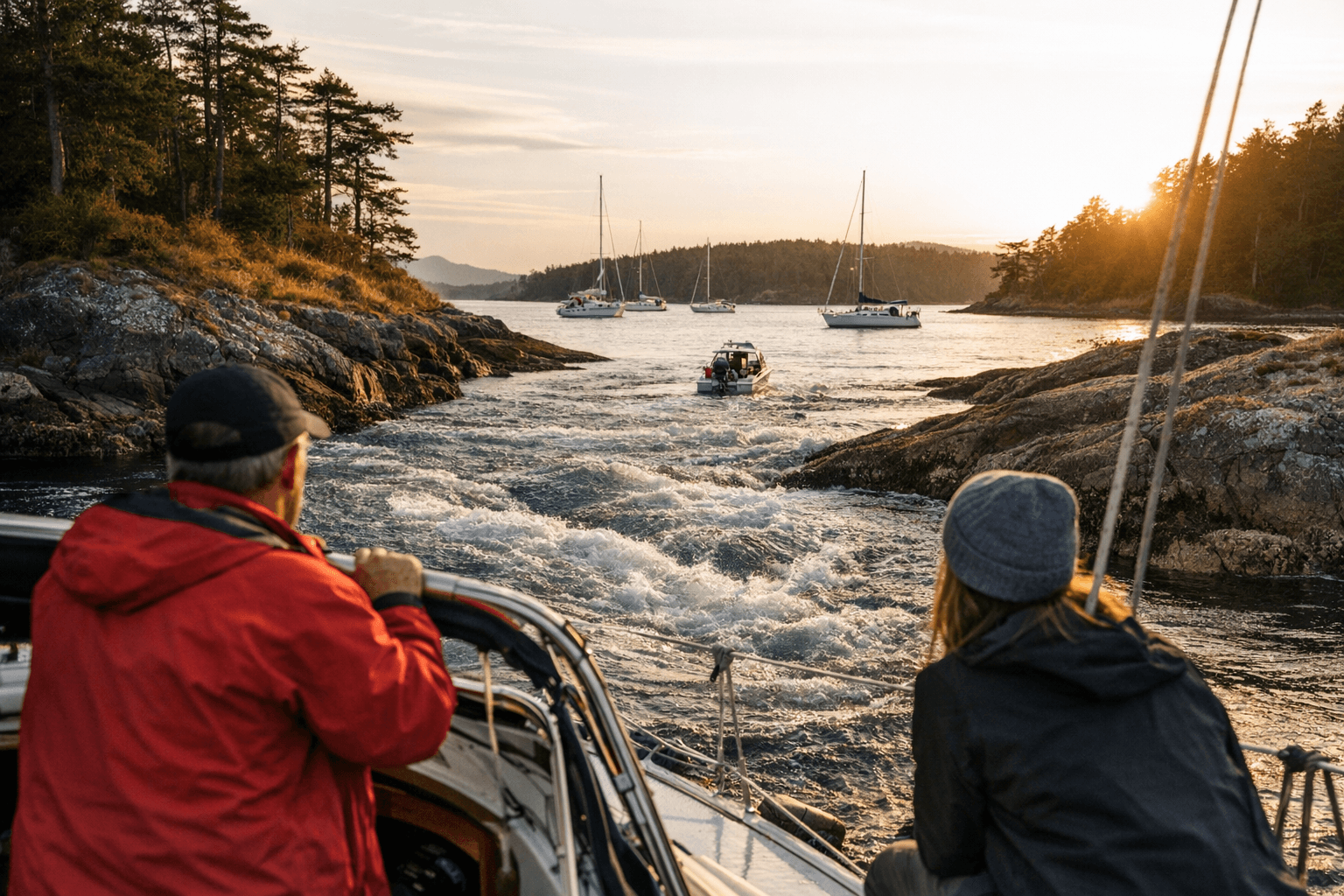
The second decision point is current. Boat Pass nearby drives strong water movement, with reports of currents exceeding 4 knots in the northeast part of the bay. Another cruising guide describes Boat Pass as about nine metres wide and best negotiated at high slack in settled weather, with submerged rocks on the Samuel Island side. If you are approaching Winter Cove in anything other than calm conditions, you need to account for that squeeze of water, not just the anchorage itself.
How to judge your ground tackle before you trust it here
Winter Cove rewards a setup that is deliberate and well-prepared. The sounder often reads in the 6.6- to 16.4-foot range, with many visits showing 12 to 15 feet at middling tides, so you are working in shallow enough water that scope, swing room, and tide stage matter immediately. That is the kind of anchorage where a weak reset is not a minor annoyance. It can turn into a drag across a crowded, current-flushed basin.
- Make sure your primary anchor is in good shape and sized for your boat’s displacement and cruising area.
- Check chain wear, shackles, pins, and the bitter end before you leave the cockpit.
- Confirm your rode length is enough for the depth plus tidal range plus a proper scope margin.
- If you use a snubber or bridle, verify the load-sharing gear is intact and not chafed.
- Set the anchor hard and watch it through at least one swing and one current change before relaxing.
Before you rely on your gear here, inspect the parts that have to do real work when the tide turns and the current starts moving:
The point is not to overcomplicate the stop. It is to respect the fact that a shallow, current-influenced anchorage exposes weak ground tackle faster than an open, forgiving bay would. If your gear is marginal, Winter Cove will tell you.
Dinghy access, traffic, and what the shoreline tells you
The shore here is not just scenery. Parks Canada describes Winter Cove’s shoreline as sandstone, shale, and shell midden, with forest, meadow, and salt marsh behind it. That mix tells you the cove sits inside an ecologically rich and culturally layered landscape, and it also explains why shore access is managed carefully. The dinghy dock is useful, but it is part of a protected place, not an invitation to treat the shoreline casually.
Traffic patterns matter too. The cove is a busy stop for day-use visitors, cruisers, and people coming ashore for the trails and picnic areas, and the Saturna Island Lamb Barbeque has been held every July 1 since 1950. That event has become a major community gathering and fundraiser, and it brings extra boat and shore traffic into Winter Cove each summer. If you are arriving around that time, or anytime the weather is good, expect more movement than the map suggests.
Why the place feels bigger than a mooring field
There is a deeper reason Winter Cove sticks in the cruising memory. The University of Victoria describes the area around the cove as Xwixwyus or XIXYES, a Coast Salish name meaning the narrow passage between Saturna and Samuel islands, and a significant gathering place and launch point across the Salish Sea. That history changes the way the anchorage reads. It is not just a convenient pocket of water, but a place with long human use and meaning.
That cultural depth fits the broader park context, too. The Gulf Islands National Park Reserve protects one of the ecologically rich stretches of coastline in British Columbia, and the cove sits inside that larger stewardship framework. The result is a stop that asks for more than anchoring skill. It asks for attention, timing, and a willingness to make the same seamanship decision every good skipper makes: whether the shelter, depth, current, and shore access genuinely match the boat in front of you.
Winter Cove is popular for a reason. When the forecast is workable and your gear is ready, it gives you the kind of anchorage that feels both useful and memorable. When the wind goes northwest, the current starts tugging through Boat Pass, or your ground tackle is not fully up to the job, it turns into a place that demands respect right away.
This article was produced by Prism’s automated news system from verified source data, official records, and press releases, then run through automated quality and moderation checks before publishing. The system is built and supervised by the people who set the standards it runs under. Read our full AI policy.
Did this article answer your question?