Four-Ingredient No-Knead Sourdough Makes Artisan Bread Easy
Four ingredients and a cold overnight rest take sourdough from intimidating to doable, with 20 minutes of prep and a loaf that still delivers crackly crust and real tang.
A loaf that fits real life
The appeal here is simple: you can get a real artisan-style loaf without kneading, without a complicated workflow, and without treating your kitchen like a bakery lab. Sparks and Bloom’s four-ingredient no-knead sourdough leans hard into that promise, using only flour, water, salt, and active starter, while fermentation does the heavy lifting. For anyone who has stared at a sticky mass of dough and assumed sourdough demanded perfect timing, perfect technique, and constant attention, this is the anti-intimidation version of the bread.
That matters because the usual sourdough pain points show up fast: endless kneading, anxiety over shaping, confusion about scoring, and the fear that one bad temperature swing will ruin the whole loaf. This method removes most of that pressure. It asks you to mix, rest, wait, and bake, then lets the dough develop itself over time into a bread with a crispy crust and an airy, flavorful crumb.
What this method takes off your plate
King Arthur Baking describes sourdough as bread that rises from starter alone, with minimal kneading and long fermentation, and notes that a hot Dutch oven helps make the loaf approachable at home. That line up mirrors exactly why this style feels so freeing. Instead of muscle and constant monitoring, the bread depends on a few controlled conditions that do the work for you: time, warmth, moisture, and heat.
The trade-off is not that you lose good bread. The trade-off is that you accept a little less control in exchange for much less effort. You are not chasing a highly open, highly engineered crumb or a hyper-managed shaping routine. You are choosing a loaf that still has depth, chew, and structure, while asking the process to handle most of the development for you.
The four ingredients, and why each one matters
The ingredient list is almost disarmingly short, but each piece has a job. Flour builds structure, water hydrates it, salt controls flavor and strengthens the dough, and active starter brings the wild yeast and bacteria that make sourdough what it is. Britannica defines sourdough in exactly those terms, as flour, water, and wild yeasts fermented together, and that basic definition is the foundation for every modern shortcut that still respects the method.
Warm water is one of the small practical moves that makes a big difference here, because it helps wake up the starter and get fermentation moving. The dough may look shaggy at first, which is one of the first moments that tends to spook new bakers, but that is not a sign something is wrong. In a no-knead loaf, the gluten develops over time during fermentation, not through hours of hand work.
Why the timing feels slower, but the process feels easier
This style asks for patience instead of effort, and that shift is the real confidence builder. King Arthur’s no-knead sourdough recipe for one large loaf keeps active prep to 20 minutes, with 55 minutes to 1 hour of baking and a total time of about 12 hours 35 minutes. That sounds long if you are only looking at the clock, but it is actually low-pressure time, not labor time. Most of it is resting, rising, and waiting for the dough to become itself.
The cold overnight rest is one of the smartest parts of the formula, because it gives the loaf deeper flavor while making the dough easier to handle. King Arthur says longer rise times generally build richer flavor, and refrigeration pushes fermentation toward more acetic acid, which is the tangier note sourdough fans recognize. In practice, that means the overnight chill is not wasted time at all. It is one of the main reasons the finished bread tastes like it came from someone who knows what they are doing.
Crust, crumb, and the trade-offs you are actually making
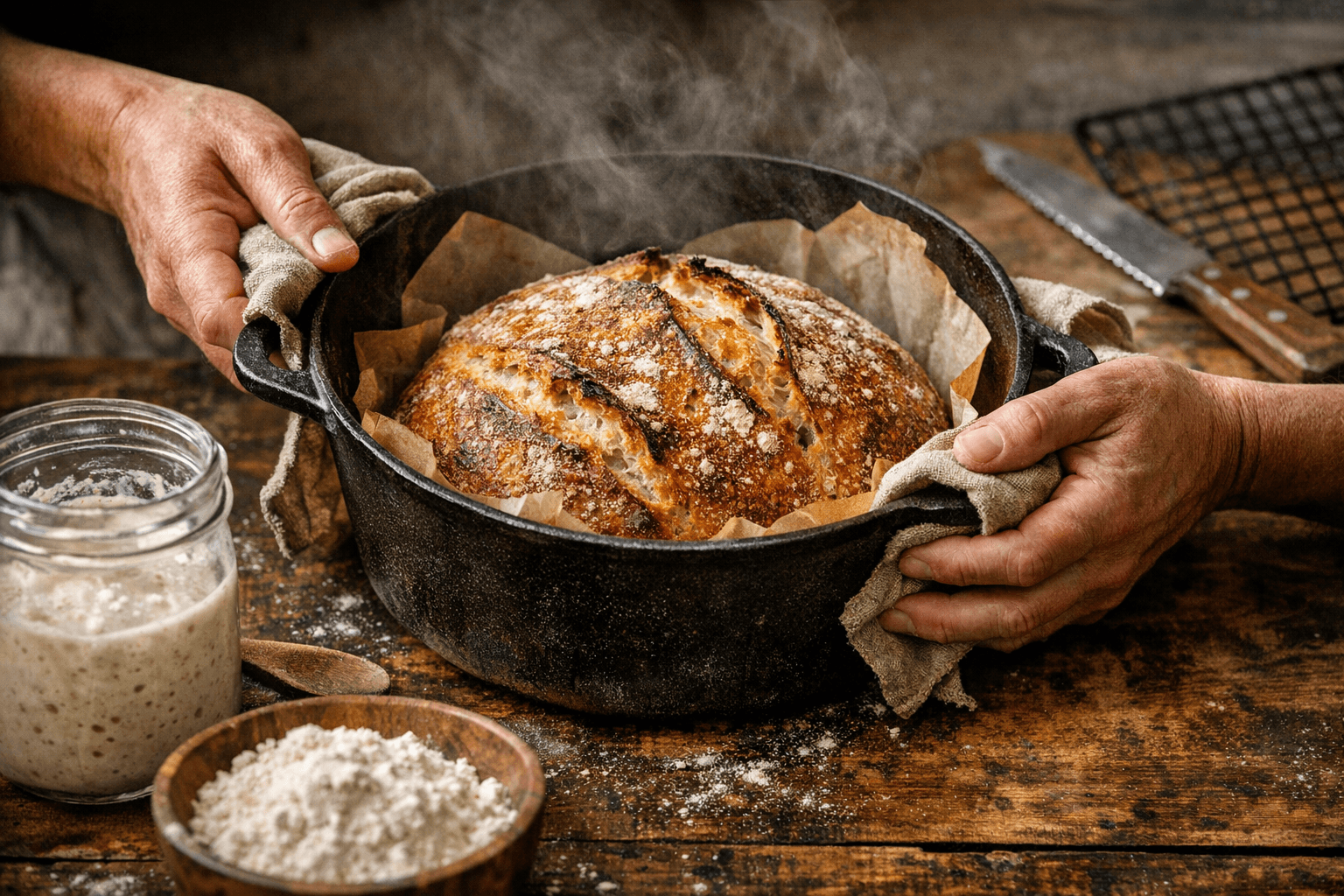
If you want bakery-style bread, the crust matters just as much as the interior, and this is where the method gets especially practical. King Arthur recommends steam or a baking shell for the crustiest, brownest crust, and Sparks and Bloom’s version leans into the same idea with ice in the oven to create humidity. That steam helps the loaf bloom and finish glossy, instead of drying out too early.
The crumb is another place where the method makes a clear trade. You are not hand-building every strand of gluten through extended kneading, so the texture will not feel like a showpiece designed for a bakery contest. What you do get is an airy, flavorful interior that reads as artisanal because the fermentation is doing real flavor work. The loaf is also judged by internal temperature, which is a huge relief if you are tired of guessing based on color alone. Measuring doneness turns the final step from a nerve-wracking instinct test into something repeatable.
Who this method is best for
This is the right bread for first-time starter owners who want a believable win, not a proving ground. It is also perfect for busy weeknight bakers who can mix the dough with minimal effort and let time take over while they do everything else. And it is exactly the kind of recipe that helps people who keep abandoning harder formulas, because it removes the technical clutter that often turns sourdough into a guilt project.
The appeal is not just that the loaf is easier. It is that the steps feel legible. You can see where the fermentation matters, where the cold rest changes the flavor, and where the steam affects the crust. Once those pieces click, sourdough stops feeling mysterious and starts feeling manageable.
A long tradition, made friendlier
Part of why sourdough still carries so much mystique is that it has deep roots. King Arthur’s history notes say hungry miners developed naturally fermented sourdough during the California Gold Rush, and that The French Bakery in San Francisco was already selling sourdough bread in 1849. That old reputation for rugged skill still hangs around the bread, even when a modern recipe strips away the hardest parts.
There is also a very current side to the story. King Arthur updated its sourdough starter recipe in February 2026 to make a smaller amount of starter after home baker feedback, which says a lot about where home baking has landed. The goal now is not to make sourdough smaller in personality. It is to make the process fit ordinary kitchens better. That is why this four-ingredient, no-knead approach lands so well: it keeps the soul of sourdough intact while removing the parts that scare people off.
In the end, this is the kind of recipe that changes how sourdough feels on a weeknight. You still get the crackling crust, the fermented depth, and the satisfaction of cutting into a loaf that looks earned. You just do not have to earn it the hard way.
This article was produced by Prism’s automated news system from verified source data, official records, and press releases, then run through automated quality and moderation checks before publishing. The system is built and supervised by the people who set the standards it runs under. Read our full AI policy.
Did this article answer your question?