How sourdough hydration shapes dough texture, starter strength, and crumb
A 65% dough feels tidy, a 75% dough balances shape and openness, and 85% pushes toward an airy crumb if you manage the stickiness.
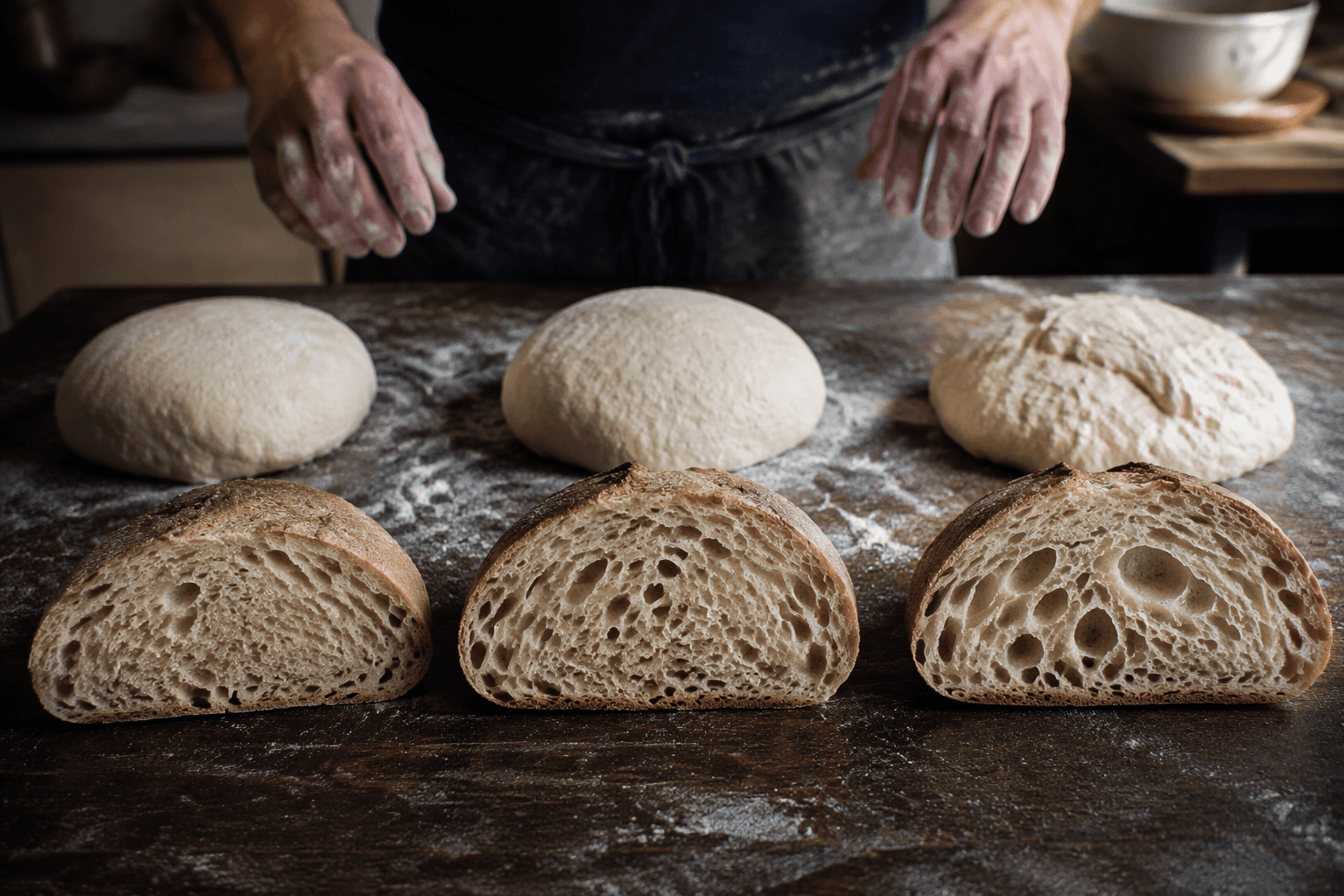
At 65% hydration, sourdough dough usually feels firm and cooperative; at 85%, it turns glossy, slack, and sticky. Hydration tells you whether your dough will hold shape on the bench, relax into an open crumb, or turn into a sticky fight you need to manage carefully.
Baker’s percentage is the language that makes hydration useful
Hydration is not a feeling, it is math: water weight divided by flour weight, multiplied by 100. In baker’s percentage, flour is always 100%, and every other ingredient is measured against that flour weight, which is why the same formula can be scaled up, compared, and adjusted without guesswork. King Arthur Baking’s baker’s percentage reference and its Jan. 11, 2023 piece on hydration use that framework, and Maurizio Leo at The Perfect Loaf uses the same language to design a loaf instead of merely following a recipe.
That math matters twice in sourdough. You are not only counting the water you pour into the bowl, you are also counting the flour and water already living in your starter or levain. If your levain is 100% hydration, half of its weight is water and half is flour, so a dough that looks like 500 grams of flour and 325 grams of water is not really 65% hydration once the preferment is included.
What 65%, 75%, and 85% look like on the bench
At 65% hydration, the dough usually feels firm, satiny, and cooperative. It should come together cleanly, clear the sides of the bowl more easily, and resist collapsing when you shape it, which is why this range is forgiving for bakers still learning to read gluten development. The tradeoff is a tighter crumb and less dramatic openness, so this is the zone for a more even sandwich loaf or a country loaf that values structure over wild holes.
At 75% hydration, the dough starts to feel supple and slightly tacky, but still manageable with stretch-and-folds and a confident pre-shape. This is the sweet spot for many home bakers because it gives you a noticeable bump in openness without asking for heroic handling, and it often lands in the range of a classic sourdough bâtard or batard-shaped country loaf. If your shaping feels smooth and the dough keeps tension without tearing, you are probably in a workable middle ground.
At 85% hydration, the dough gets glossy, slack, and noticeably sticky. You can still make a beautiful loaf at that level, but only if the flour can take the water, the gluten is developed well, and your shaping is precise enough to keep the dough from spreading into a puddle. King Arthur Baking’s August 2021 high-hydration tips and its Aug. 16, 2021 piece on whether wetter dough is really better make the same point: wetter is not automatically better; it is just better suited to certain loaves and certain hands.
The starter or levain changes the final number
This is where a lot of recipes quietly mislead people. If the starter goes into the dough at 100% hydration, it contributes both flour and water, so the final dough will behave wetter than the added water alone suggests. That is why a levain-heavy formula can feel looser than a straight dough on paper, even when the ingredient list looks similar at first glance.
A stiffer starter brings a different feel to the mix than a looser one, because it shifts the balance of flour and water before the final dough is mixed. The practical move is simple: treat your starter like part of the formula, not a separate little blob you ignore until the final mix.
Flour choice changes how much water the dough wants
White flour, bread flour, whole wheat flour, rye, and high-extraction flour do not absorb water the same way. Bran and grain composition in whole wheat grab more water, so a dough that feels perfect at 70% with white flour can feel dry and stiff once you swap in more whole grain. That is why whole wheat sourdough formulas often run wetter than refined-flour doughs, and why the same target hydration cannot be copied across flours without adjustment.
Breadtopia’s No Knead Whole Wheat Sourdough hydration comparison shows breads that differ mainly by water amount. Change only the hydration and you change the feel in mixing, the way the dough spreads, and the final crumb, which is a cleaner lesson than chasing five variables at once. The Sourdough School has been teaching sourdough since 2001, and hydration becomes even more important once bran starts competing for water.
How to rescue a dough that is too wet or too dry
The fastest fix is to stop guessing and look at the dough. If it is under-hydrated, it will feel shaggy, resist stretching, and tear when you try to fold it; if it is over-hydrated, it will smear, slump, and spread instead of holding tension. King Arthur Baking’s handling advice for high-hydration doughs makes the same point: the solution is usually better timing and technique, not panic flour.
- Hold back a small portion of water at the mix, then add it only if the dough can take it after the flour has hydrated.
- If the dough feels dry after mixing, add water a little at a time and work it in during rest periods rather than dumping in flour.
- If the dough feels too wet, give it a longer rest and more folds before reaching for extra flour, which can throw off the formula and leave dry patches.
- Use stronger shaping on higher-hydration doughs, because tension is what keeps an 85% dough from flattening into a puddle.
A few practical moves make the difference:
This article was produced by Prism’s automated news system from verified source data, official records, and press releases, then run through automated quality and moderation checks before publishing. The system is built and supervised by the people who set the standards it runs under. Read our full AI policy.
Did this article answer your question?