New 9-Phase Sourdough Protocol Book Promises Predictable, Repeatable Results for Home Bakers
Angela Baker's new sourdough manual breaks the baking process into 9 discrete phases, targeting the dense crumb and weak oven spring that frustrate home bakers.
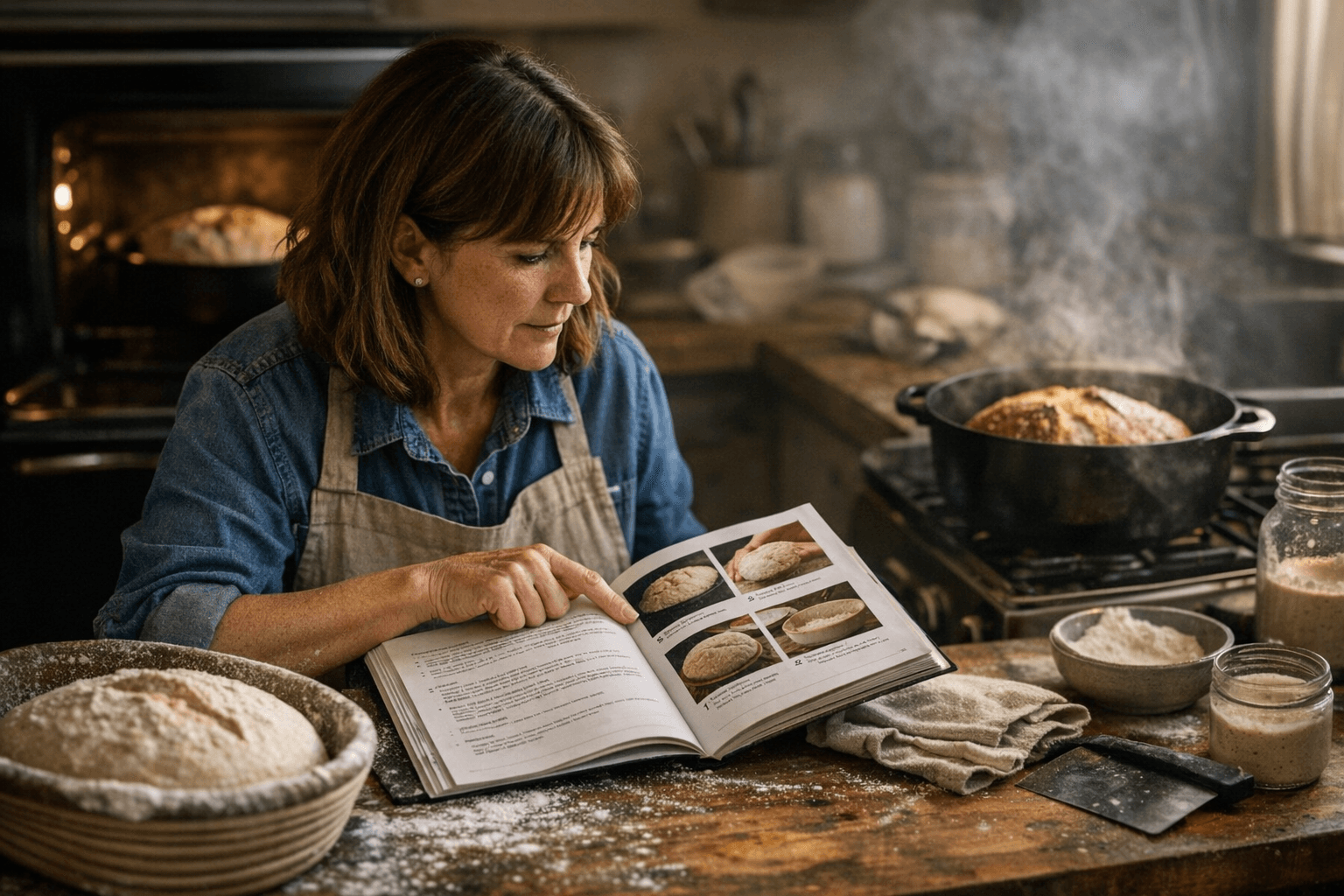
Angela Baker's "Predictable Sourdough & Artisan Bread Protocol" landed on April 4, 2026, with a premise that cuts straight to the frustration most home bakers know well: sourdough fails not from lack of effort, but from lack of a repeatable system. The paperback, available internationally through Amazon, structures the entire process across nine sequential phases designed to give bakers a disciplined mental model they can slot into a daily routine and execute the same way every time.
The nine phases walk bakers from the ground up: creating and managing a healthy starter, building a levain, controlling dough development, and carrying loaves through shaping and the final bake. Each phase functions as a distinct checkpoint rather than a vague instruction, which is the core distinction Baker appears to be making against more intuition-driven approaches. For bakers who already track starter peak times, ambient and dough temperatures, and hydration percentages, a phase-gated workflow offers a structure that matches how they already think about the process.
Two failure modes sit at the center of the book's pitch: dense crumb and weak oven spring. Both are notorious in the sourdough community precisely because they can stem from a dozen different variables, from under-fermented dough to improper shaping tension to a starter that looked active but wasn't strong enough to drive a full rise. Baker's protocol addresses these by building in explicit timed rests, including autolyse and bulk fermentation stages, alongside temperature control guidance that runs through the multi-day build.
The levain-building and dough-scaling sections are especially relevant for bakers managing complex, high-hydration doughs. Open crumb work at 78 percent hydration or above is notoriously difficult to systematize, and the protocol's emphasis on shaping stages as a defined phase rather than a single step reflects a methodology closer to professional production baking than to most home-baker guides.
Baking instructors and community education programs often reach for exactly this kind of manual when students need a take-home reference that reinforces hands-on workshop learning. A protocol-based text, with its explicit sequencing, translates more directly into class curriculum than a recipe-forward book, and its phase terminology gives instructors and students a shared vocabulary for troubleshooting.
The paperback format and broad Amazon distribution suggest Baker is targeting the same serious home bakers who wear their lame blades out and argue about the merits of a 1:5:5 versus 1:2:2 starter ratio. For that audience, a nine-phase framework that promises to make complex artisan builds teachable and repeatable rather than mystical and variable is a genuinely compelling proposition.
This article was produced by Prism’s automated news system from verified source data, official records, and press releases, then run through automated quality and moderation checks before publishing. The system is built and supervised by the people who set the standards it runs under. Read our full AI policy.
Did this article answer your question?