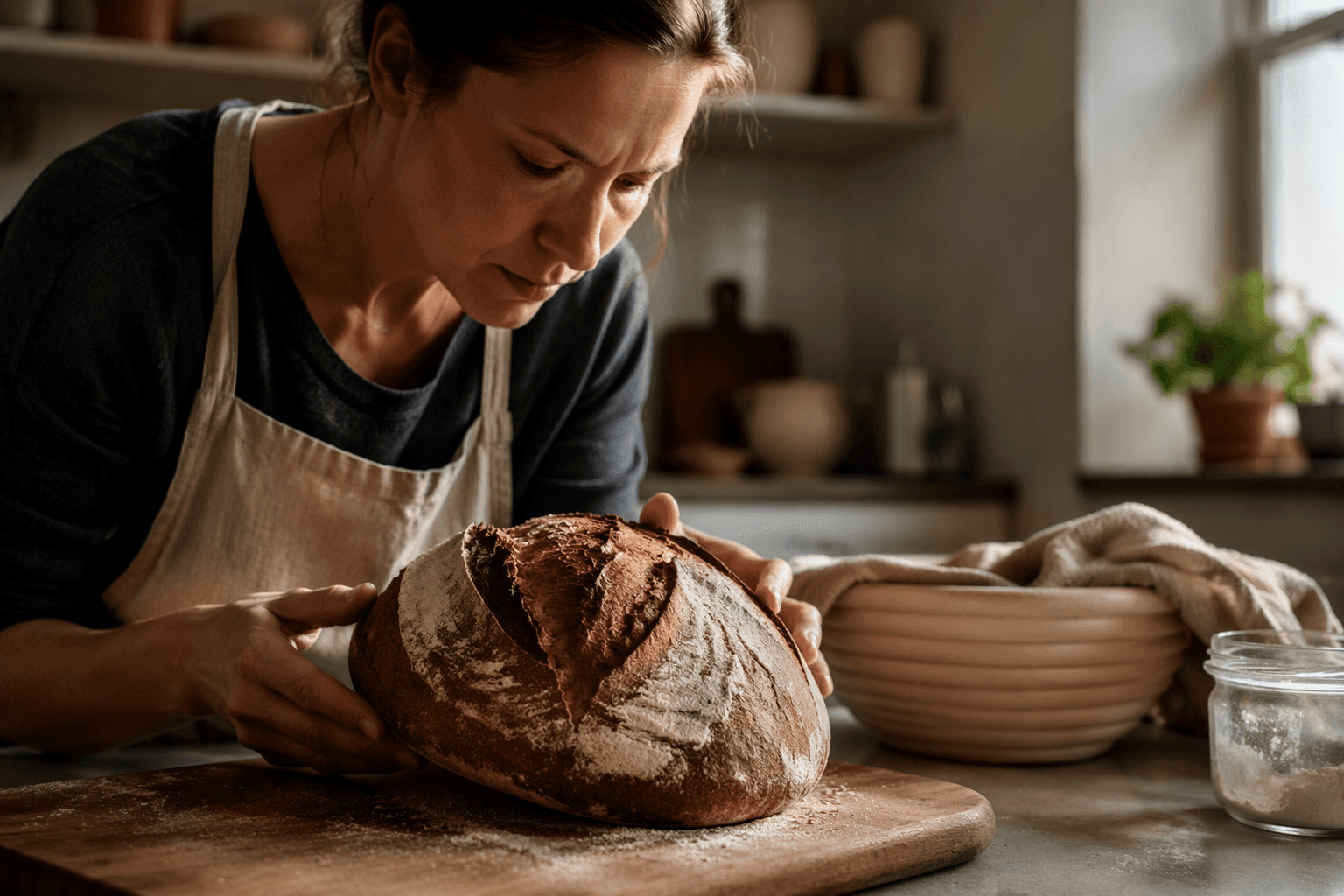
New step‑by‑step home recipe published for first-time sourdough bakers (CookLikeMom guide)
Professor Raymond Calvel's 1974 autolyse method anchors a new CookLikeMom beginner sourdough guide that replaces clock-watching with sensory cues first-time bakers can actually use.

The autolyse technique has a precise origin story: French master baker Professor Raymond Calvel developed the method in 1974 as a way to build strong gluten structure through rest rather than intensive kneading. More than fifty years later, it remains one of sourdough's most elegant tools, and it sits at the center of CookLikeMom's "Simple Sourdough Recipe From Starter," a comprehensive beginner guide that translates sourdough science into kitchen-ready action. At a moment when Puratos's 2025 trend report records a 79% year-over-year jump in global sourdough conversations, and when Taylor Swift's publicly stated sourdough interest on the New Heights podcast produced a measurable search spike, the appetite for accessible sourdough education has never been more obvious.
Starting With a Healthy Levain
Everything in sourdough begins with a living culture, and the guide treats starter maintenance as a foundational skill rather than a preliminary chore. The recommendation is a straightforward flour-and-water feeding routine that keeps the levain predictable and ready to leaven. The most critical concept here is timing: bakers are coached to look for a specific visual cue before mixing begins. The levain should be domed and active, showing clear signs of fermentation activity. A starter that hasn't peaked will underferment the dough; one that's collapsed past its peak will produce a slack, overly acidic loaf.
Discard use gets practical attention as well. Rather than treating unfed starter as waste, the guide offers ideas for incorporating sourdough discard into other recipes, extending the value of maintaining an active culture well beyond any single bake.
The Autolyse: Calvel's Gift to Home Kitchens
The autolyse step is deceptively simple: flour and water are combined and left to rest before the levain and salt are introduced. Professor Calvel's 1974 insight was that giving flour time to fully hydrate initiates gluten development on its own, reducing the need for heavy mechanical work. For home bakers without commercial mixers, this matters enormously. The dough becomes more extensible and easier to shape, and the final crumb tends to open more reliably without aggressive kneading. King Arthur Baking Company has documented the autolyse's central place in modern sourdough practice, and its widespread adoption across artisan bakeries and home kitchens alike reflects how thoroughly Calvel's method has reshaped the craft over five decades.
Bulk Fermentation: Folding, Timing, and Trusting Your Senses
After the levain and salt are incorporated, the dough enters bulk fermentation, the long, transformative period during which wild yeast and Lactobacillus bacteria work together to produce carbon dioxide, acetic acid, and lactic acid. The guide prescribes a stretch-and-fold cadence at regular intervals during this phase. Each set of folds builds structural tension in the dough, encouraging gluten network development without deflating the gas already trapped inside.
The guide's most useful contribution here is its emphasis on visual and tactile cues over rigid clock times:
- The dough should feel noticeably more airy and alive by the end of bulk fermentation
- It should have increased in volume and developed a slight dome at the surface
- A poke test should show slow, steady spring-back rather than an immediate snap
Fermentation timing shifts with kitchen temperature, flour type, and starter activity, making sensory cues far more reliable than a fixed schedule. Long fermentation also delivers real benefits beyond flavor complexity. The extended process improves digestibility, as Lactobacillus activity breaks down some of the harder-to-digest proteins and phytic acid in the grain, a benefit the guide addresses without requiring a deep dive into food science.
Shaping and Bench Rest
Once bulk fermentation is complete, the dough is pre-shaped and allowed to rest on the bench before its final form is set. The bench rest gives gluten time to relax after the stress of pre-shaping, making the dough more cooperative for the final shaping stage. The guide recommends a series of tension-building turns during final shaping, using friction against the work surface to create a tight, taut skin on the exterior of the loaf. That surface tension is what produces sourdough's characteristic ear and oven spring once the scored loaf hits a hot oven. Getting this step right separates a loaf that spreads flat from one that holds its height and opens dramatically upward during baking.
Proofing: Cold Retardation as a Scheduling Tool
The guide recommends a combination of cold retardation and room-temperature final proofing. Placing the shaped loaf in a refrigerator overnight slows fermentation, developing more complex flavor compounds while syncing the bake to a realistic home schedule. A cold-retarded loaf can go directly from refrigerator to a preheated Dutch oven without requiring additional warm-up time, and the oven spring on a properly cold-retarded loaf is typically more dramatic than one proofed entirely at room temperature.
This schedule flexibility is one of the guide's most practical contributions for working bakers. The 2024 AHDB survey found that 11% of people bake weekly and 20% bake monthly, numbers that reflect the reality of fitting bread baking around full schedules. Cold retardation transforms a demanding two-day process into something genuinely compatible with modern life.
Troubleshooting for When Things Go Wrong
No beginner sourdough guide would be complete without addressing failure modes, and this one doesn't sidestep that step. Common issues include dense crumb (usually a sign of underfermentation or an underactive starter), excessive spread (often caused by weak shaping or an over-proofed dough), and a gummy interior (typically a patience problem, resolved by allowing the loaf to cool fully before cutting). The guide approaches these issues through the same sensory-cue framework it uses throughout, training bakers to diagnose problems by what they see and feel rather than by what the clock says.
Why the Sourdough Moment Keeps Growing
Sourdough's current reach has deep roots. San Francisco sourdough culture gained national recognition in the 1990s, extending a tradition tied to the 1970s back-to-the-land movement. When a commercial yeast shortage hit during the COVID-19 pandemic, 37% of U.S. consumers turned to home bread baking according to a 2020 National Restaurant Association survey, and millions discovered sourdough precisely because it requires no commercial leavening. That pandemic-era momentum never fully retreated. Bake Magazine's 2024 analysis of Google Trends data shows sourdough searches running at triple their post-pandemic lows, and the community that grew up around the craft, centered on r/sourdough, one of the largest subreddits in the world, has remained expansive and deeply engaged.
The market numbers reflect this sustained appetite. MarketsandMarkets values the global sourdough market at USD 2.5 billion in 2024 and projects it reaching USD 3.8 billion by 2029, a compound annual growth rate of 9.2%. MetaTech Insights forecasts the sourdough bread segment specifically climbing from USD 3.87 billion in 2024 to USD 8.53 billion by 2035. Wider grocery and retail access to specialty flours and quality baking equipment, from bannetons to Dutch ovens, has lowered the barriers to entry considerably, meaning the gap between sourdough curiosity and a first successful bake has never been narrower.
Guides that bridge the distance between sourdough science and home kitchen reality, using terms like levain, autolyse, and bulk fermentation but explaining what to look and feel for at every stage, are exactly what a growing community of first-time bakers needs. When the dough is domed and active, you're ready. The rest, as Calvel understood in 1974, takes care of itself.
This article was produced by Prism’s automated news system from verified source data, official records, and press releases, then run through automated quality and moderation checks before publishing. The system is built and supervised by the people who set the standards it runs under. Read our full AI policy.
Did this article answer your question?