Sourdough Discard Banana Bread Stays Moist for Three Days, with a Five-Minute Mix
This is the discard bake that pays you back fast: five minutes to mix, three days of moisture, and a loaf that works with any starter schedule.
Why this loaf earns a place in your rotation
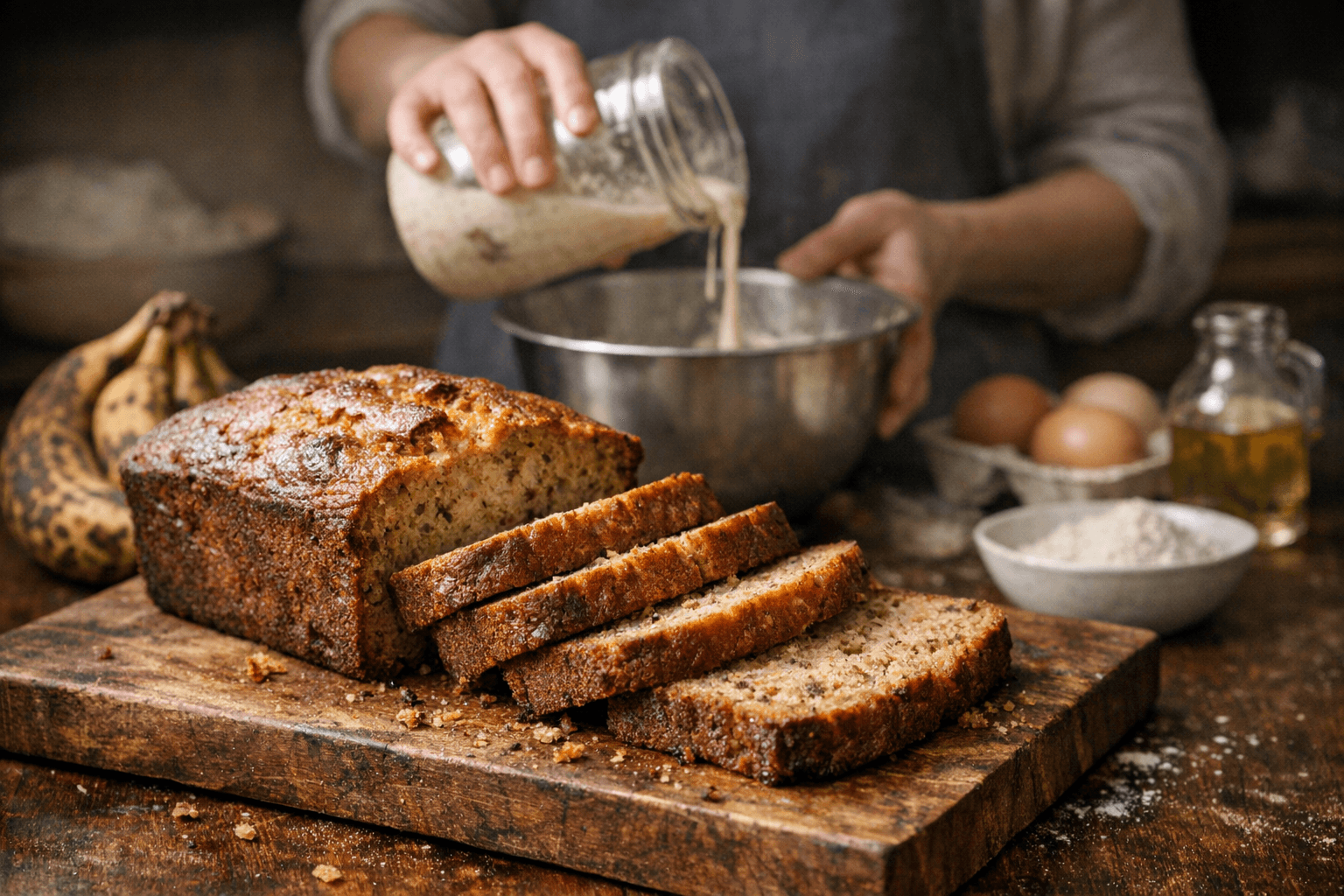
Sourdough discard banana bread solves the two problems that make discard baking feel worth the trouble: waste and dryness. Forkful Daily’s recipe leans into a simple promise, use the discard, keep the loaf moist for days, and get breakfast bread that does not feel like a project.
That is the real appeal here. The discard brings tang, tenderness, and a little complexity, while overripe bananas and brown sugar carry the moisture load. The result is a soft crumb that stays pleasant for up to three days, which is exactly the kind of payoff that makes a quick loaf feel smarter than tossing starter down the drain.
Discard is the ingredient, not the leftover
The best sourdough discard recipes stop treating discard like a kitchen inconvenience and start treating it like a usable ingredient. King Arthur Baking defines sourdough discard as the portion removed during routine starter maintenance, and it makes a point that regular discarding and refreshing helps keep the microorganisms healthy.
That matters because it reframes the whole habit. You are not trying to rescue scraps from the bin. You are taking part of an active starter routine and turning it into something useful, which is why banana bread fits the format so well. King Arthur’s own sourdough banana bread recipe says discard adds a pleasant subtle tang that balances the sweetness of bananas and honey, and it notes that the bread stays fresh longer than an ordinary loaf.
Food52 makes the same point in sharper language, calling discard’s “two superpowers” tang and tenderization. That acidity helps limit gluten development, which is one reason discard banana bread can feel softer and more moist than a standard banana bread without asking you to do more work at the bowl.
A practical recipe for an irregular schedule
The other reason this recipe lands is timing. Forkful Daily’s version is built for bakers who do not always feed on a neat schedule, which is most of us. It has a 15-minute prep time and a bake window of 1 hour 5 minutes to 1 hour 15 minutes, so it still counts as a straightforward loaf even though it does a little more than a basic quick bread.
The batter rest is the detail that makes the recipe feel tested, not just assembled. Letting the batter sit for 20 minutes before baking gives the flour time to hydrate and helps the loaf rise taller and more evenly, instead of collapsing into a dense center. That is a small step with a big return, and it is exactly the kind of thing that separates a good discard bake from a forgettable one.
The pan size is not a footnote
Quick breads fail for boring reasons, and the pan is one of the biggest. The recipe points out that the right pan size matters because a loaf that is too large or too small can bake up with a raw middle or a flatter finish. That is not glamorous advice, but it is the kind that saves a loaf.
King Arthur’s banana bread guidance gives the standard shape a 9-inch by 5-inch loaf pan or a 12-inch by 4-inch tea loaf pan, which is a useful marker when you are checking your own setup. If the pan is off, the bread bakes off. If the pan is right, the crumb has room to rise without turning gummy in the center.
What to expect from the mix
The formula works because it balances flavor and moisture instead of trying to hide the discard. Overripe bananas do the heavy lifting, brown sugar deepens the flavor, and the discard adds the mild tang that keeps the sweetness from feeling one-note. That combination gives you the kind of loaf that can be sliced for breakfast, packed for later, or frozen in pieces and brought back through the week.
This is also why banana bread has stayed so useful for so long. Smithsonian Magazine traces banana bread to the 1930s, when baking soda and baking powder were mass produced and the Great Depression pushed cooks to use overripe bananas instead of throwing them away. Sourdough discard banana bread carries that same logic forward: use what you have, make it taste good, and waste less in the process.
Why the waste story still matters
The larger appeal goes beyond a single loaf. USDA says over one-third of all available food in the United States goes uneaten through loss or waste, and the US EPA estimates that 66 million tons of wasted food were generated in retail, food service, and residential sectors in 2019. USDA also says the average American family of four loses $1,500 a year to uneaten food, and the federal goal is to cut food loss and waste in half by 2030.
That is a big number for a loaf of banana bread to carry, but it explains why discard baking has stuck. If starter maintenance is part of your routine anyway, using discard in a loaf that stays moist for three days turns a minor kitchen byproduct into breakfast with a practical return. It is thrift, but it is also better eating.
The payoff in one slice
The best sourdough discard banana bread does not ask you to choose between convenience and quality. It takes five minutes to mix, rewards a 20-minute rest, bakes in a standard loaf pan, and comes out with enough tang and tenderness to justify the starter jar on your counter. For a bake built from what many people would otherwise throw away, that is a very good deal.
This article was produced by Prism’s automated news system from verified source data, official records, and press releases, then run through automated quality and moderation checks before publishing. The system is built and supervised by the people who set the standards it runs under. Read our full AI policy.
Know something we missed? Have a correction or additional information?
Submit a Tip