Sourdough may boost iron absorption, but long-term benefits remain unclear
Sourdough can improve iron absorption, but only when the flour, fermentation, and serving size line up. The long-term ferritin story is far less impressive.
The iron story is real, but it is not the fairy tale
Sourdough has earned a health halo for a reason: fermentation can lower phytate, the compound in grain that latches onto minerals and makes them harder to absorb. But the latest review shows the iron claim is much narrower than the internet version. In a systematic review from Frontiers in Nutrition, researchers working under COST Action CA20218, also called PIMENTO, screened studies from January 1970 through December 2024 across PubMed, Scopus, and the Cochrane Library and found only eight human intervention studies that met the bar.
That tiny evidence base matters. The review was framed around European Food Safety Authority guidance for health claims, which is exactly where the hype usually breaks apart. The short version is simple: sourdough can help iron bioavailability in some settings, but it is not a blanket upgrade for every loaf, every flour, or every eater.
What actually changes iron absorption
The strongest signal shows up in acute, post-meal testing. In those studies, sourdough and low-phytate breads sometimes improved non-haem iron bioavailability, and that fits the chemistry. If fermentation knocks phytate down, more iron stays available to the body instead of getting trapped in the dough.
One of the clearest examples in the review is a bread comparison that tracked serum iron over two hours. Low-phytate white bread produced a rise of 59 micrograms Fe per 100 mL, compared with 30 micrograms Fe per 100 mL for high-phytate wholemeal bread. That is a meaningful gap, and it is the kind of number that explains why bakers keep hearing that sourdough is “better” for minerals.
The mechanism gets even clearer when phytase enters the picture. In controlled settings, exogenous phytase increased iron absorption by 50% for ferrous sulfate and 61% for iron bis-glycine chelate. That is not a vague wellness effect. It is a direct mineral-availability effect, and it shows that the fermentation process, or an added enzyme doing similar work, can materially change what the body gets from the plate.
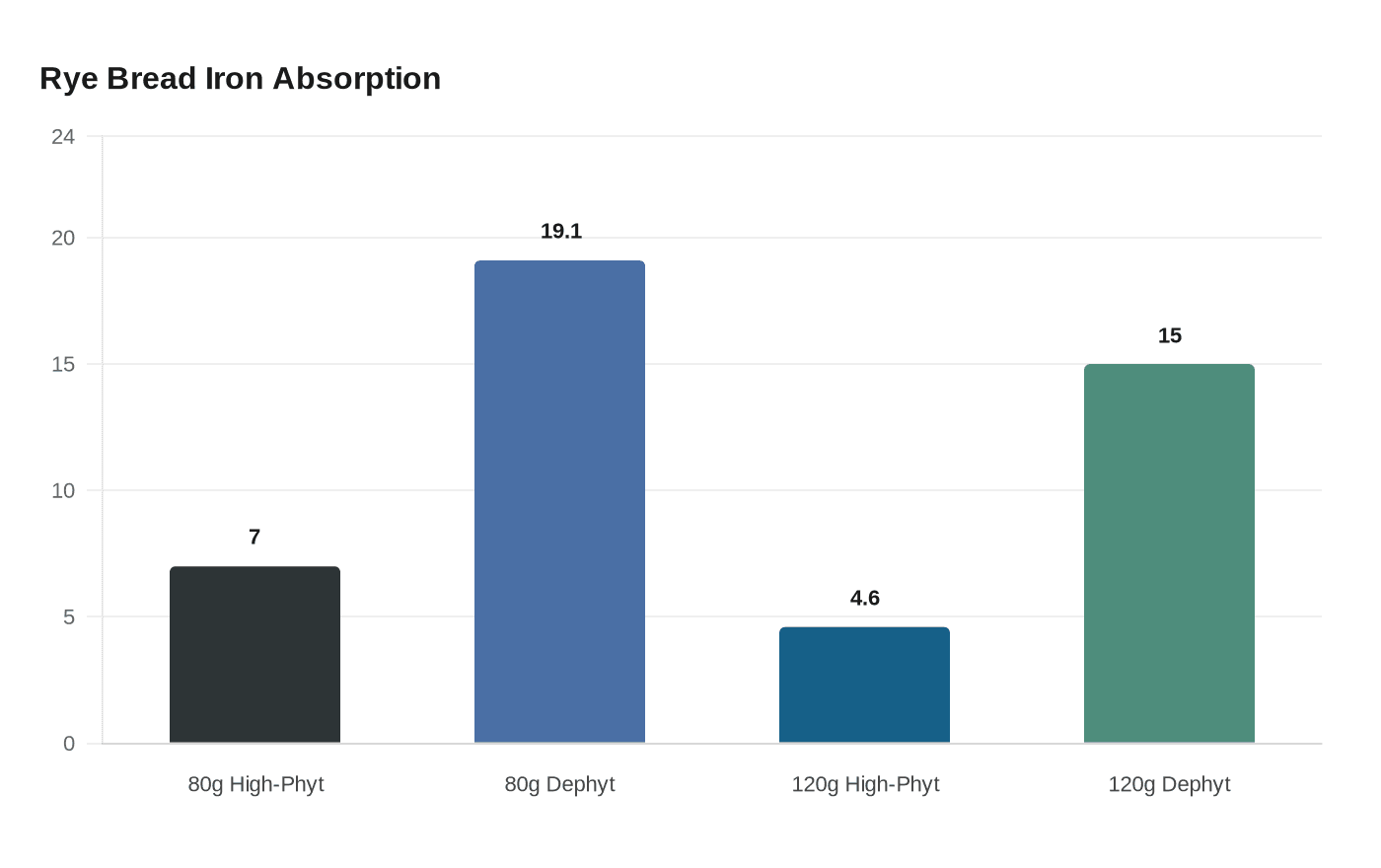
A newer 2025 whole-grain rye study pushed the point further. In healthy women, iron absorption rose from 7.0% in high-phytate bread to 19.1% in dephytinized bread at an 80 gram portion, and from 4.6% to 15.0% at a 120 gram portion. That is the kind of result that should make any home baker sit up, because it shows the effect depends not just on whether the bread is sourdough, but on how much phytate remains and how much bread gets eaten.
The long-term story is much messier
Here is where the myth-check matters. Short-term absorption gains do not automatically translate into better iron stores over weeks or months. The review says the longer trials did not improve ferritin or total body iron overall, which is the marker most people actually care about if they are trying to avoid low iron.
The clearest cautionary example comes from a 12-week Swedish intervention. Researchers randomized 102 females to eat 200 grams per day of either high-phytate or dephytinized wholegrain rye bread. Later reports found that the low-phytate bread group showed reductions in iron-status markers, and a re-analysis noted a between-group difference in total body iron. The authors also suggested that the bread’s strong acidic flavor may have changed dietary habits, which is a reminder that real life does not behave like a lab tray.
That is the part social media usually skips. A bread can improve absorption in a test meal and still fail to move the needle over time if people eat less of it, eat differently around it, or if the rest of the diet does not support iron status. Ferritin is not impressed by good intentions.
What matters at the bench, not just in the headline
For home bakers, the practical take is less glamorous but much more useful. Sourdough can contribute to a better mineral profile, but only under some conditions. Flour choice, phytate reduction, the amount eaten, and the rest of the diet all matter, and the effects appear to depend heavily on how the bread is formulated and who is eating it.
If your goal is iron, keep these realities in mind:
- Rye and other wholegrain flours often bring more phytate along with more minerals, so the fermentation has to do real work if you want better availability.
- A loaf that tastes sharply acidic may signal more dephytinization, but flavor alone is not proof that iron intake improved.
- Portion size matters. The 2025 rye study showed a stronger absorption jump at both 80 gram and 120 gram servings when phytate was reduced, but the absolute numbers still depended on the bread chemistry.
- Sourdough is helpful, not magical. It can improve the mineral profile of a loaf, but it does not cancel out the rest of the meal or the rest of the week.
That last point is where the science lands most cleanly. Fermentation may help, but the effect is conditional rather than guaranteed. A loaf that gives up more iron in a two-hour test is not automatically a loaf that will fix low ferritin in daily life.
Why this matters beyond one loaf
The review also fits into a broader European push around fermented foods. PIMENTO’s long-term goal is to put Europe at the spearhead of innovation in microbial foods and build a multi-stakeholder vision around them. That context matters because sourdough is no longer being sold only as craft baking, it is being studied as a functional food with measurable effects.
Researchers connected to this work, including Michael Hoppe, Ann-Sofie Sandberg, and Lena Hulthén, have helped sharpen the conversation around what sourdough can and cannot do. The useful part of that conversation is not the slogan that sourdough is “healthy.” It is the more precise, more honest claim that fermentation can change mineral bioavailability, especially iron, when the flour, process, and serving size line up.
That is the real takeaway for the bakery counter. Sourdough has a biochemical edge, but the edge is small, specific, and easy to overstate. If you want the mineral benefit, pay attention to the flour, the phytate reduction, and the total meal. If you do not, the loaf still tastes great, which is reason enough to bake it, but not reason enough to call it a cure-all.
This article was produced by Prism’s automated news system from verified source data, official records, and press releases, then run through automated quality and moderation checks before publishing. The system is built and supervised by the people who set the standards it runs under. Read our full AI policy.
Did this article answer your question?