Yeast Starter Species Shapes Bacterial Communities in Backslopped Sourdoughs, Study Finds
Two yeast strains, same flour and water: full-length 16S rRNA sequencing reveals they cultivate entirely different bacterial communities across backslopped sourdough refreshes.
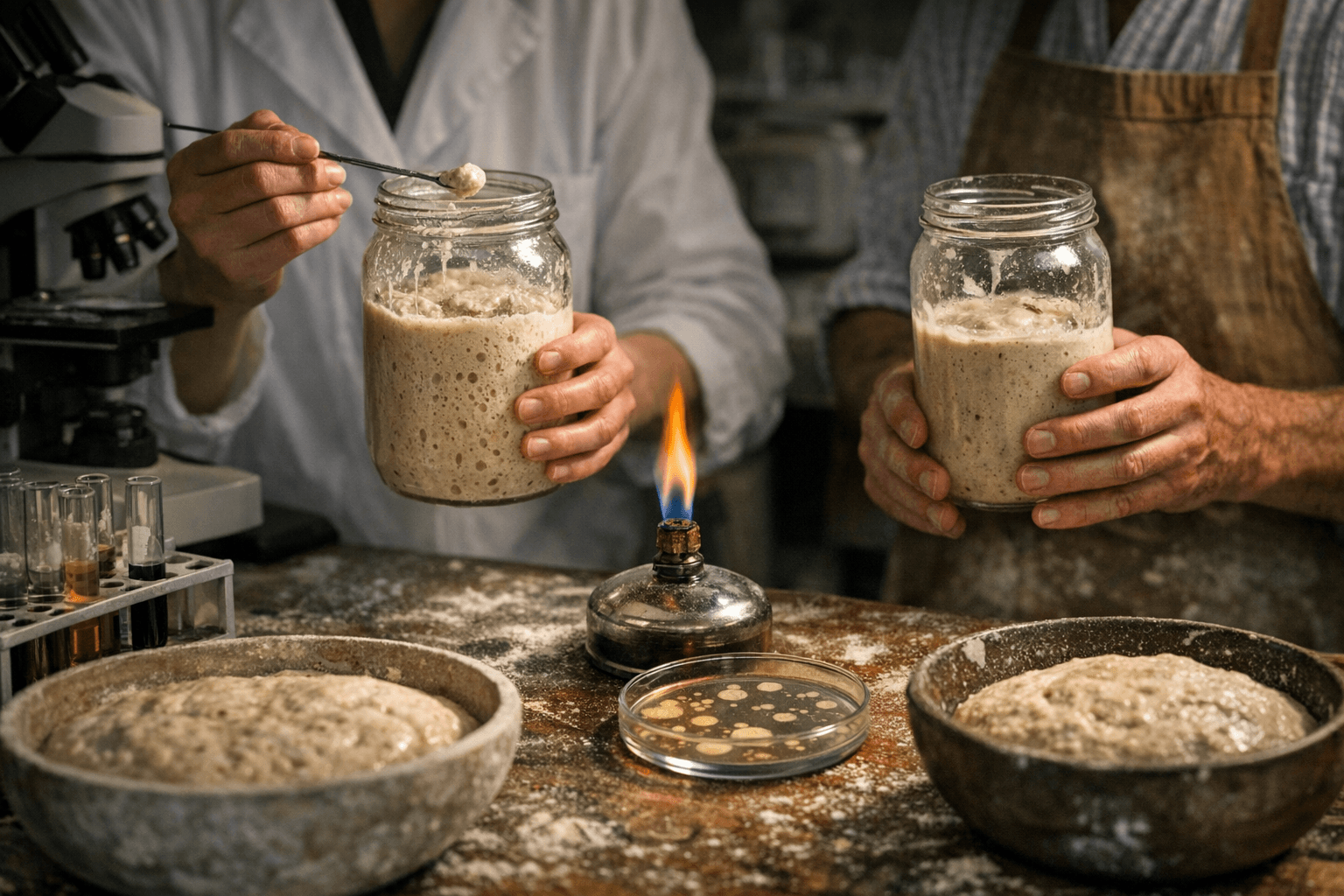
The yeast you choose to initiate a sourdough starter doesn't just determine how fast your dough rises. According to a peer-reviewed study published April 8, it determines which lactic acid bacteria will colonize your culture entirely.
Researchers used full-length 16S rRNA gene sequencing, a higher-resolution taxonomic method than the short-amplicon approaches common in earlier sourdough microbiology, to track bacterial population shifts across successive backslopping cycles in two parallel starters. One was initiated with Maudiozyma humilis LB4; the other with Saccharomyces cerevisiae C1. The two cultures diverged sharply in their dominant bacterial species over time, establishing that yeast identity is a primary driver of downstream bacterial ecology rather than a passive bystander to it.
That finding maps cleanly onto parallel research from Lesaffre, whose fermentation scientist Laura-Jeanne Rousselle summarized related co-culture experiments: "Our study revealed that the structure of the interaction indices depended on the species for yeasts and the strain for LAB. In addition, co-cultures combining M. humilis with different LAB strains showed better overall fermentation performance compared to co-cultures involving S. cerevisiae."
What "better overall fermentation performance" means in practice is the part that matters to anyone maintaining a daily-fed starter. The bacterial community that takes hold under each yeast regime correlates with measurable fermentation parameters: acidity levels, gas production rates, and metabolite profiles. Change the yeast, and you change which lactic acid bacteria win the ecological competition across refreshes, which in turn shifts your crumb structure, your sour note, and potentially your dough's FODMAP reduction and phytate breakdown capacity.
This is where the research becomes a usable framework rather than a lab curiosity. Run the study yourself with two jars and the same flour-to-water ratio. Seed one with a Saccharomyces cerevisiae-forward culture, such as a commercial yeast inoculant, and seed the other with a Maudiozyma humilis-dominant wild or specialty starter. Feed both on identical schedules with identical flour. On day one, note rise time and peak height. By day three, start smelling: which culture trends more acidic, which more malty or fruity? By day five, check dough extensibility in a small test loaf from each. The divergence the researchers captured through 16S rRNA sequencing will be playing out in sensory form right in your kitchen.
The study's authors note that full flavor, digestibility, and technological impacts require integrated metabolomic and sensory studies to fully characterize. But the microbial architecture is now clear enough to guide deliberate starter design: by pairing specific yeast strains with chosen LAB partners, bakers can select for fermentation kinetics, aroma profiles, or stability suited to their process.
For anyone who has ever wondered why a gifted starter bakes differently from one built from scratch, or why swapping flour brands can quietly shift a loaf's character over months, the answer is now sharper. Every backslop is an ecological decision, and the yeast you feed forward is conducting the bacterial succession that defines your bread.
This article was produced by Prism’s automated news system from verified source data, official records, and press releases, then run through automated quality and moderation checks before publishing. The system is built and supervised by the people who set the standards it runs under. Read our full AI policy.
Did this article answer your question?