Merrick Library Hosts Hands-On Sourdough Workshop for Beginner Bakers
Lactobacillus plantarum, the dominant bug in your sourdough starter, has been shown to selectively kill cancer cells in lab research. Anthony Pepe taught Merrick Library bakers not to kill it first.
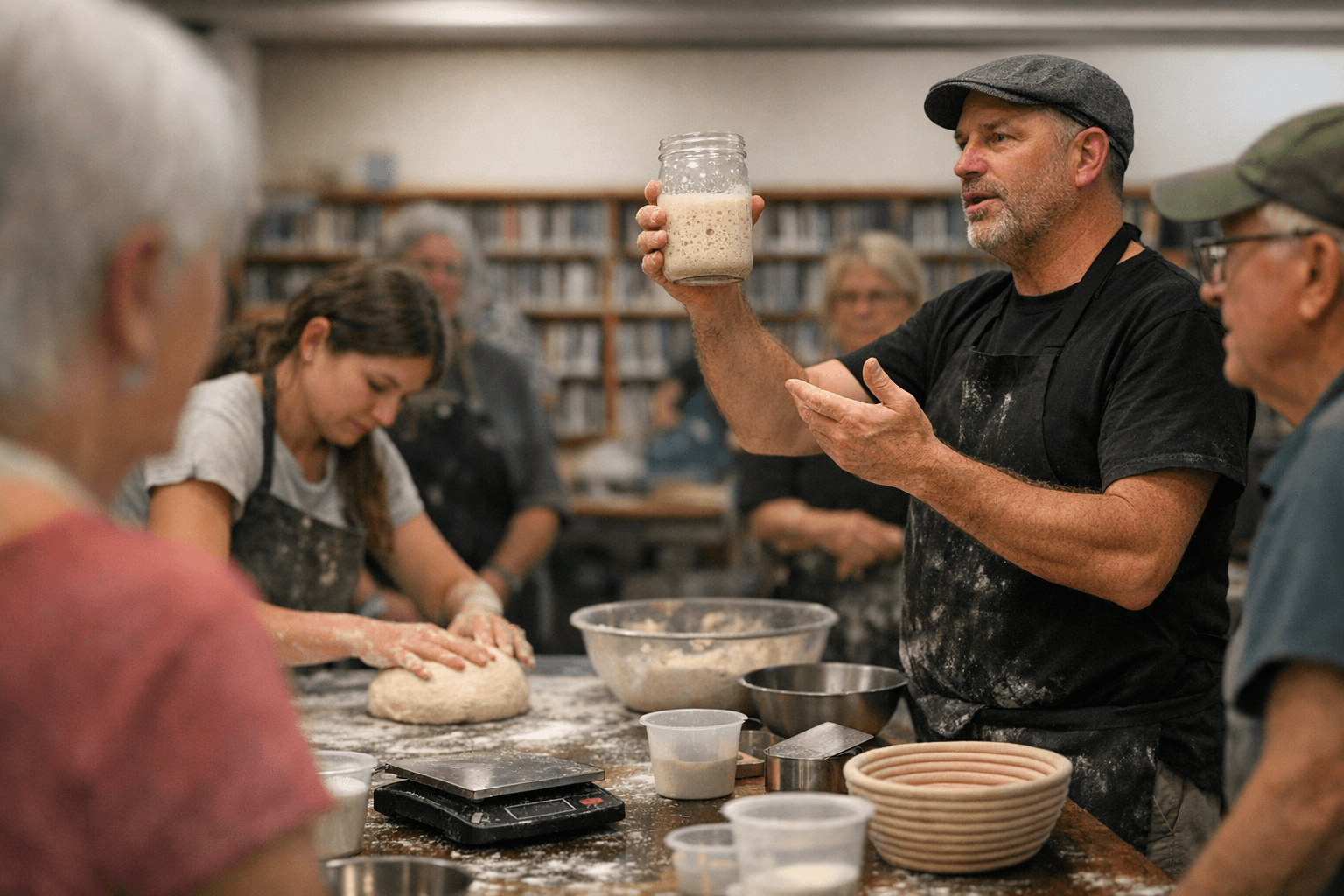
What lives in your starter may matter far more than most bakers realize. Lactobacillus plantarum, the dominant lactic acid bacterium in naturally fermented sourdough, has been the subject of peer-reviewed research showing its metabolites exhibit selective cytotoxic effects against malignant cancer cells while leaving healthy cells intact. Most beginners accidentally wipe it out in their first two weeks. That irony was the quiet context behind Anthony Pepe's "Know It All: Sourdough 101" session on April 4 at Merrick Library's community room, where he walked first-time bakers through the five places their dough is most likely to fail before it ever reaches the oven.
Pepe co-founded A Mano Baking Company with his sister, building the Lindenhurst, New York operation on old-world fermentation techniques inherited from their parents and grandparents and an original San Francisco sourdough culture they've maintained since the bakery launched. A Mano has since earned six Best of Long Island nominations. The April 4 session required registration and brought hands-on participants into direct contact with live starters and actual dough rather than slides.
The first thing that kills a beginner's starter is misreading acidity. When a starter sits unfed too long, the bacterial population floods the environment with acetic acid and the yeast dies off, leaving a gray liquid pooled at the surface. The smell shifts from ripe fruit to nail polish remover. The fix is a deep discard, down to roughly a tablespoon, followed by a fresh feed at a 1:5:5 ratio of starter to flour to water by weight. That smell is the diagnostic; if it stings your nose, the yeast is already gone.
Under-fermentation is the most common structural failure in a first loaf. A baker who pulls dough from bulk ferment too early gets dense, gummy crumb with no open structure. The diagnostic is dough volume and surface behavior: a properly fermented dough should increase 50 to 75 percent, develop a dome, and show visible bubbles along the container walls. The float test, dropping a marble-sized piece of active levain into water, provides a secondary read; if it sinks, the dough isn't ready.
Over-proofing during the final rest is the opposite problem and equally unrecoverable once it sets in. A loaf that has gone too far collapses in the oven instead of springing. The poke test is the diagnostic: indent the dough with a floured finger and watch the rebound. Slow, partial recovery means the window is closing fast. No recovery means it has already closed. Cold-proofing overnight in the refrigerator slows fermentation enough to widen the timing window for home bakers who can't watch dough constantly.
Shaping is where oven spring is built or surrendered. Without surface tension, a loaf spreads flat. The tension drag technique, pushing the dough away from the body across an unfloured surface to tighten the outer skin, is the core skill. If the surface tears during shaping, the gluten is underdeveloped or the bench rest was too short.
Scoring is the final point of failure. A blade held perpendicular to the dough drags rather than cuts cleanly. Holding a lame at a 30 to 45 degree angle and committing to a single decisive stroke is the fix. The proof shows up in the oven: a properly scored, well-tensioned loaf opens cleanly along the cut and develops a pronounced ear. No ear means something upstream went wrong, and the poke test or shaping step is where to look first.
The session at Merrick Library was free and open to the public, part of A Mano's consistent pattern of community education work with local libraries across Long Island.
This article was produced by Prism’s automated news system from verified source data, official records, and press releases, then run through automated quality and moderation checks before publishing. The system is built and supervised by the people who set the standards it runs under. Read our full AI policy.
Did this article answer your question?