Lake Powell low water reshapes Bullfrog Marina boating access
Bullfrog Marina is still on the map, but not on the old terms. Launching now depends on lake level, rerouted services, and a tighter read on conditions before you tow.
Bullfrog still works, but only if you plan for a different Lake Powell
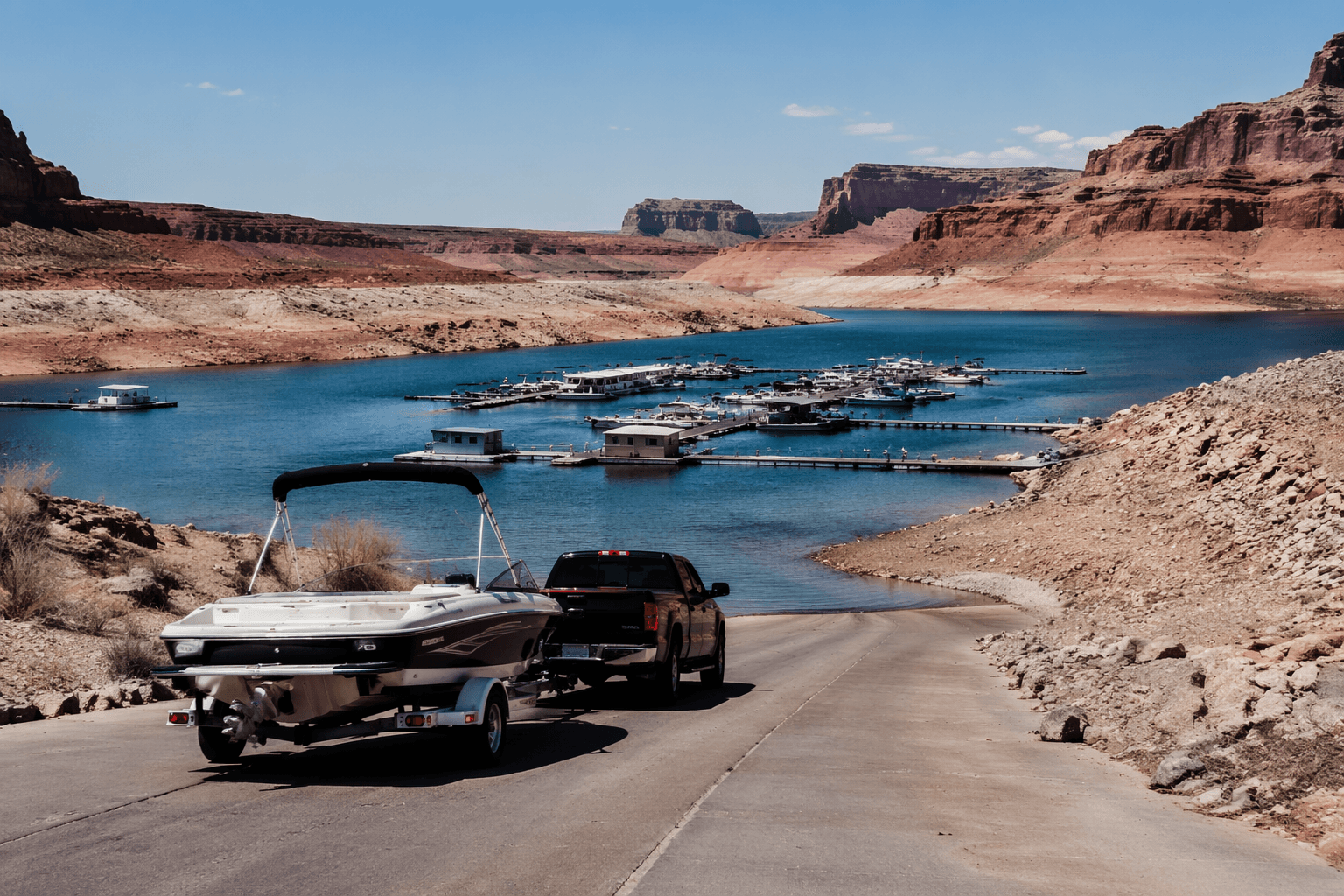
If you are heading for Bullfrog Marina expecting the old, straightforward launch day, the answer is no. You can still get on Lake Powell, but access now depends on deeper-water operations near Halls Crossing, the current lake level, and whether the ramp and marina setup can handle the day you arrive.
The National Park Service has temporarily moved Bullfrog Marina and the Bullfrog Boat Rentals/Fuel Dock into deeper water near Halls Crossing Marina. Land-based services at Bullfrog remain open, and fuel stays attached to the Bullfrog Boat Rentals dock. That keeps the area usable, but it also changes the rhythm of a trip that used to revolve around a single, familiar marina.
What changed at Bullfrog
The most important shift for boaters is that Bullfrog is no longer functioning as a simple all-in-one launch point. The park is finalizing a permanent long-term ramp at Stanton Creek at Bullfrog, built to work at lower lake elevations, but it will not be ready for summer 2026. For this season, the park is also exploring a primitive ramp in the Bullfrog and Stanton Creek area, which tells you how fluid the access picture has become.
That matters because Bullfrog is not just a dock. It is the gateway for houseboats, day boats, fishing runs, and shoreline camping trips that depend on fast, predictable water access. When the marina moves, even temporarily, the whole visitor routine shifts with it.
Halls Crossing is now the backup that matters
Halls Crossing has become the practical backup for Bullfrog boaters because it sits directly across the lake and about 95 miles upstream from Glen Canyon Dam. NPS says it includes a launch ramp, a free boat pump-out station, and a boater contact station that is staffed intermittently in summer. The launch ramp is open year-round when lake level allows, which makes it the most important piece of redundancy in this part of Lake Powell.
That does not mean it feels like business as usual. It means the trip now begins with one extra layer of decision-making: whether Bullfrog, Halls Crossing, or Stanton Creek is the safest and most workable place to start. For anyone hauling a trailer or meeting a rental boat on a schedule, that distinction is the difference between a smooth departure and a long delay.
The lake level is the real story behind the reroute
Lake Powell’s elevation was 3,527.60 feet on May 21, 2026, according to the park, and the long slide since 2001 has been reshaping the shoreline ever since. NPS says the drop has been driven by climate change and 20 years of drought, and the consequences show up in boat ramp access points, on-lake facilities, and the landscape itself.
The park warns that visitors should expect longer lines, limited parking, congestion at ramps and docks, and variable availability of restrooms, floating walkways, pump-out stations, fuel, and convenience services. In other words, the low-water story is not abstract. It is the difference between pulling in, launching, and leaving, versus waiting, rerouting, or finding a service missing from the dock you counted on.
What to check before you commit to a trip
A Lake Powell run now needs the same kind of preflight check you would give a mountain pass after a storm. Before you leave, make sure you have current information on lake levels, ramp status, and operating conditions. If your plan depends on Bullfrog, also confirm whether the workable access point is actually Bullfrog, Halls Crossing, or Stanton Creek that day.
A smart launch checklist looks like this:
- Current lake elevation and how it compares with your intended ramp
- Bullfrog, Halls Crossing, and Stanton Creek access status
- Parking and line conditions at the ramp
- Fuel availability and whether it is attached to a dock or moved elsewhere
- Pump-out, restroom, floating walkway, and convenience service availability
- Any no-wake restrictions or channel changes near your route
NPS also says its ATON team marks the primary travel channels, but it cannot mark every hazard because of the size of the lake and the way water levels keep changing. Boaters can run into newly exposed shorelines, submerged obstacles, and channels that are narrower or shifted from where they were last season. That is the kind of detail that matters most once you are already on the water.
The forecasts show why this may keep changing
The Bureau of Reclamation’s May 2026 24-Month Study projects Lake Powell could end water year 2026 near 3,510.85 feet with about 4.77 million acre-feet in storage under the probable minimum scenario. A separate probable-minimum study from April 2026 projects the reservoir could fall to 3,464.07 feet by Dec. 31, 2026. Reclamation also says the probable-minimum water year 2026 unregulated inflow into Lake Powell is 3.01 million acre-feet, or 31% of average.
That is why the access map keeps moving. In January 2026, Reclamation projected Lake Powell would start the year at 3,538.47 feet, about 162 feet below full pool and 48 feet above minimum power pool, and the current season has already shown how quickly marina planning has to adapt when the lake continues to fall. The numbers are not just hydrology; they are the reason ramp layouts, service docks, and boat routes keep being rewritten.
Why Bullfrog access still matters to the region
This is bigger than a single launch ramp. NPS says 4.72 million visitors came to Glen Canyon National Recreation Area and Rainbow Bridge National Monument in 2024, spending $518.2 million in nearby communities and generating a cumulative local economic benefit of $635.4 million. When Bullfrog access shifts, that pressure reaches beyond boaters and into the surrounding recreation economy.
For travelers, the takeaway is simple: Lake Powell remains open for water-based recreation, but the old assumptions no longer hold. If Bullfrog is your starting point, the trip now depends on checking the lake, checking the ramp, and accepting that the marina may work differently than it did last season. At Bullfrog, the adventure still starts on the water, but only after you make sure the path to the water is still there.
This article was produced by Prism’s automated news system from verified source data, official records, and press releases, then run through automated quality and moderation checks before publishing. The system is built and supervised by the people who set the standards it runs under. Read our full AI policy.
Know something we missed? Have a correction or additional information?
Submit a Tip