Aussie Tiny Mansion Adds Rooftop Deck, Doubling Its Living Space
A rooftop terrace turns the Solace into a two-level tiny mansion, making outdoor space feel like real square footage. It is a sharp sign of where premium tiny homes are headed.
Rooftop living is becoming the new luxury metric
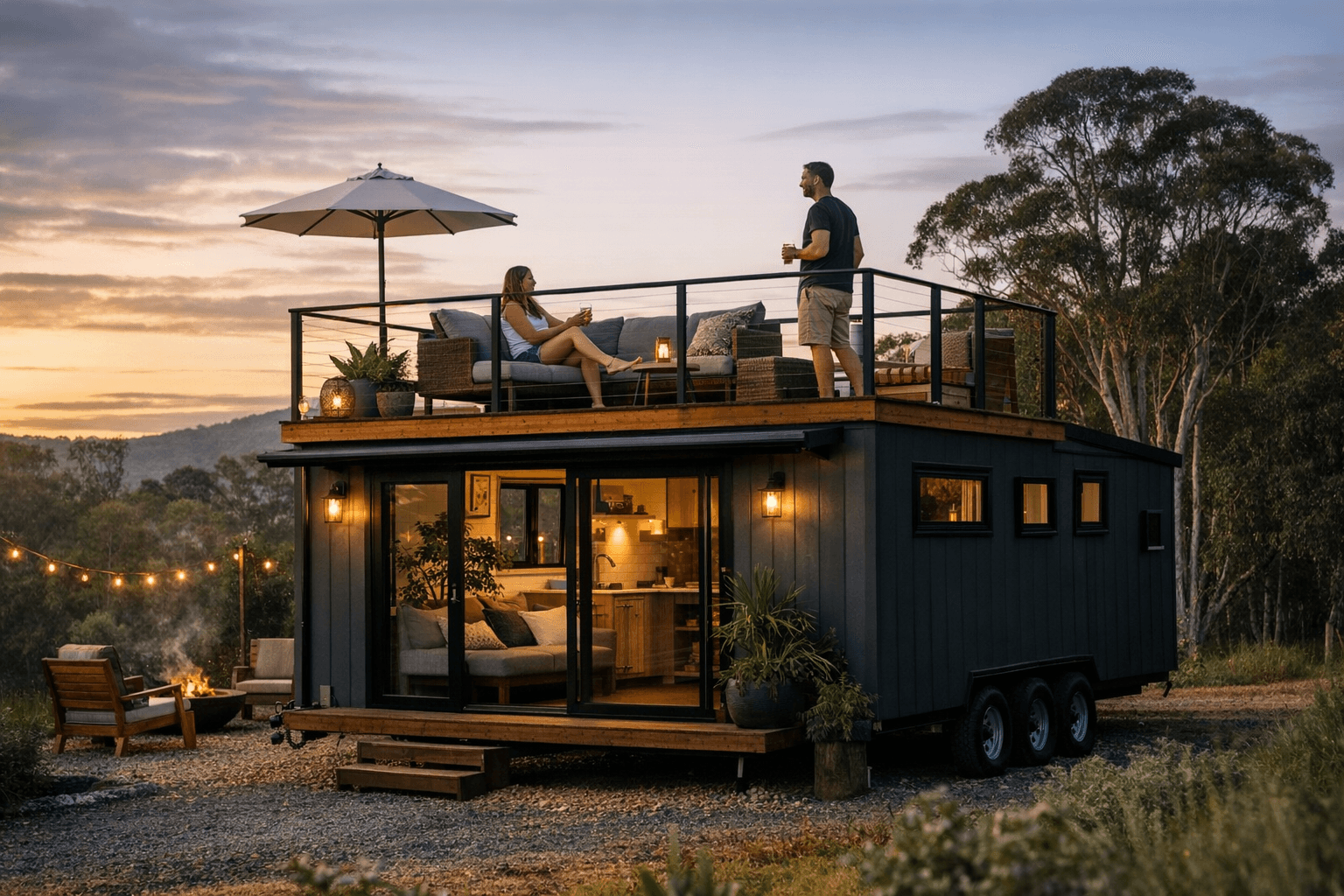
The Solace tiny home makes its biggest statement above the roofline. Built by Removed Tiny Homes in Brisbane, Queensland, this 10-meter-long, 3.4-meter-wide model is being sold as a premium tiny mansion that stretches its livable area upward with a full-length rooftop terrace, not just outward with more floor space.
That matters because the Solace is not framed as a casual tow-anywhere rig. It is limited in mobility but still relocatable, which puts it in a different lane from smaller, travel-friendly builds. This is a site-friendly tiny home designed to feel closer to a compact house than a trailer, and that is exactly why the rooftop deck lands as more than a novelty.
Why the roof deck changes the value proposition
The headline feature is the full-length rooftop terrace, reached by an external stairway. In practical terms, that adds a second hangout zone to a home that already includes a large front deck tied directly to the main living area through five-panel bi-fold doors. The result is a layout that treats outdoor square footage as part of the home’s usable footprint, not as a side benefit.
That shift is important for buyers shopping premium models. A tiny home only feels cramped when every job happens in the same interior room, so a deck that works as a real living zone can change daily use in a meaningful way. Meals, conversations, sunset drinks, quiet reading, or hosting a few guests all move outside, leaving the interior free for sleeping, cooking, and private downtime.
The rooftop space also carries a different kind of value than a ground-level porch. It gives height, privacy, and a view, three things that can make a small footprint feel far larger than the measurements suggest. In homes like the Solace, that elevated outdoor room is not just decoration. It is the feature that lets the home feel like a retreat rather than a scaled-down box.
What the Solace is built to feel like inside
Inside, the Solace leans hard into the premium end of the tiny-home market. Its single-level open floor plan, floor-to-ceiling glazing, and refined finishes are all meant to reinforce the sense that this is a polished small home, not a stripped-back cabin. The visual language is open, bright, and clean, with the indoor spaces clearly designed to flow toward the decks.
The five-panel bi-fold doors are especially important because they erase some of the boundary between the main living area and the front deck. That makes the ground-level outdoor space feel less like an add-on and more like an extension of the interior plan. For buyers who want the tiny-home lifestyle without sacrificing the feeling of space, that kind of transition can matter as much as raw square footage.
The choice of a rooftop terrace fits the same logic. Tiny-home builders are increasingly treating decks, terraces, and outdoor rooms as part of the floor plan, especially at the premium end where finish quality and lifestyle sell the home as much as size does. The Solace is a clean example of that approach, using height to expand livability instead of relying only on a longer or wider shell.
How much living space does the deck really add?
The honest answer is that the rooftop deck does not add interior square footage, but it does add functional living area. That distinction matters for anyone comparing premium tiny homes, because the real question is not only how many square feet sit under the roof, but how many places the home gives you to actually live.
With a rooftop terrace and a large front deck, the Solace essentially gives owners two separate outdoor zones. One works in direct connection with the main living area, while the other creates an elevated second destination. Together, they can reduce pressure on the interior, which is often the biggest problem in small homes that try to do everything in one open room.
That is why the deck feels so central to the sales pitch. It changes how the home functions across the day. Morning coffee can happen outside, midday work or reading can move to the shaded interior, and evenings can shift back to the roof for views and entertaining. The home stays compact, but the lifestyle around it becomes much larger.
Who this layout suits best
The Solace is built for buyers who value comfort, presentation, and a strong indoor-outdoor lifestyle more than all-terrain flexibility. If you want a premium tiny home that feels site-ready and polished, this is the kind of model that makes sense. If you want a unit that can be moved often and easily, the limited mobility will be a bigger consideration.
This type of design also fits buyers who are willing to trade pure portability for a stronger sense of permanence. The scale, the finishes, and the rooftop terrace all point toward a home that is meant to settle in and perform like a small custom residence. That makes it especially appealing to people who want tiny-home efficiency without giving up the social and visual advantages of a larger house.
For the broader tiny-house community, the Solace is another sign that premium builders are no longer selling size alone. They are selling usable atmosphere, layered outdoor space, and the feeling that a compact footprint can still live large. In that market, a rooftop deck is not just an extra feature anymore. It is becoming the proof that tiny-home living can expand upward as well as outward.
This article was produced by Prism’s automated news system from verified source data, official records, and press releases, then run through automated quality and moderation checks before publishing. The system is built and supervised by the people who set the standards it runs under. Read our full AI policy.
Did this article answer your question?