Escape Traveler Glass House brings park-model living closer to a real home
Escape’s Glass House pushes tiny living toward cabin-level comfort, but the bigger footprint, fixed siting, and $146,830 starting price make the tradeoffs obvious.
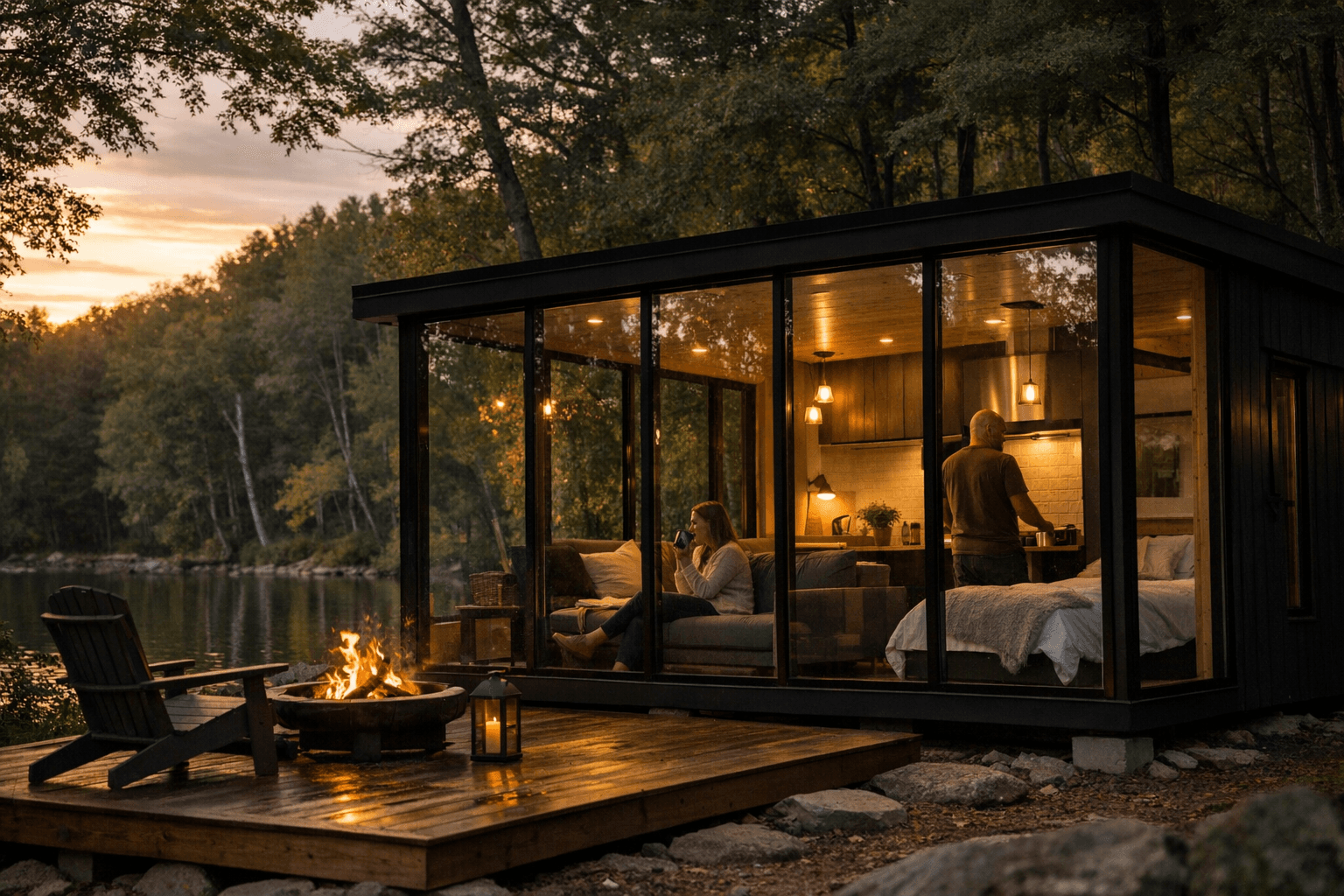
A tiny home that reads like a small lakeside house
Escape Traveler’s Glass House is not trying to look spare. It stretches the builder’s Classic King XL platform into something much closer to a real home, with a massive wall of glass in the living area, another glass wall in the bedroom, and glass French doors that open onto a large screened porch. When those doors are open, Escape says the combined living-and-porch zone runs 27 feet, which is the kind of detail that tells you exactly where this design is headed: comfort, openness, and view-first living.
That is the big shift here. The Glass House is still part of the tiny-house world, but it is moving away from the stripped-down, road-ready image that started the category. This one is about sitting still, looking out at the water, and living more like you would in a compact cabin than in a minimalist trailer.
What Escape actually built
Under the glass and finish work, the numbers are still very specific. Escape lists the Classic King XL at 45 feet long, 11 feet 5 inches wide, and 13 feet 6 inches high, with 520 square feet including the screened porch. It sits on a steel trailer with four axles and radial tires, and Escape says it is RVIA member certified. The introductory base price is $146,830.
Those details matter because they show how far the product has drifted from the old tiny-house formula. This is not a bare-bones shell, and it is not sized like a compact RV. It is a premium, highly finished park-model-style home that happens to be built on a trailer platform.
Escape also loads the interior with practical upgrades that tilt it further toward a conventional home feel. The layout includes an all-electric design, a king bedroom, expanded storage, an optional electric fireplace, a built-in Smart TV, a versatile dining and work table with USB power, and bathroom options such as a custom walk-in tile shower and washer-dryer.
Why the classification matters more than the glass
The legal category is the part most buyers should pay attention to first. Wisconsin defines a park model as a recreational vehicle built on a single chassis, mounted on wheels, with no more than 400 square feet of gross trailer area in setup mode and ANSI A119.5 certification. HUD’s guidance uses the same 400-square-foot threshold for the RV exemption tied to park-model recreational vehicles.
That is why the Glass House is so interesting. At 520 square feet including the screened porch, it sits beyond the standard size definition that usually keeps park models in the RV-like lane. The result is a home that behaves more like a small permanent retreat, even if it is still riding on a trailer base. In practical terms, that changes how you think about where it can go, how it can be permitted, and how mobile it really is once it is placed.
This is the main tradeoff in the modern tiny-home market: the more the product looks and lives like a house, the less it behaves like one you can freely move around. The Glass House makes that tension visible instead of hiding it.
Canoe Bay Village is doing more than hosting the model
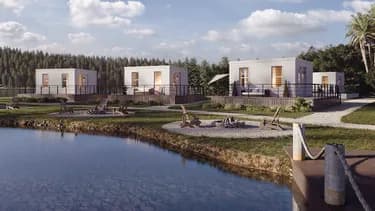
Escape places the Classic King XL at Lost Lake in Canoe Bay Village in Wisconsin, and that setting is part of the pitch. Escape describes Canoe Bay Village as sitting on more than 100 acres of rolling mixed hardwood forests, with wetlands and two private lakes, Mallard Lake and Lost Lake. Escape Vacations goes a step further and calls Canoe Bay Village the Midwest’s largest tiny house resort.
That matters because the Glass House is being sold on location, not as a roam-anywhere trailer you hitch up and haul off into the sunset. The home is tied to a resort-style setting, and that context shapes the whole experience. With lake views, a screened porch, and a wall of glass, the design is clearly meant to turn the site into the asset.
A key comparison also appeared in Tiny House Talk’s April 11, 2026 listing for a brand-new turnkey unit at Canoe Bay Village on Lost Lake, which highlighted a 30-foot wall of glass and lakefront views. That reinforces the same point from another angle: the newest offerings in this space are leaning harder into scenery, turnkey setup, and the feeling of a small vacation home.
A model with a longer runway than a trend piece
The Glass House did not appear out of nowhere. Woodall’s Campground Magazine reported in August 2024 that Escape Homes reintroduced the Classic King as a modernized version of an earlier design developed by founder Dan Dobrowolski after customers responded strongly to his Prairie-style cottages at Canoe Bay. That same report said the original Classic King came in at under $120,000, measured 12 feet by 40 feet, and marked both the 10th anniversary of Escape Homes and the 30th anniversary of Canoe Bay.
Woodall’s also reported more than 25,000 inquiries in the first 48 hours when the original 400-square-foot cabin debuted at Canoe Bay. That is the kind of response that explains why Escape keeps pushing the format upward. When a concept draws that much attention, the temptation is obvious: make it bigger, make it brighter, and make it feel more like a real home.
That is exactly what the Glass House does. It keeps the tiny-home branding, but the execution is getting more residential, more polished, and more expensive.
What you gain, and what you give up
If you are tracking where the tiny-house market is headed, the Glass House is a clean example of the premium park-model lane. What you gain is easy to see: more glass, more light, more usable space, a king bedroom, better storage, and a porch that acts like an outdoor room. The lakefront setting makes the whole package feel less cramped and more livable.
What you lose is just as clear. You give up the freedom of a true tow-anywhere tiny house, you step into a more fixed siting reality, and you move into a price bracket that starts to overlap with conventional small-home budgets. Once you are at 520 square feet with a screened porch and resort placement, you are no longer talking about minimalist living in the old sense.
The Glass House is evidence that park-model living is drifting toward conventional-home expectations. It is still tiny by house standards, but it is no longer tiny in spirit. It is a small, high-end home that treats the view, the site, and the finishes as the main event, and that may be the future of the category.
This article was produced by Prism’s automated news system from verified source data, official records, and press releases, then run through automated quality and moderation checks before publishing. The system is built and supervised by the people who set the standards it runs under. Read our full AI policy.
Did this article answer your question?