Backcountry Tiny Homes’ extra-wide Knoll blends recreation and daily living
The Knoll’s library loft and 10-foot width make a sharp case for tiny houses with real hobbies built in. But the extra room comes with permit-heavy transport and a more permanent footprint.
The library loft is the tell
The smartest thing about Backcountry Tiny Homes’ Knoll is not the color, the trailer, or even the extra width. It is the library loft, because that one move changes the whole argument for the house. Instead of treating the loft as a grudging place to sleep, the Knoll uses its taller, wider shell to carve out space for reading, storage, and actual recreation without squeezing the rest of the floor plan.
That matters because the Knoll is not trying to cosplay as a stripped-down cabin. It is trying to show that a tiny house can support a real daily routine, with a place for hobbies, a proper living area, and enough visual warmth to feel lived in rather than improvised.
An extra-wide build that buys room, and costs mobility
The Knoll is a 38-foot-long, 10-foot-wide gooseneck tiny house built on a triple-axle trailer. That extra width is not a styling flourish. It is what gives Backcountry Tiny Homes enough room to make the interior feel more apartment-like and to fit the library loft without gutting the main living space.
The tradeoff is simple: a 10-foot-wide tiny house is not a casual tow. Federal trucking rules set a 102-inch width limit for vehicles on the National Network, and states can issue special-use permits for loads wider than that. If you want this kind of footprint, you are stepping into a build that makes far more sense for someone planning to settle in than for someone who expects to move every few months.
Color and texture do the heavy lifting inside
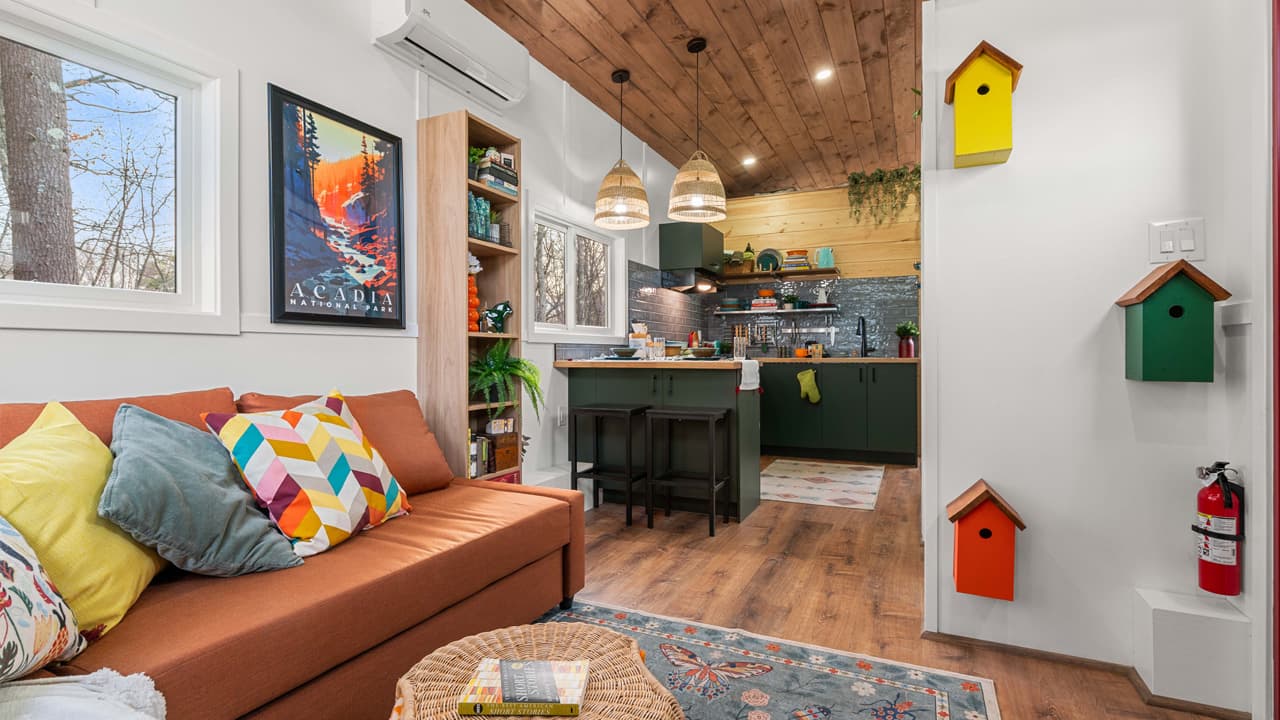
The exterior stays restrained, with two-tone metal and board-and-batten siding, but the interior goes in the opposite direction. Backcountry Tiny Homes leans into painted board-and-batten walls, natural tongue-and-groove accents, a stained knotty pine ceiling, and vinyl flooring. The effect is not loud for the sake of being loud; it is deliberate contrast, the kind that makes a tiny interior feel fuller and more permanent.
That is the real lesson here. Color and texture are not just decorative in a small house. In a compact plan, they shape how generous the space feels, especially when the shell is larger than standard and the furnishings have to work hard. The Knoll uses that palette to make the house feel intentional instead of minimal by default.
The living area is built for actual use, not just photos
The front door, painted bright red, opens into an open kitchen and living area that gets strong daylight through well-placed windows. That matters because the house’s wide footprint would mean little if the interior still felt dim or chopped up. Here, the light helps the layout read more like a small apartment than a corridor with furniture.
The living room keeps that practical tone. It includes a sleeper sofa, coffee table, open cabinet, bookshelf, and entertainment unit, which gives the space the kind of everyday utility tiny-house buyers actually look for. Nothing in that room feels like it was added just to stage a tour video; it feels arranged for someone who wants to sit, store things, watch something, and live there.
A kitchen with personality that still works like a kitchen
The kitchen follows the same logic. Hunter’s green cabinetry, butcher-block countertops, and a breakfast counter give it personality, but the layout still reads as functional first. This is the sort of kitchen that makes sense in a tiny house where the owner expects to cook, not just reheat.
That balance is the point of the Knoll as a whole. Tiny-house design gets stale fast when it treats function and identity as opposites. The Knoll shows a better route: make the kitchen memorable, make the surfaces warm, and keep the workflow straightforward enough that the house can handle day-to-day living without feeling precious.
What the Knoll says about the tiny-house category
The Knoll also pushes right against the usual tiny-house formula. A standard setup often revolves around a sleeping loft above a ground-floor kitchen and living area. By using a larger shell and adding a library loft, Backcountry Tiny Homes shows that the category can make room for more than one life pattern.
That matters because tiny-house code discussions commonly define a tiny house as 400 square feet or less, excluding lofts. A 38-foot gooseneck with a dedicated library loft still lives within the tiny-house conversation, but it stretches the idea in a way that may appeal more to buyers who want a long-term home than to buyers chasing a minimalist novelty.
Why this build fits the movement’s larger history
The Knoll does not appear out of nowhere. Jay Shafer says he began building a very small house on wheels in 1997, and by the summer of 1999, his dwelling and The Small House Book were complete. He also says the house has been featured by more than 200 media outlets. That history helps explain why designs like the Knoll matter now: the movement has been pressing for years toward housing that is smaller, more affordable, and more livable without feeling punishing.
That broader framing also matches the work of organizations such as the Small House Society, founded in 2002 to promote smaller housing alternatives that can be more affordable and ecological. The Knoll fits into that lineage, but it updates it with a more polished, personality-driven approach that is less about sacrifice and more about fit.
Who the Knoll is really for
Backcountry Tiny Homes describes itself as a woman-owned carpentry, construction, and engineering company in Hampstead, New Hampshire, specializing in mobile tiny home design and construction, with design, construction, and build classes as part of its offer. That background shows in the Knoll’s confidence: this is not a novelty shell pretending to be a house, but a mobile build that understands structure, transport, and livability at the same time.
The Knoll is best read as a tiny house for someone who wants to stay put, unpack, and keep hobbies in the mix. Its extra width, triple-axle foundation, and library loft solve real tiny-house pain points such as storage, function, and personality, but they also move the build closer to a niche product that asks for more planning, more permits, and more commitment. That is not a flaw. It is the price of turning tiny living into something you can actually enjoy long term.
This article was produced by Prism’s automated news system from verified source data, official records, and press releases, then run through automated quality and moderation checks before publishing. The system is built and supervised by the people who set the standards it runs under. Read our full AI policy.
Did this article answer your question?