Bengaluru tiny house uses perforated brick facade and garden cooling
A Bengaluru house turns a brick jaali and garden void into a cooling system, showing how tiny-house thinking can beat heat without shrinking comfort.
A bigger home that thinks like a small one
An architectural designer’s post with 300-plus likes has pushed the Big-Little House into the tiny-house conversation for one simple reason: it treats heat control as part of the floor plan. Completed in 2023 in Bengaluru, India, by Kamat & Rozario Architecture, the home is listed at 2,450 ft², yet the firm describes it as “a large house built on a small plot.”
That tension is the point. The project sits on a 1,500-square-foot site, and one-fourth of that land was deliberately left unbuilt as a garden. In a city where hot, humid conditions make air conditioning feel like a default answer, this house shows a different route: open space, shade, and breathable surfaces doing work that mechanical systems usually shoulder.
The garden is not leftover space
The garden is the project’s real engine, not a decorative afterthought. The major living spaces, a double-height living room, family space, dining area, and kitchen, all overlook it, so daily life stays visually tied to the planted void. That choice gives the home a larger sense of volume without demanding a larger footprint.
The car park was also lowered in height so the kitchen and dining above stay connected to the garden volume. That matters because it stops the site from feeling chopped into isolated boxes. Instead, the house behaves as one continuous sequence of inside and outside, which is exactly the kind of spatial trick tiny-house builders can borrow when every square foot has to feel generous.
The plot next to a eucalyptus plantation adds another layer. The architects describe that stand of trees as a vertical extension of the garden, and it gives the upper floors their own green outlook, turning borrowed landscape into part of the cooling strategy.
The brick screen does more than look good
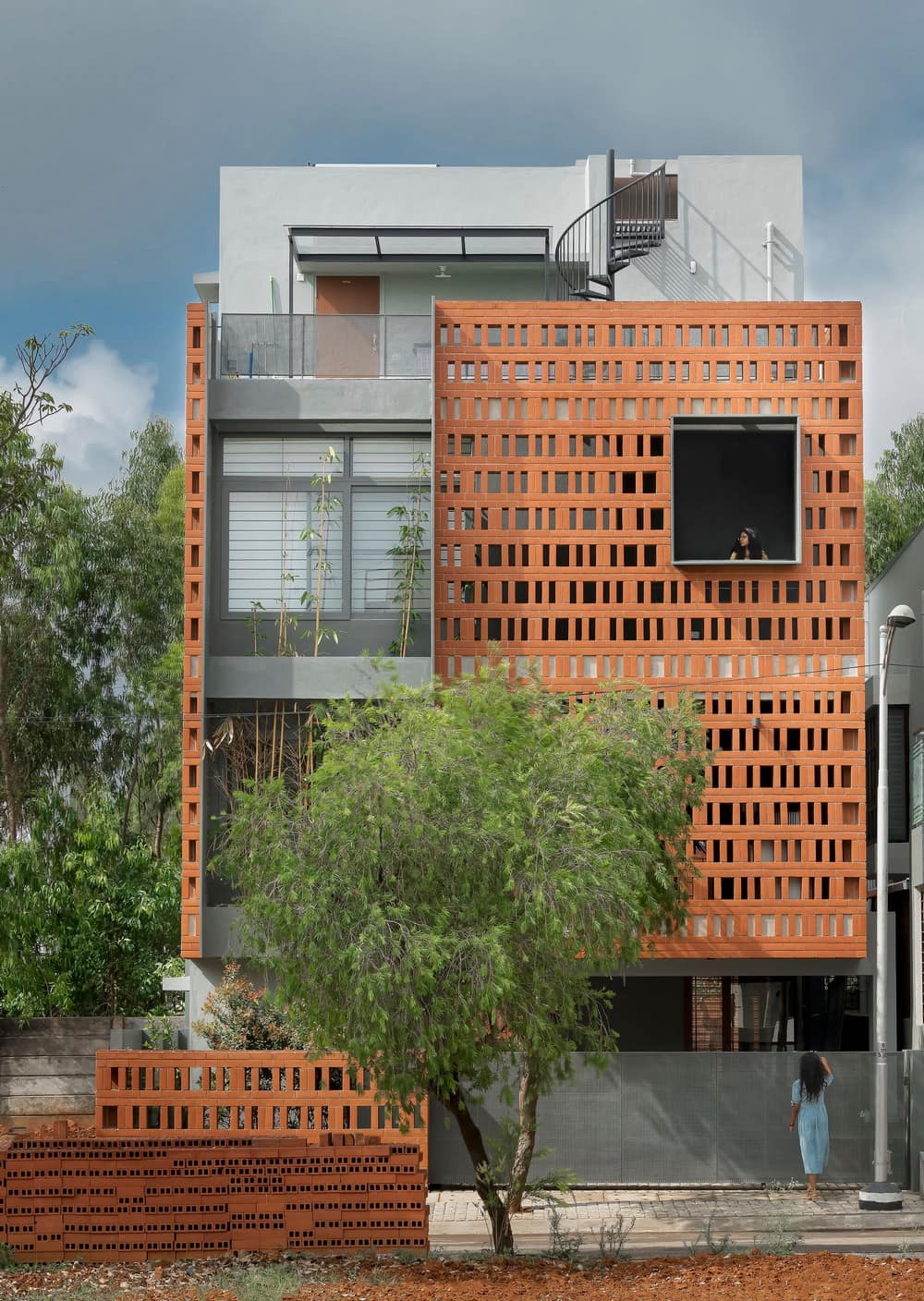
The front facade is where the house stops being merely compact and starts becoming climate-smart. It was conceived as a brick screen, or brick jaali, to conceal service areas such as the utility space. Instead of a flat wall, the architects experimented with stacking bricks on edge, creating a playful, permeable surface that filters views and air at the same time.
That permeability is not just visual. Coverage from uni.xyz notes that bamboo grows through the voids, so the facade reads like a planted vertical garden, with greenery threading itself through the brickwork. The result is a boundary that feels alive rather than sealed, which is a useful lesson for any builder trying to reduce solar gain without turning a home into a bunker.
A large metal box interrupts the screen to connect the street to the kids’ bedroom, which keeps the facade from becoming a monotone veil. It also shows how a carefully placed solid element can puncture a porous envelope without destroying the whole idea. For small homes, that balance between openness and privacy is often the hardest part to get right.
Split levels stretch space without stretching the plot
The house also uses split levels to reduce the perceived building volume. Architizer and the project team both point to this move as part of the home’s spatial strategy, and it is a smart one for dense cities because it lets a modest site feel layered rather than cramped. You do not need a bigger shell when the interior can shift in height and section to create moments of expansion.
Upstairs, the program stays compact and practical, with two bedrooms and a master bedroom sharing a common terrace. That terrace keeps the upper floor from becoming sealed off from the rest of the house. In hot climates, these in-between spaces matter because they give you shade, air movement, and another place to live that does not rely on conditioned air.
The project has also circulated under slightly different listing details, which is common in architecture coverage of built work. ArchDaily identifies the project area as 2,450 ft² and the plot as 1,500 square feet, while the firm’s own page refers to an 1,800-square-foot plot. Archello places it at JR Greenpark, Chandapura-Anekal Road, Marsur, Karnataka, India, underscoring how often one house can travel through several catalogues with slightly different framing while the design logic stays the same.
What tiny-house builders can borrow from Bengaluru
The Big-Little House is not a copy-paste template, but its moves are realistic for small-footprint projects anywhere heat is a problem.
- Leave a real outdoor void. One-fourth of the site became garden space, and that emptiness does more than fill a checklist. It cools, brightens, and gives the house a breathing room that tiny homes often lose when every edge gets built out.
- Put service spaces behind a breathable skin. The brick screen hides utility areas while still allowing the facade to work as a filter. For smaller homes, that means the ugly-but-necessary rooms can disappear into a layer that also blocks glare and heat.
- Use section, not just plan, to create generosity. Split levels and a lowered car park let the main rooms stay visually tied to the garden. In a compact build, vertical shifts can do the work that extra square footage usually promises.
- Treat planting as infrastructure. Bamboo growing through the brick voids turns the facade into a living edge. Even a much smaller home can use vines, trellises, or narrow planting bands to soften heat and break up hard surfaces.
- Connect rooms to something cooler than themselves. The eucalyptus plantation matters here because it gives the upper floor shade, views, and a sense of depth. Tiny-house design gets stronger when every window is aimed at relief, not just daylight.
Big-Little House works because it never asks a small site to behave like a sealed box. It uses brick, garden, section, and shade to make room where the footprint cannot, and that is the lesson that will travel far beyond Bengaluru.
Know something we missed? Have a correction or additional information?
Submit a Tip