French Tiny House Gains Space with 33-Square-Meter Covered Patio
A 33-square-meter covered patio turns this French tiny house into something that lives bigger than its footprint. It is a smart move when you want real outdoor room, not just a bigger box.
Why Une Maxi works
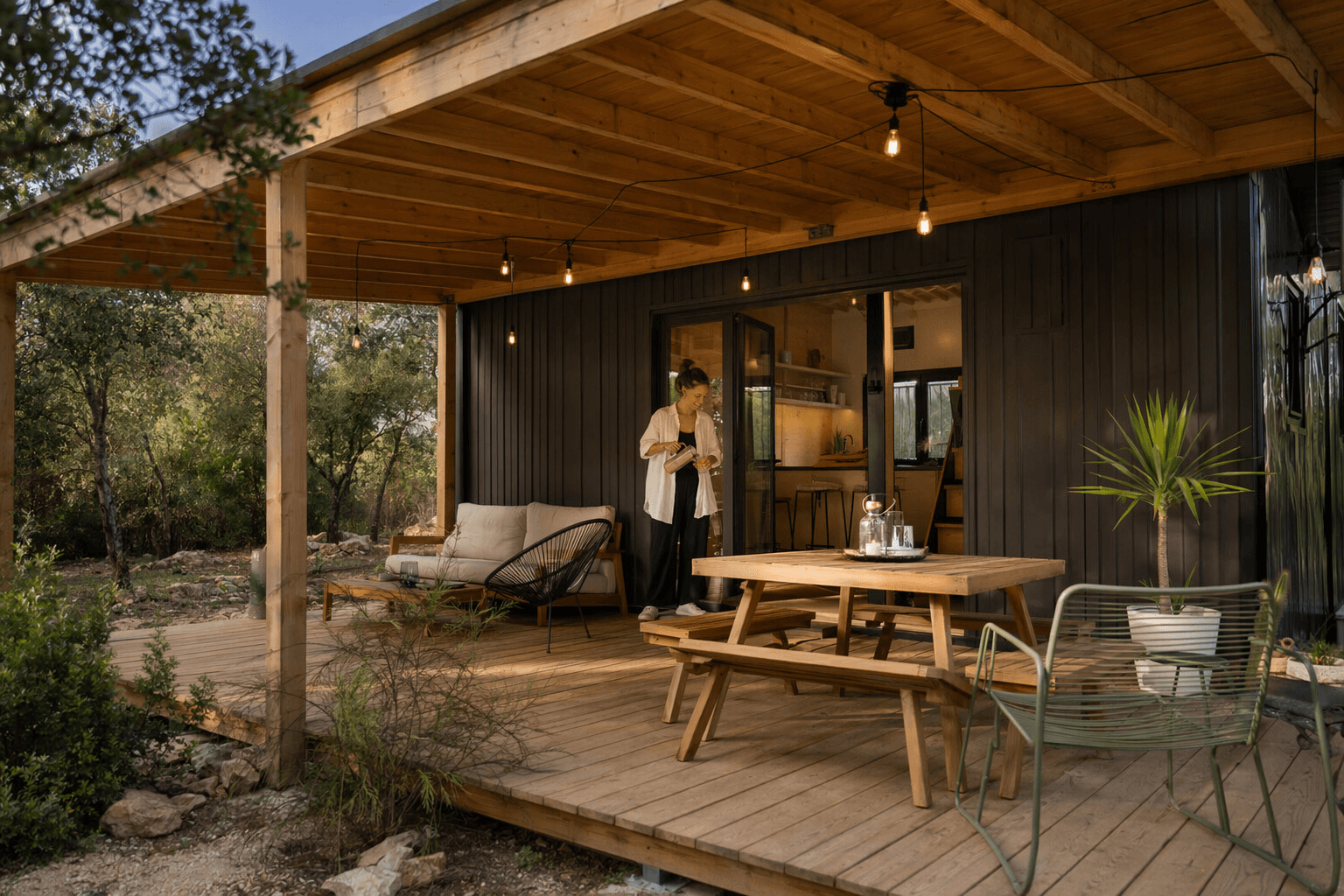
Floriane and Benjamin did not try to beat tiny-house living by stuffing in more cabinets or a loft trick. They left a conventional house behind and asked for something simpler, warmer, and better matched to the way they actually live. The result is a turnkey tiny house meant to work as a principal residence, and its smartest move is obvious the moment you look at it: a 33-square-meter L-shaped covered patio that acts like bonus square footage without enlarging the main living box.
That is the part worth paying attention to. This home is not selling the fantasy of “small but cute.” It is solving the real tiny-house problem, which is claustrophobia. By pushing daily life outward, the build makes the compact interior feel less like a compromise and more like one piece of a larger, usable whole.
The outdoor room is the real floor plan
The covered patio is not decorative overflow. At 33 square meters, it is large enough to function as a true outdoor room, and the L-shape matters because it creates zones instead of one flat slab of space. You can imagine a dining corner, a lounging corner, and a protected circulation path that keeps the patio usable even when weather shifts.
That is why this layout feels more generous than many tiny houses with more square meters inside. The main cabin stays compact, but the patio extends daily life into a space that can handle morning coffee, drying gear, evening meals, and casual hosting without making the interior carry all the load. In tiny-house terms, that is not a nice extra. It is the difference between feeling boxed in and feeling like you have room to breathe.
Why this couple’s brief makes sense
Floriane and Benjamin had already lived in a conventional house, so they were not chasing tiny-house living as a novelty. They had enough real-world housing experience to know that what they wanted was not simply less space, but better space. La Tiny House describes their goal as a turnkey main residence that would be warmer and more aligned with their needs, and that framing explains every design choice here.
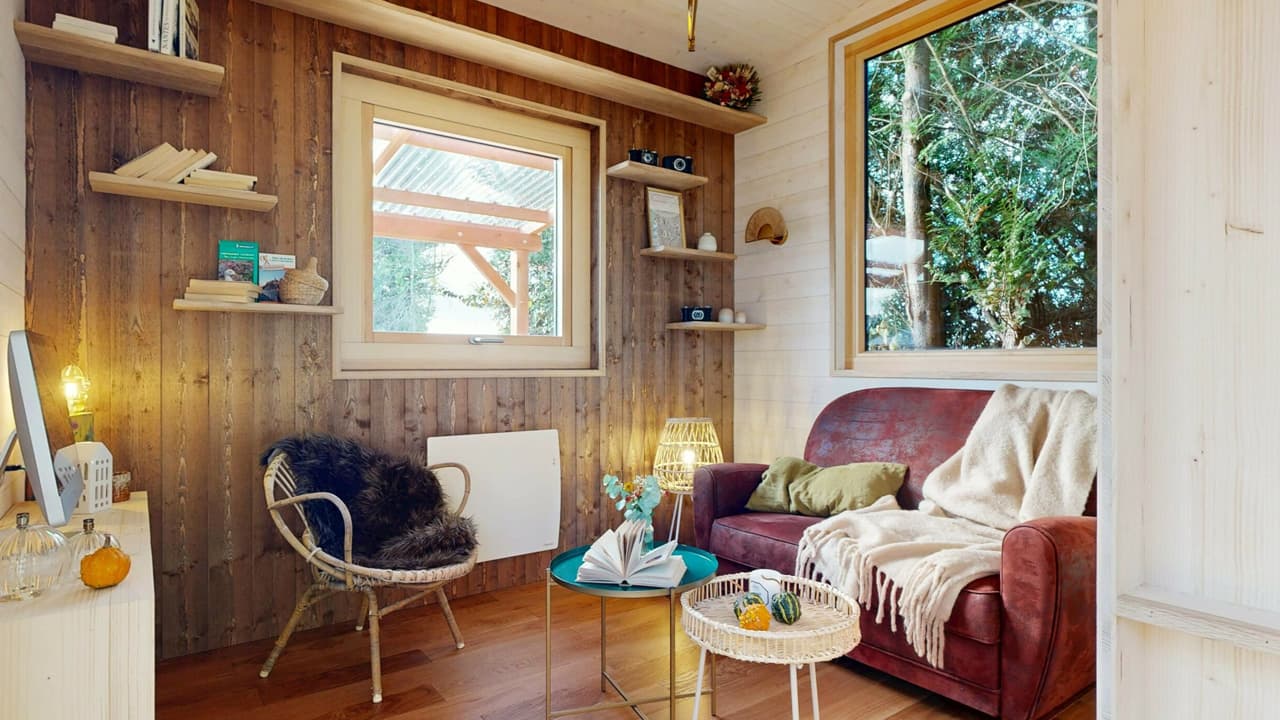
That is also why the build feels so practical. The interior is described as complete and comfortable for everyday life, with the necessary amenities already built in. The house is based on a custom-made chassis, which signals that this was not pulled from a generic catalog and dressed up with a few nice finishes. It was sized for real use, not for a brochure.
When a covered patio beats more interior square footage
A patio like this works best when the site supports outdoor living for a meaningful part of the year. Mild climates are the obvious win, but shade, wind protection, and rain cover matter just as much. If your site gives you privacy, a covered patio becomes an extension of the home instead of a stage set you only use on special occasions.
It is also a smart move when entertaining matters. Tiny interiors can feel awkward the second more than two or three people show up, but a covered patio changes the equation fast. You can host outside, cook outside, and spread out without turning the living room into a traffic jam. If your real frustration with a tiny house is that there is nowhere to sit with guests except in the middle of your kitchen, the patio solves more than another two or three square meters ever could.
The indoor-outdoor flow is the other big win. A covered edge between house and yard gives the home a softer transition than a hard doorway. That matters in a tiny house, where every threshold is magnified. The more naturally you can move from inside to outside, the less the house feels like a sealed box.
When the patio is the smarter upgrade
This is the kind of design choice I would recommend over adding interior space when the bedroom, kitchen, and bathroom are already functional and the real pressure point is living room crowding. If the inside is basically working, but the home still feels tight, the outdoor room is a cleaner fix than stretching the chassis or forcing in another awkward loft.
It is also the better move when handcrafted structure is part of the appeal. La Tiny House has a reputation for wooden structures, and this project leans hard into that strength. Earlier models from the builder were usually much smaller, often in the 10- to 15-square-meter range with one or two mezzanines of 5 to 7 square meters, so this build shows a different strategy: instead of relying only on internal stacking, it grows through covered exterior space.
That approach is particularly compelling if you want the home to feel less like a capsule and more like a small house with a real perimeter. In other words, if you care more about lived comfort than bragging rights on interior square meters, this is the more sensible upgrade.
The French tiny-house context matters
This project also fits into a bigger shift in France, where mobile wooden homes are increasingly treated as legitimate full-time housing rather than hobby builds. La Tiny House typically offers optional bathrooms, kitchens, and customized finishes, and that flexibility is part of why its homes work as actual residences instead of weekend toys. The company’s earlier basic 4-meter model started at €23,500, which gives a useful sense of how broad the range is, from entry-level small builds to more ambitious custom homes like this one.
The legal backdrop is just as important. French rules distinguish between habitation légère de loisirs and other categories of mobile housing, and placement depends on where the structure sits and how it is used. Those rules help explain why a fully custom principal residence carries more weight than a style statement. It is not just a tiny house with a nice patio. It is part of the ongoing normalization of tiny houses as year-round homes, with all the site, use, and authorization questions that come with that.
What Une Maxi gets right
The reason this build lands is that it understands scale in the way tiny-house people actually live it. Space is not only measured in what sits inside four walls. It is also the covered threshold, the shaded seating area, the place where a meal can happen without rearranging the whole house, and the buffer that keeps a compact home from feeling cramped.
Une Maxi makes a strong case that the best tiny houses do not just shrink housing. They edit it. Floriane and Benjamin chose a home that is practical, warm, and dimensioned to their lives, and the 33-square-meter covered patio is the part that makes the whole idea work.
This article was produced by Prism’s automated news system from verified source data, official records, and press releases, then run through automated quality and moderation checks before publishing. The system is built and supervised by the people who set the standards it runs under. Read our full AI policy.
Did this article answer your question?