French tiny house uses hammock floor to link family lofts
A hammock floor turns a tight French tiny house into a real family layout, not a novelty. In Haute-Savoie, that’s the kind of space-saving move that actually earns its keep.

A tiny house that was designed for a family, not a couple
Aurelie and Stefano’s French tiny house works because it starts with the household’s actual problem: how to live comfortably in Haute-Savoie without paying full-price for conventional housing in one of eastern France’s priciest departments. Tiny Concept built the home as a custom project for that reality, and the result is a compact interior that treats family life as the baseline, not an afterthought.
That matters more than the usual tiny-house charm offensive. This is not a box with one bed and a ladder dressed up as a lifestyle statement. It is a fully thought-out family cabin on wheels, built around sleeping, storage, circulation, and the daily routines that make or break tiny living when more than one person has to use the same square footage all day.
Why the site choice matters as much as the floor plan
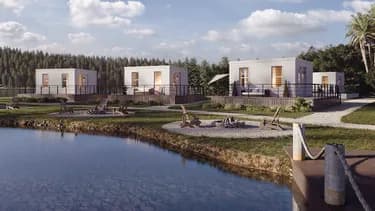
The siting tells you almost everything about how this home functions day to day. Aurelie and Stefano placed the tiny house on an old campsite, where they already had access to electricity and water, which removes a lot of the friction that usually makes tiny-house living feel improvised. The campsite owners also required water-flush toilets tied into the site’s wastewater system, so the setup is practical rather than romanticized off-grid theater.
That detail is worth underlining because family viability in tiny living often comes down to boring infrastructure. When power, water, and wastewater are handled cleanly, the family can focus on living in the house instead of managing workarounds. For a young household in Haute-Savoie, that kind of site arrangement is not a compromise on paper, it is what makes the whole idea workable.
The hammock floor is the real family move
The most distinctive feature is the net insertion, also described as a hammock floor, stretched between the two lofts. In tiny-house terms, that is not just a design flourish. It is a circulation solution, a shared lounge, and a way to connect upper sleeping zones without spending precious floor area on a second staircase or ladder.
That is the key thing family tiny homes get wrong all the time: they stack beds, then forget that people still need to move, sit, play, and decompress. Here, the netted middle span gives the home a sense of openness that a rigid hallway or extra stair would kill. It also adds a playful, almost treehouse-like space without sacrificing the efficiency the family needs every single day.
This is what makes the feature more than a social-media stunt. The hammock floor is doing three jobs at once, and all three matter in a household where the home has to flex between sleeping space, circulation, and informal living space. It is one of those rare tiny-house details that looks clever because it is clever.
Sleeping arrangements that actually hold up in a family layout
The larger loft is clearly the primary bedroom, and it is built like one. It has room for a double bed, a floor-to-ceiling built-in library, generous storage at the base, and an open-faced closet that doubles as a room divider with a curtain rod. That combination makes the loft feel finished rather than squeezed in.
The smaller loft gives the home another flexible zone for sleeping or storage, which is exactly what a family layout needs. Even if the household changes over time, that second loft keeps options open instead of locking the home into a single use case. Just as importantly, the arrangement prevents the interior from feeling stacked and claustrophobic, which is the failure mode of so many tiny homes that try to fit family life into a couple-sized shell.

The storage details are doing quiet but serious work here. A built-in library is not decorative fluff when you live small, because vertical storage helps keep books, toys, and everyday objects off the floor. The open-faced closet and curtain rod are equally smart, since they soften the boundary of the bedroom without adding a heavy wall or wasting width.
Why this design already has a French precedent
The net floor is not a one-off gimmick, either. A previous French tiny house by Baluchon in Haute-Savoie used a similar netted floor to connect loft bedrooms in a compact family home. That matters because it shows the idea has already moved beyond novelty and into the category of proven design language for small-family living.
In other words, this is an established French answer to a familiar problem: how to connect lofts without cluttering the interior with another staircase or dead hallway. The repetition of the idea in the same mountainous region suggests that designers are responding to the same pressures over and over again, especially the need to save space while keeping the home livable for more than one person.
The market pressure behind the house is real
Haute-Savoie is not a region where tiny-house choices happen in a vacuum. Official notary data puts median prices at 5,444 euros per square meter for apartments and 5,152 euros per square meter for houses in the latest département-level snapshot. That is the sort of price environment that pushes families to look seriously at smaller footprints and alternative ownership models.
The population scale also helps explain the pressure. INSEE’s updated department dossier lists Haute-Savoie’s population at 849,583 in 2022, which means this is not some sleepy backwater where housing demand can be hand-waved away. It is a populated Alpine department where the cost of getting a roof over your head can force real compromises, and Tiny Concept’s project page is explicit that affordability and a pleasant natural setting were central to Aurelie and Stefano’s decision.
The rulebook still shapes the choice
French planning rules are part of the picture too. Official and legal guides make clear that a tiny house’s status can change depending on whether it is treated as a mobile dwelling or as a construction, and how long it stays in one place. That is why a campsite placement can be such a practical solution: it can fit a tiny house into an existing framework instead of forcing the owners to fight the system from scratch.
That legal context matters for family viability because stability is part of livability. A tiny house that looks beautiful but has nowhere sensible to go is not really a family home, it is a design object. Aurelie and Stefano’s setup lands differently because the site, the utilities, the toilet requirements, and the loft layout all line up around one goal: making a small house function like a real household.
The lesson here is simple. If you want tiny living to work for a family day after day, the winning move is not a cute aesthetic or a headline-friendly gimmick. It is a design that solves sleep, storage, privacy, circulation, and site logistics in one go, and this hammock-floor French build does exactly that.
This article was produced by Prism’s automated news system from verified source data, official records, and press releases, then run through automated quality and moderation checks before publishing. The system is built and supervised by the people who set the standards it runs under. Read our full AI policy.
Did this article answer your question?