Luxury tiny house Lena blends mobility with spacious comfort
Lena pushes tiny living into luxury territory, stretching to 11 meters with two lofts, a full kitchen, and real lounge space without giving up the wheels.
Luxury that still rolls
Lena is the kind of tiny house that makes purists squint. Built in Poland as a custom home on wheels, it stretches the idea of “tiny” into something far closer to a compact luxury house, with an 11-meter length, 3-meter width, and just under 4 meters of height. That puts it almost twice the length of many European towable models, and that extra size is exactly the point: this is not about stripping life down, but about making mobility feel upscale.
The backlash here is obvious. For years, tiny houses sold the fantasy of less, less stuff, less footprint, less cost. Lena flips that script and argues that small living can also mean better finishes, better proportions, and a layout that feels intentional instead of improvised. The result is a home that still moves, still treads lightly on land, but looks designed for people who want comfort first and sacrifice second.
What the layout buys you
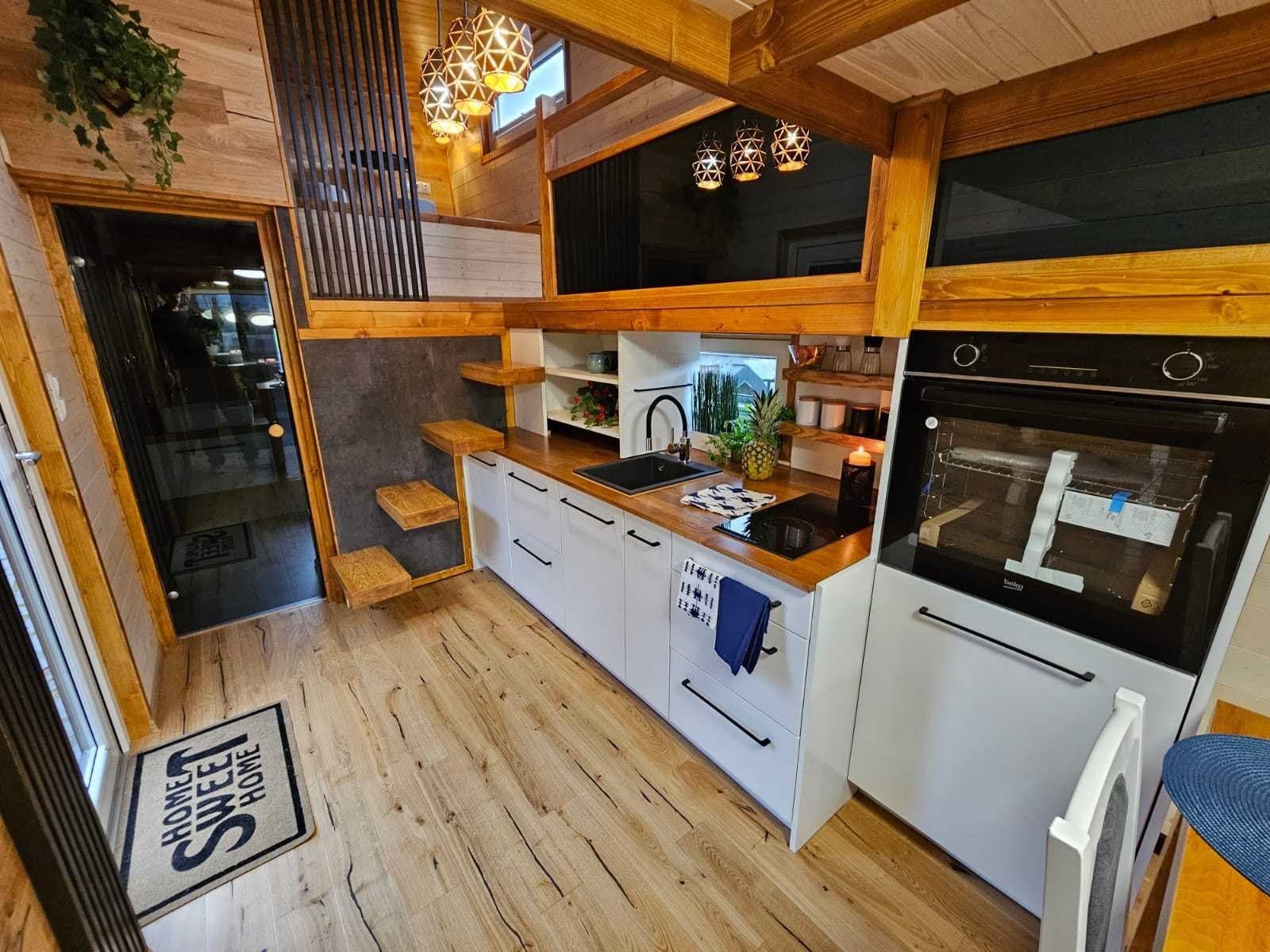
The bigger shell allows Lena to do something many tiny homes only pretend to do well: separate the spaces so they read like rooms, not compromises. Upstairs, it has two large loft rooms connected by a walkway, which is a lot more generous than the usual squeeze-every-inch sleeping nook. Downstairs, the plan includes an elegant dining area, a full-size kitchen, and a chic lounge, all presented as part of the design rather than as leftovers from whatever space remained.
That matters because the house is clearly aimed at a couple or a small family, not at maximizing sleeping count. The layout is about giving each zone enough room to feel deliberate, which is a different philosophy from the all-in-one micro-cabin approach. If you want one home to do everything at once, Lena is not built like a dorm on wheels. It is built like a compact house that happens to travel.
The premium tiny-house turn
Lena fits into a broader shift that is changing the tiny-house conversation across Europe. Mobi House, for example, now markets its MOBILE LINE premium home series specifically as comfortable, stylish mobile homes in XL form, and says its largest projects measure 10 meters by 3 meters by 4 meters, with an area of 35 square meters. That is already a far cry from the image of a bare-bones shed on a trailer.
Rabahaus takes the same idea even further with the Lena XL model. Its product page lists a steel frame, Vlemmix VTA trailer, 11-meter length, 3-meter width, and 4.5-meter height, and describes the home as an ideal solution for people who want to live comfortably without sacrificing mobility. Put those numbers next to Mobi House’s XL line and the pattern is clear: oversized tiny homes are no longer oddities. They are becoming a niche with its own premium language, dimensions, and expectations.
Why the structure matters as much as the styling
A house like Lena only works because the platform beneath it is serious hardware. Rabahaus specifies a steel frame, and the trailer maker Vlemmix has been publishing its own guidance on tiny-house trailer use in Europe, where trailer rules, building regulations, permits, and environmental legislation all shape what can actually be parked and where. In other words, mobility is not the same thing as freedom from regulation.
Vlemmix also notes that its standard tiny-house trailer platform height is 52 cm, while its platform version is 62 cm with a flat surface to build on. That height is not just a technical footnote. It affects roofline, towing profile, and how much interior volume a builder can reclaim without pushing the finished home into awkward transport territory. When a tiny house gets this large, every centimeter has to work twice, once for the road and once for the room.
The legal reality behind the dream
The luxury tiny-house pitch gets even more complicated once you cross borders. French legislation, as summarized by Quadrapol, treats tiny houses as caravans only if they stay within 2.55 meters wide, 4.50 meters high, and 3.5 tons. Lena, at 3 meters wide and 4.5 meters high, already shows how quickly an XL design can drift beyond the simplest caravan classification.
That is the real trade-off when tiny becomes aspirational: the more the house starts to resemble a small conventional home, the less likely it is to fit neatly into the tidy legal and transport categories that made tiny living feel so nimble in the first place. Buyers gain room, finish quality, and a more normal daily routine. They lose some of the portability fantasy, and sometimes some of the regulatory simplicity that came with the movement’s scrappier roots.
What buyers actually gain
For the right owner, Lena’s appeal is obvious. You get a home that still occupies less land than a traditional house and will likely require less energy than a typical larger build, while offering a living room, proper kitchen, and dual lofts that don’t feel like afterthoughts. That combination is rare enough to justify the buzz, especially for people who want the tiny-house lifestyle without the usual sense of perpetual compromise.
You also get something else that matters in this market: dignity of space. A full-size kitchen and a true lounge change how a house feels on a rainy Tuesday, not just how it photographs on a sunny day. That is the quiet promise of this new luxury tier, and it is why designs like Lena matter more than just as curiosities. They show tiny living being redefined in real time, from minimalist escape pod to premium mobile home.
Lena is still technically a tiny house, but it is also a warning shot to the old definition. Once a towable home grows to 11 meters long, 3 meters wide, and 4.5 meters high, the category stops being about deprivation and starts being about priorities. In that new lane, the question is no longer whether you can live with less, but whether you want the tiny-house label to cover something this comfortable.
This article was produced by Prism’s automated news system from verified source data, official records, and press releases, then run through automated quality and moderation checks before publishing. The system is built and supervised by the people who set the standards it runs under. Read our full AI policy.
Did this article answer your question?