Mirrored Gaia Nook dome blends futuristic style with rustic tiny-house warmth
Gaia Nook turns a mirrored dome into a bookable stay by pairing spectacle with a warm, efficient tiny-house interior and a smart Maine setting.
The mirrored shell does the heavy lifting
Gaia Nook is the kind of tiny-house stay that stops you cold before you even think about floor plans. The dome’s nearly all-mirrored exterior turns the forest into a moving skin of reflections, so the structure reads less like a cabin and more like a spaceship landed among the trees. That visual hit is the hook, but the smarter move is what happens next: the design does not waste the drama on the outside.
What makes this place worth stealing as a concept is the balance. The mirrored shell is the attention magnet, yet the retreat still has to function as a stay people will actually book, sleep in, and recommend. That is where Gaia Nook gets interesting for tiny-house readers who care about more than a pretty render.
A site built for immersion, not just a photo stop
Nature Nooks unfolds across 17 acres of woodland in Sullivan, Maine, just minutes from the Schoodic Peninsula and Acadia National Park. That matters because the setting is doing real work here: the property leans into the appeal of being close to one of the country’s most visited parks while still feeling removed from the crush. Acadia sees about 4 million visits a year, and the Schoodic Peninsula is the park’s only mainland section, intentionally managed as a more secluded, low-visitation area.
That combination gives Gaia Nook a useful position in the market. You get the Acadia name recognition that helps the listing sell, but you are not dropping guests into the busiest, most crowded version of the park experience. Sullivan itself, with a 2020 census population of 1,218, is small enough that a design-forward retreat like this can feel outsized without feeling out of place. The result is a hospitality setup that trades on location, but still sells privacy.
The cluster concept is what makes the retreat feel complete
This is not a lonely novelty dome dropped into a clearing and left to fend for itself. Nature Nooks is arranged as a cluster of five habitat options with a shared campfire area, which gives the whole project a more considered, village-like feel. That matters for tiny-house and glamping readers because it shows how a property can scale atmosphere without losing intimacy.
The shared campfire zone is the kind of detail that changes the guest experience immediately. It gives the site a social center, but it does not force interaction on anyone, and that is exactly the kind of design balance glamping operators should pay attention to. The retreat feels curated rather than improvised, which is a big part of why it reads as bookable instead of just photogenic.
Inside, the dome trades spectacle for warmth
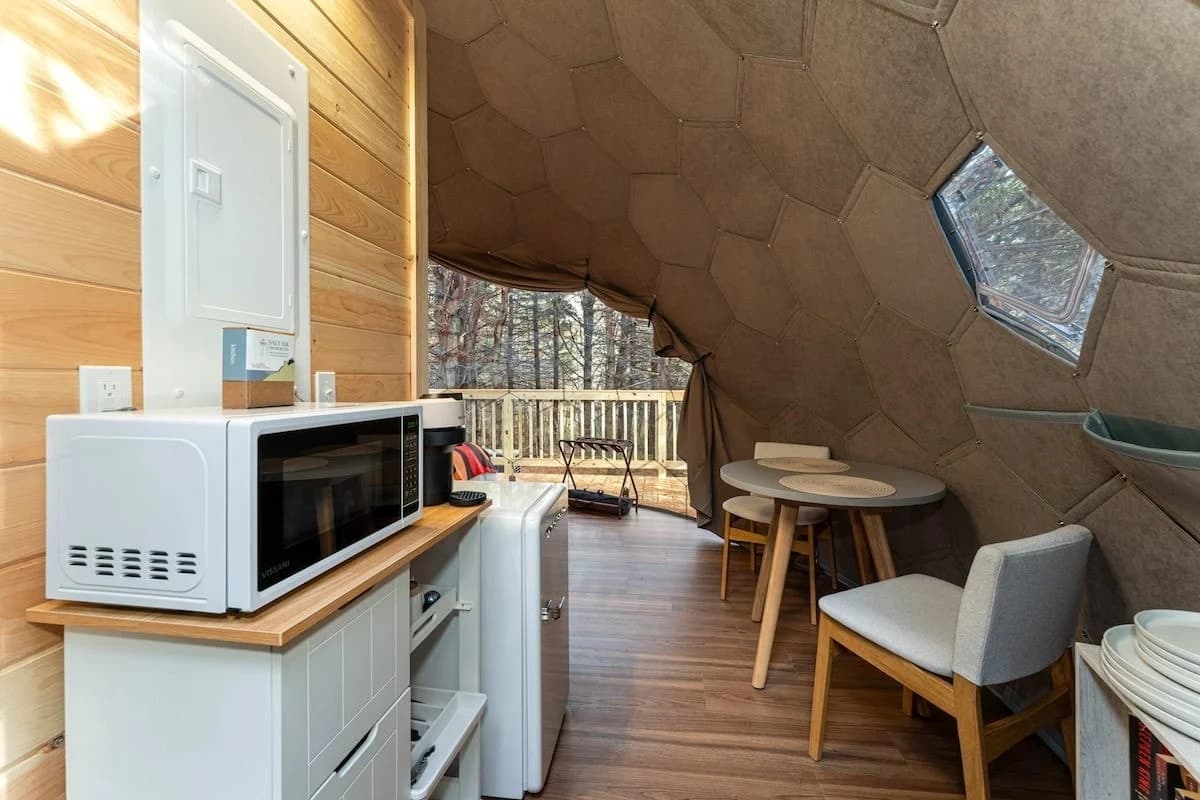
The real trick with Gaia Nook is that the interior does not try to compete with the exterior. Instead, it settles into a cozy, cocoon-like tiny-house mood with traditional wood surfaces and a rustic finish palette. The coverage emphasizes a Scandinavian-style simplicity layered over warmth, which is the right move for a dome this bold: the inside has to calm the eye after the mirrored exterior has done its work.

That contrast is the design lesson. A lot of standout tiny spaces fail because they spend all their energy on the shell and leave the interior feeling like a showroom. Gaia Nook avoids that trap by grounding the experience in timber-heavy comfort. For readers building or briefing a compact stay, the takeaway is simple: one high-concept move is enough if the interior follows through with livability.
- a visual exterior that makes the listing instantly recognizable
- a wood-forward interior that softens the wow factor
- a cocoon-like layout that keeps the space feeling private
- a style language that blends rustic warmth with clean Scandinavian restraint
What the setup gets right:
Why this works as hospitality, not just design theater
Hypedome describes Nature Nooks as a project created by Edoardo Centioni, a former startup founder and real estate investor, and says the site uses Hypedome L Mirror geodesic structures that reflect the surrounding forest. That background helps explain why the project feels more like an experiential-hospitality play than a one-off novelty build. It is not simply selling a place to sleep; it is selling a curated environment with a strong identity.
That identity is also why the property has traction beyond design circles. The retreat has been operating since the summer of 2025, so this is not a prototype or a concept sketch. It is an active site that keeps drawing attention because the idea is coherent from curb appeal to checkout. In tiny-house terms, that is the difference between a clever build and a repeatable business model.
The Airbnb and Vrbo listings reinforce the same positioning. Gaia Nook is presented as a modern dome in the woods of Sullivan, near Schoodic Peninsula and Acadia National Park, with a private deck and fast Wi-Fi. Those are not throwaway amenities. They tell you the operator understands the glamping audience, which wants novelty without giving up the basics that make a stay feel easy.
What tiny-house builders can steal from Gaia Nook
The market context matters here. In 2025, glamping is no longer being framed as a fringe experiment; it is a mainstream outdoor-hospitality segment, and tiny homes remain one of the most popular accommodation types inside it. That shift explains why places like Gaia Nook are getting attention. The bar is higher now. Guests expect comfort, privacy, speed, and a design story they can remember after the trip ends.
- use one exterior gesture that makes the property instantly legible
- make sure the interior feels calmer, warmer, and easier to live in
- place the unit where the landscape helps the design story land
- include practical amenities like a private deck and fast Wi-Fi so the wow factor does not collapse into inconvenience
The lesson is not to copy the mirrored shell just because it looks futuristic. The better lesson is to think in layers:
Gaia Nook works because every part of it pulls in the same direction. The mirrored dome grabs you from the trees, but the rustic, timber-rich interior is what makes you want to stay. That is the real design idea worth stealing: let the outside make the promise, then let the inside prove you meant it.
This article was produced by Prism’s automated news system from verified source data, official records, and press releases, then run through automated quality and moderation checks before publishing. The system is built and supervised by the people who set the standards it runs under. Read our full AI policy.
Did this article answer your question?