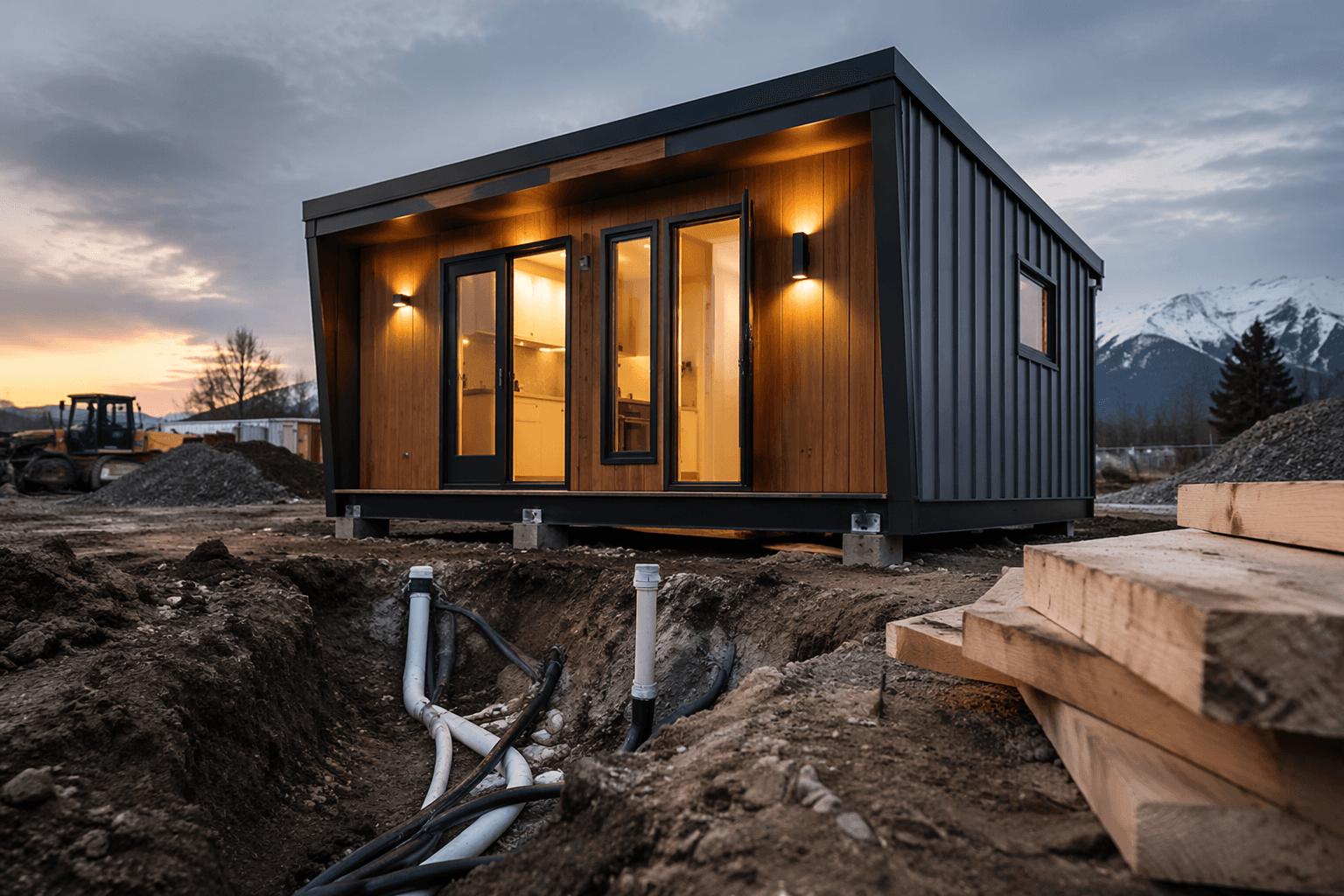
Mobi House’s Chocolate tiny home targets budget hospitality entrepreneurs
Mobi House packed a 15.68-square-meter year-round rental unit into its cheapest Sunrise model, built for owners who want to start small and scale later.

Mobi House is pitching the Chocolate version of its MOBI MODUL SUNRISE as a low-friction way into tiny-home hospitality: a 15.68-square-meter unit, plus a mini terrace, built on a THM 660 LIFT&GO trailer and sold as an on-grid year-round home that needs electricity, water and sewage. The point is not luxury for its own sake. It is to give first-time owners a compact rental asset that can be launched without taking on a full-size cabin or a sprawling custom build.
That business-first approach fits the company’s own backstory. Mobi House was founded in 2018 by Kasia and Bartek, after Bartek spent two years living in a tiny house in Norway. Ania and Patrycjusz joined in 2020, and the company says it has since completed several hundred projects and built a distribution network across many European countries, with direct sales in Poland. For a builder that started in Scandinavian-style trailers, the Chocolate model shows Mobi House leaning harder into modular hospitality rather than purely lifestyle-driven small homes.
The model sits inside the Modul Line, which Mobi House describes as a fully equipped, year-round modular home with one of the lowest purchase prices on the market. The key selling point is flexibility: modules can be combined in any configuration, and buyers can start with one section, then add more later as finances and demand allow. Mobi House also says the line is aimed at investors, and its German site stresses mobility, including the ability to relocate units toward sites with the strongest earning potential.

That matters because the legal and operational side of tiny-house hospitality is where many would-be owners get stuck. Mobi House says it is one of the few companies in Europe with full vehicle homologation as a caravan, which supports legal technical inspections and movement on European roads. It also offers professional warranty and post-warranty service. The Chocolate can even be bought on the LIFT&GO frame without the wheeled trailer and supports, which lowers the price further and trims the project down to a more basic entry point.
Inside, the Sunrise follows a straightforward rental layout: a living room for customization, a functional kitchenette, a modern bathroom and a loft for two people. Mobi House lists the footprint at 6.6 meters by 2.5 meters by 4.0 meters, and says the Sunrise is its most affordable project. In rental terms, it is sized for three people as a standalone unit, while two connected modules can sleep up to seven. That is the kind of scaling logic hospitality operators understand immediately: start with one booking unit, then expand if occupancy justifies it.

The commercial case is not theoretical. Berlin-based Raus said in late 2023 that it was operating more than 50 cabins across Germany, a sign that tiny-house stays have already found a real audience in European markets. Mobi House is clearly chasing that same lane with a cheaper, modular product that looks less like a novelty and more like a starter asset. The Chocolate’s real pitch is not just that it is small. It is that it gives a budget operator a way in, then a path to grow.
This article was produced by Prism’s automated news system from verified source data, official records, and press releases, then run through automated quality and moderation checks before publishing. The system is built and supervised by the people who set the standards it runs under. Read our full AI policy.
Did this article answer your question?