New York's Fairy-Tale Tiny House Village Grows to 140 Storybook Cottages
Bruno Schickel's 140-cottage storybook village near Ithaca took 20 years and a children's book to build; studios start at $1,695/month on a 60-acre Tompkins County property.
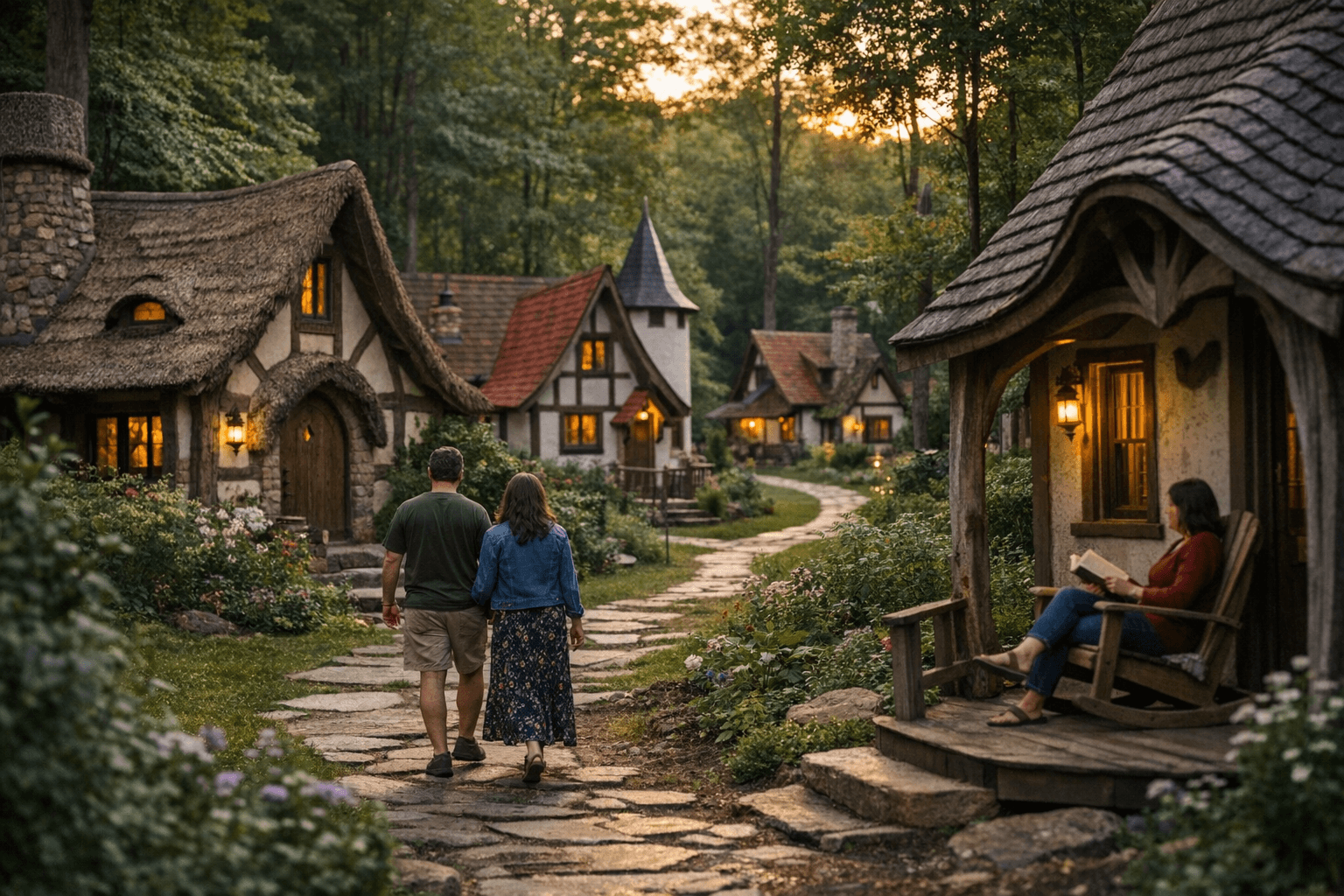
When Bruno Schickel read Barbara Cooney's "Miss Rumphius" to his daughters in the mid-1990s, the children's picture book about a woman who vows to fill the world with lupine flowers sparked what he later called a eureka moment. His answer to Miss Rumphius's mission was not flowers but architecture: clusters of gothic gingerbread cottages built to make a corner of upstate New York feel like the illustrations he had just read aloud.
Schickel, through his Schickel Construction Co., broke ground in Brooktondale in 1996, placing the first storybook-style small homes on a 60-acre property in Tompkins County, roughly ten minutes from Ithaca. What began as a handful of experimental rentals grew in groups of three, each trio painted in a unique color palette drawn from more than 50 Sherwin-Williams and Benjamin Moore paints, cycling through bright yellow, turquoise, lavender, and pink. Construction finally wrapped in 2016, completing all 140 cottages.
"In this book, there are beautiful illustrations of this little gothic gingerbread cottage on the coast of Maine, and the village where she would bicycle through and plant her lupines," Schickel said. "It really was inspiration for me to design and create something that looked like that."
Boiceville Cottages operates as a year-round rental community on 12-month leases. Studios start at roughly $1,695 per month; two-bedroom gatehouse cottages rent for about $2,395 per month. Those figures compete directly with standard apartment offerings in the Ithaca market while delivering something no conventional multifamily building can replicate: a distinct architectural identity spread across 60 acres that reads more like an illustrated village than a rental complex.
The operating model pairs privacy with communal opportunity. Each trio of cottages sits apart from its neighbors with its own color identity, yet the shared land and deliberate density create the conditions for genuine community rather than the isolation of dispersed rural tiny-home living.
Schickel has since extended the same formula to a second project, La Bourgade on Seneca, a year-round rental community on the southeast shore of Seneca Lake in the Finger Lakes, demonstrating that the storybook model is a replicable regional brand and not a one-time development curiosity.
For the broader tiny-house movement, Boiceville is concrete proof that a well-managed village can occupy its own market position entirely: not a homelessness intervention, not an ADU policy experiment, but a commercially operated rental community that has been quietly validating the model since 1996, one painted cottage cluster at a time.
This article was produced by Prism’s automated news system from verified source data, official records, and press releases, then run through automated quality and moderation checks before publishing. The system is built and supervised by the people who set the standards it runs under. Read our full AI policy.
Did this article answer your question?